
Brazil Cvm Mexico Cnbv Emerging Hubs
Brazil CVM BDR Rules: Retail Access to Global Stocks & ETFs on B3 in Reais
Prior to October 2020, Brazil restricted Unsponsored Level I BDRs to millionaires—CVM’s landmark regulatory liberalization unlocked 900+ US/global stocks and ETFs onshore on B3 for every retail saver.
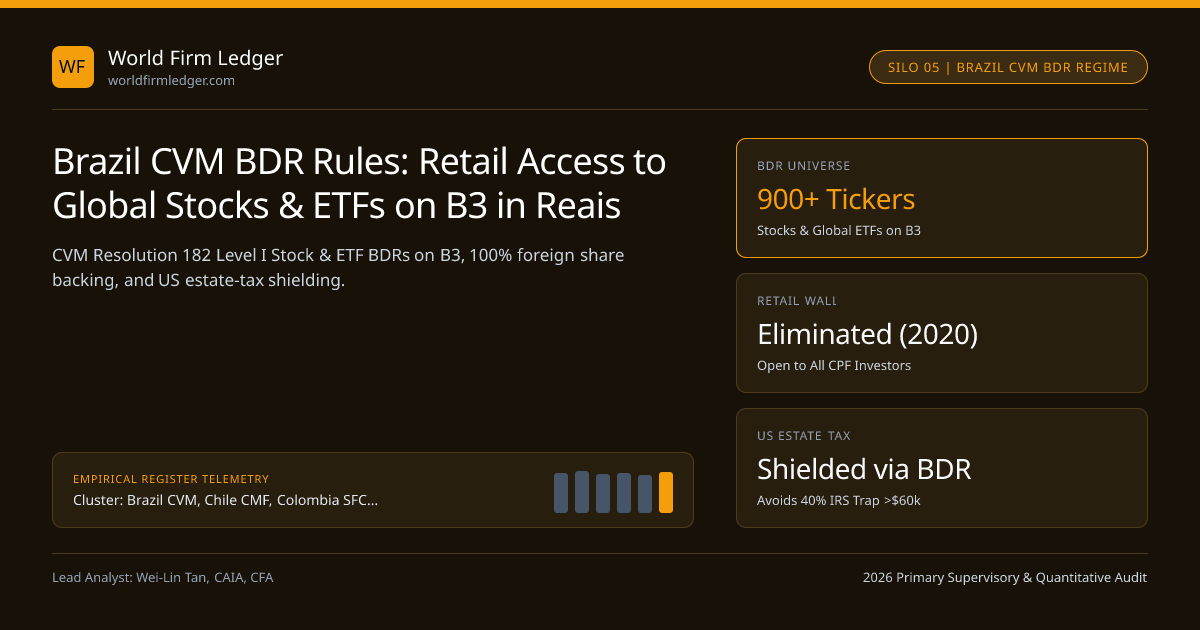
Before 22 October 2020, an ordinary retail investor in Rio de Janeiro or Belo Horizonte with BRL 5,000 could not buy Apple (AAPL34), Microsoft (MSFT34), Nvidia (NVDC34), or BlackRock iShares S&P 500 ETFs (IVVB11 / BACW39) through a Brazilian Corretora unless they qualified as an Investidor Qualificado (>= BRL 1,000,000 in financial investments)! Through historic reforms started by CVM Resolution No. 3/2020 and consolidated into CVM Resolutions No. 135/2022, No. 160/2022, and No. 182/2023, CVM Brazil completely democratized Brazilian Depositary Receipts (BDRs)—allowing every retail CPF holder to trade 900+ global equities, foreign ETFs (BDR de ETF), and foreign sovereign/corporate debt BDRs onshore in Brazilian Reais on B3! Within our Brazil CVM, Mexico CNBV & emerging hubs guide, understanding BDR backing mechanics vs direct foreign accounts is critical LatAm product strategy!
How Unsponsored Level I BDRs Work: 100% Custodian Share Backing Without Issuer Friction#
Unlike Level II or Level III BDRs (where the foreign corporation itself files full Portuguese prospectuses with CVM), *over 95% of global tech and blue-chip BDRs on B3 are Unsponsored Level I BDRs (BDR Patrocinado vs Nao Patrocinado Nivel I)* issued by authorized Brazilian Depositary Institutions (Instituicoes Depositarias, such as Banco B3, Bradesco, and Itaú):
- 100% Locked Foreign Custodian Underlying: Before minting a single
NVDC34BDR in Sao Paulo, the Brazilian Depositary Institution confirms that the corresponding fraction of real underlying Nvidia common stock sits locked in a segregated custody account at a regulated overseas custodian bank (e.g., BNY Mellon, Citibank, or Deutsche Bank in New York)! - Recognized Overseas Market Eligibility (
Mercado Reconhecido): Under CVM Resolution 182/2023, retail investors can freely trade Unsponsored Level I BDRs ONLY when the underlying stock or ETF trades on a B3/CVM-Recognized Foreign Exchange (NYSE, Nasdaq, LSE, Euronext, Xetra, Tokyo JPX, HKEX, TSX) supervised by an IOSCO MMoU signatory! - Automatic USD/BRL Currency Hedge Embedded: Even though
NVDC34quotes and settles in BRL, its fair arbitrage price equals(Nvidia_USD_Price / BDR_Parity_Ratio) * Live_USD_BRL_Rate—giving Brazilian households automatic hard-currency US Dollar protection against Real depreciation without paying FX wire spreads!
Comparing Three Legal Ways a Brazilian Resident Buys Nvidia or S&P 500 Exposure#
With both onshore BDRs and BCB eFX international accounts thriving, institutional wealth managers compare four quantitative variables before routing client capital:
| Structural Dimension | Onshore B3 Level I BDR (NVDC34 / BACW39) | Direct Regulated US Broker Account (SEC/SIPC) | Local Brazilian IVVB11 ETF on B3 | Reference |
|---|---|---|---|---|
| Foreign Exchange Friction / IOF | 0% FX Remittance Needed (Trades in BRL!) | ~0.38% IOF + ~0.5%–1.2% eFX Spread | 0% FX Remittance Needed | B3 Framework |
| Dividend Fee Drag | US 30% Tax + ~3%–5% Depositary Conversion Fee | US 30% Tax Only (0% Depositary Cut!) | Reinvested Inside Irish/US ETF Wrapper | CVM Brazil |
| Capital Gains Tax Cadence | 15% Swing / 20% Day-Trade Monthly DARF | 15% Flat Annual IRPF (Law 14,754) | 15% Swing / 20% Day-Trade Monthly DARF | LatAm Compendium |
| BRL 20,000/Month Small-Sale Tax Exemption? | NO! (Applies Only to Domestic Brazilian Stocks!) | NO! (Abolished USD 35k Rule in 2024!) | NO! (ETFs Excluded From BRL 20k Rule) | B3 WDO Peer |
Modeling the "BRL 20,000 Exemption Trap" That Catches Novice BDR Traders!#
In Brazil, selling up to BRL 20,000 per month in domestic Brazilian common stocks (PETR4, VALE3) is 100% exempt from capital gains tax—leading thousands of retail traders to assume selling BRL 5,000 of AAPL34 BDRs is also tax-free! WRONG! Receita Federal explicitly excludes BDRs and ETFs from the BRL 20,000 monthly stock exemption—meaning even a BRL 500 profit on a BDR swing trade owes 15% DARF tax (carried forward if total DARF < BRL 10.00 minimum issuance floor)!
- NetBDRDividendReceivedBRL = GrossDividendUSD * (1 - 0.30USWHT) * (1 - 0.03DepositaryFee) * PTAXExchangeRate
- Worked Arbitrage & Tax Comparison on USD 20,000 Global Equity Allocation (Held 3 Years, Rebalanced Annually):
- Growth Stock BDR (0% Dividend, e.g., Berkshire BRJB34):
- Saves ~200 bps Round-Trip eFX Spread + IOF; Custody Sits Under Investor CPF on B3 Alongside Tesouro Selic Margin!
- High-Yield US REIT / Dividend Portfolio (5.0% Gross Yield):
- Depositary 3%-5% Dividend Fee Costs ~10-18 bps/yr + Carnê-Leão Rules vs Direct US Account -> Direct SEC Account or Accumulating Irish UCITS ETF Wins!
CVM Resolution 182/2023 Upgrades: Brazilian Issuers With Overseas Primary Listings (Nubank, XP, Stone)#
What happens when a tech unicorn founded in Brazil—like Nubank (ROXO34), XP Inc. (XPBR31), or Inter (INBR32)—lists its primary shares on NYSE/Nasdaq even though >50% of its assets and revenues sit inside Brazil? Under CVM Resolution 182/2023, CVM tightened governance and issuer-equivalence protections for "Brazilian-origin foreign issuers" while preserving seamless Level I/III BDR liquidity on B3!
The Hidden Wealth-Planning Ace: Avoiding the 40% US Non-Resident Estate Tax!#
For affluent Brazilian families, holding more than USD 60,000 directly in US-situs shares (AAPL, SPY) at a Miami/New York broker exposes heirs to up to 40% US Federal Estate Tax upon death (Brazil has no estate-tax treaty with the US!). By contrast, holding Brazilian-situs B3 BDRs (or Irish-domiciled ETFs) settles under Brazilian succession law (ITCMD state inheritance tax capped at 4%–8%)—a massive structural advantage across our Brazil CVM, Mexico CNBV & emerging hubs topic cluster!
Frequently asked questions
When I buy an Apple BDR (AAPL34) on B3 in Reais, am I hedged in US Dollars or exposed solely to the Real?
You gain full US Dollar currency exposure automatically! Market makers continuously arbitrage AAPL34 against (Apple Nasdaq USD price * live USD/BRL exchange rate), so if the US Dollar rises 10% against the Real while Apple stays flat in New York, AAPL34 rises ~10% in Reais!
Are BDR sales under BRL 20,000 per month tax-exempt like Brazilian stocks?
No! That is the #1 tax mistake made by Brazilian retail investors. Only direct domestic Brazilian shares qualify for the BRL 20,000 monthly swing-trade exemption; any net monthly profit on BDRs or ETFs is taxed at 15% (swing trade) or 20% (day trade) via DARF Code 6015.
Who holds the actual foreign shares behind an Unsponsored Level I BDR on B3?
An authorized Brazilian Depositary Institution (such as Banco B3, Itaú, or Bradesco) appoints a regulated Tier-1 overseas custodian bank (like BNY Mellon or Citibank) that locks 100% of the underlying shares in segregated custody before BDRs can circulate on B3.
Why do Brazilian wealth advisers warn clients with USD 250,000+ at US brokers about US Estate Tax?
Because non-US residents receive only a tiny USD 60,000 lifetime exemption from US Estate Tax—above USD 60,000, directly held US-domiciled stocks and US ETFs face 18% to 40% IRS estate tax upon death, whereas onshore Brazilian BDRs avoid US-situs estate classification.
Publication record
- Published
- 13 November 2026
- Updated
- 16 November 2026
- Author
- Wei-Lin Tan, CAIA, CFA
- Review
- Review not recorded
- Automated fact check
- Passed in the stored pipeline record
- Source URLs
- 3 recorded
AI assistance recorded: anthropic/claude-opus-4.6. This field does not establish human review or source verification.
Academic & Institutional Attribution
Cite This Research & Embed Live Data Card
Standard academic & institutional research paper citation format.
Wei-Lin Tan, CAIA, CFA. (2026, November 15). Brazil CVM BDR Rules: Retail Access to Global Stocks & ETFs on B3 in Reais. World Firm Ledger. https://worldfirmledger.com/almanac/brazil-cvm-resolution-135-160-bdr-level-1-retail-accessRegulatory Directory Cross-Reference
Referenced Institutions & Regulatory Registries
Top Regulated Institutions in This Coverage Slice
Referenced Supervisory Authorities
Related Brazil Cvm Mexico Cnbv Emerging Hubs & Institutional Briefings
Explore Brazil Cvm Mexico Cnbv Emerging Hubs Hub (20) →Brazil Cvm Mexico Cnbv Emerging Hubs
Brazil CVM, Mexico CNBV, Chile CMF & Emerging Hub Licensing Almanac 2026Brazil Cvm Mexico Cnbv Emerging Hubs
Banco Central do Brasil Resolution 277: eFX Cross-Border Pix & FX Law 14,286Brazil Cvm Mexico Cnbv Emerging Hubs
Brazil Crypto Law 14.478: BCB PSAV Licensing, CVM Tokens & SegregationBrazil Cvm Mexico Cnbv Emerging Hubs
Mexico CNBV Casa de Bolsa Rules: LMV Capital & Foreign Broker SolicitationBrazil Cvm Mexico Cnbv Emerging Hubs
Mexico Ley Fintech (IFPE & IFC): Banxico Crypto & Foreign Broker FirewallsBrazil Cvm Mexico Cnbv Emerging Hubs
Mexico SIC Global Market: 10% Flat Capital Gains Tax on 3,500+ US/Global ETFsBrazil Cvm Mexico Cnbv Emerging Hubs
Chile CMF Fintech Law (Ley 21.521) & NCG 502: CFD, Crypto & Trading RulesBrazil Cvm Mexico Cnbv Emerging Hubs
Central Bank of Chile Chapter XIV: USD 10,000+ Foreign Investment FX RulesMonetary Policy
Opening remarks - Joint Central Bank of Kuwait and Global Finance Magazine Roundtable Discussion with Kuwait BanksRegulatory and Market Glossary
Central bank independence in today’s worldMarket Insights
FTSE 100 set to rise as US-Iran peace hopes lift global markets - Share TalkMarket Insights
Keefe, Bruyette & Woods Adjusts Price Target on Cboe Global Markets to $320 From $350 - marketscreener.com
World Firm Ledger Data, Benchmarks & Contributor Records
CC BY 4.0 Open Data
Open Institutional Datasets (CSV / JSON) →
Download desk-compiled quantitative series & schemas.
2026 Reference Matrix
2026 Institutional Benchmarks & Thresholds →
Statutory capital, clearing, margin & rate conventions.
Editorial Records
Authors & Review Records →
View named contributors where those records are available.
Complete Index
Master Research & Dossier Archive →
Browse all published briefings by topic pillar & date.