
Difc Dfsa Adgm Fsra Gulf Categories
DIFC & ADGM Onshore Boundary: AED Dirham Clearing & CBUAE Ring-Fencing Rules
Under UAE Federal Law No. 8 of 2004, DIFC and ADGM financial free zones cannot accept deposits in UAE Dirhams or deal in onshore AED banking markets without CBUAE authorization.
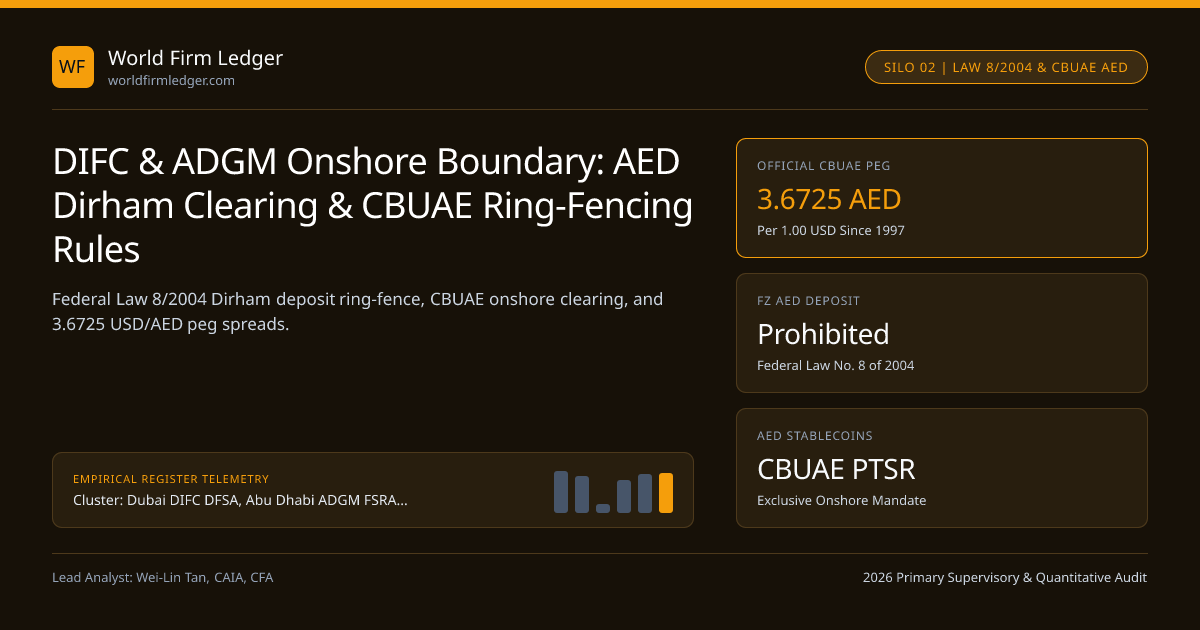
Article 4 of UAE Federal Law No. (8) of 2004 Regarding Financial Free Zones contains the single most consequential monetary boundary in Gulf finance: institutions licensed inside Financial Free Zones (specifically DIFC and ADGM) are statutorily prohibited from taking deposits from the State's onshore markets and prohibited from dealing in the UAE Dirham (AED) as deposit-takers! Within our Gulf DFSA, ADGM, SCA & CMA licensing guide, this federal ring-fence preserves the exclusive monetary-policy and local-currency clearing monopoly of the Central Bank of the UAE (CBUAE) over the 3.6725 AED/USD peg, explaining why every DIFC Category 1 wholesale bank and Category 3A brokerage prices regulatory capital and core trading ledgers in US Dollars.
Deposit-Taking AED Ban vs Broker Client-Money AED Settlement#
Corporate treasurers and expatriate traders frequently conflate Category 1 Bank Deposit-Taking with Category 3A Broker Client-Money Settlement—so let us draw the exact legal line enforced jointly by CBUAE, DFSA, and ADGM FSRA:
- Strict Prohibition on DIFC/ADGM Banks (Category 1): A bank holding only a DFSA Category 1 or ADGM Category 1 license inside the free zone cannot accept retail deposits, cannot open AED deposit accounts inside the free zone, and cannot participate directly in CBUAE's onshore UAE Funds Transfer System (UAEFTS / AANI) unless it also holds a separate onshore commercial/wholesale banking license from the Central Bank of the UAE!
- How DIFC/ADGM Brokers Settle UAE Resident Clients Lawfully: While a DIFC or ADGM Category 3A brokerage (such as firms audited under DFSA COB 6.12 client money rules) maintains its statutory books and trading accounts predominantly in USD/EUR/GBP, it opens its designated segregated Client Money accounts with onshore CBUAE-licensed commercial banks (such as Emirates NBD, First Abu Dhabi Bank, or Standard Chartered UAE). When a UAE client wires AED from an onshore personal bank account into the broker's onshore UAE bank Client Account—or converts at the bank's pegged 3.6725 FX spread into USD—all Dirham deposit-taking and clearing stays 100% inside the CBUAE-regulated banking perimeter!
CBUAE's Payment Token Services Regulation (PTSR): The AED Stablecoin Rule#
In 2024–2025, the Central Bank of the UAE extended this exact Dirham monetary ring-fence into Web3 through its Payment Token Services Regulation (PTSR):
- AED Payment Tokens: Only entities licensed directly by CBUAE onshore may issue Dirham-pegged Payment Tokens (
AEDTequivalents), backed 100% by segregated AED cash in UAE banks. - Merchant Payment Restriction Onshore: Onshore UAE merchants and payment processors cannot accept unregistered foreign fiat-pegged stablecoins (such as unregistered USDT/USDC) for everyday onshore goods and services—restricting foreign payment tokens on the mainland strictly to virtual-asset investment trading inside SCA or Dubai VARA licensed VASP platforms, while free-zone wholesale execution stays inside DIFC/ADGM perimeters!
| Monetary / Clearing Activity | DIFC (DFSA Only) | ADGM (FSRA Only) | Onshore UAE (CBUAE / SCA) | Legal Statutory Anchor |
|---|---|---|---|---|
| Retail Bank Deposits (Any CCY) | Prohibited (Cat 1 = Pro/Market Only) | Prohibited (Wholesale Only) | Permitted (CBUAE Commercial Banks) | DFSA PIB / ADGM PRU / CBUAE Law |
| Wholesale AED Deposit-Taking | Prohibited | Prohibited | Permitted (CBUAE Banks Only) | UAE Federal Law No. 8 of 2004 |
| Direct CBUAE UAEFTS / AANI Access | Via Onshore CBUAE Correspondent | Via Onshore CBUAE Correspondent | Direct Central Bank RTGS Member | CBUAE Ministry |
| AED-Pegged Stablecoin Issuance | Prohibited Without CBUAE Alignment | FSRA FRT (Non-Onshore Retail AED) | CBUAE Payment Token License | CBUAE PTSR 2024 |
| Mainland Cold-Calling / Roadshows | Restricted Outside DIFC | Restricted Outside ADGM | Permitted w/ UAE SCA Cat 1/5 | SCA Cat 1 vs Cat 5 Rules |
Modeling FX Conversion Friction Along the 3.6725 USD/AED Peg#
Even though the UAE Central Bank has defended the 1 USD = 3.6725 AED midpoint peg without deviation since November 1997, retail and HNW clients wiring AED into USD-base DIFC/ADGM trading accounts lose 35 to 95 basis points per round-trip if commercial banks apply wide retail FX board spreads instead of institutional treasury spreads:
- AnnualizedDragOnActiveCapital = RoundTripAEDtoUSDDragUSD / TradingEquityUSD * FundingCyclesPerYear
- Worked AED 1,836,250 (USD 500,000 Par) HNW Funding Audit:
- Case A (Retail Bank Auto-FX Spread: Buy USD at 3.6880 [+42 bps], Sell USD at 3.6570 [-42 bps] -> 84 bps round-trip):
- RoundTripConversionLoss = 500,000 * 0.00842 = USD 4,210 lost purely on pegged USD/AED conversion!
- Case B (Institutional DIFC Broker Treasury FX Desk Rate: 3.6735 / 3.6715 -> 5.4 bps round-trip):
- RoundTripConversionLoss = 500,000 * 0.00054 = USD 272 (Saves USD 3,938 per funding cycle!)
Currency Settlement Rails Across Free-Zone and Mainland Perimeters#
Tracing USD correspondent accounts, CBUAE onshore Dirham payment-token rules, and conversion spreads clarifies legal funding channels for UAE accounts.
Compliant Dual-Structure Playbook: Free-Zone Hub + Mainland SCA Cat 5#
How do leading regional brokerages serve both international HNW clients under English common law and mainland Emirati/resident clients lawfully? They operate a DIFC Category 2/3A (or ADGM FSRA) executing hub paired with either an onshore SCA Category 1 dealer or a properly disclosed SCA Category 5 onshore promotion subsidiary—eliminating territorial friction across our Gulf regulatory licensing topic hub.
Frequently asked questions
Why are DIFC and ADGM bank accounts and broker capital requirements denominated in US Dollars instead of UAE Dirhams?
UAE Federal Law No. 8 of 2004 barred Financial Free Zones from dealing in onshore UAE Dirham deposit-taking to keep domestic monetary policy and AED clearing under the sole control of the Central Bank of the UAE (CBUAE).
Is it legal for a UAE resident to wire AED from Emirates NBD to a DFSA-regulated broker?
Yes, when the DFSA-regulated broker holds a Retail Endorsement (or the resident qualifies as a Professional Client) and maintains its COB 6.12 segregated Client Account at an onshore CBUAE-licensed bank where the AED wire clears and converts lawfully.
Can a DIFC-licensed broker open a sales kiosk inside Dubai Mall without another license?
No. Dubai Mall sits in mainland Dubai outside the DIFC free-zone geographic perimeter; conducting physical financial promotion or client solicitation on the UAE mainland requires authorization from the onshore UAE Securities and Commodities Authority (SCA).
Can onshore Dubai coffee shops or e-commerce stores legally accept USDT for everyday AED payments?
No. Under the Central Bank of the UAE’s Payment Token Services Regulation (PTSR), onshore payment for goods and services using payment tokens is restricted to CBUAE-licensed AED Payment Tokens, keeping foreign tokens inside SCA/VARA investment trading rails.
Publication record
- Published
- 14 November 2026
- Updated
- 15 November 2026
- Author
- Wei-Lin Tan, CAIA, CFA
- Review
- Review not recorded
- Automated fact check
- Passed in the stored pipeline record
- Source URLs
- 3 recorded
AI assistance recorded: anthropic/claude-opus-4.6. This field does not establish human review or source verification.
Academic & Institutional Attribution
Cite This Research & Embed Live Data Card
Standard academic & institutional research paper citation format.
Wei-Lin Tan, CAIA, CFA. (2026, November 14). DIFC & ADGM Onshore Boundary: AED Dirham Clearing & CBUAE Ring-Fencing Rules. World Firm Ledger. https://worldfirmledger.com/almanac/difc-adgm-free-zone-onshore-uae-dirham-cbuae-clearingRegulatory Directory Cross-Reference
Referenced Institutions & Regulatory Registries
Top Regulated Institutions in This Coverage Slice
Related Difc Dfsa Adgm Fsra Gulf Categories & Institutional Briefings
Explore Difc Dfsa Adgm Fsra Gulf Categories Hub (20) →Difc Dfsa Adgm Fsra Gulf Categories
Gulf Financial Licensing Guide: DIFC DFSA, ADGM FSRA, UAE SCA & Saudi CMADifc Dfsa Adgm Fsra Gulf Categories
Dubai VARA Rulebooks: Virtual Asset Broker-Dealer vs Exchange Paid-Up AED CapitalDifc Dfsa Adgm Fsra Gulf Categories
Saudi CMA Capital Market Institutions: SAR 50M Dealing vs SAR 2M Advising TiersDifc Dfsa Adgm Fsra Gulf Categories
Saudi SAMA vs CMA Jurisdiction: FX Spot Banking Perimeters & Tadawul DerivativesDifc Dfsa Adgm Fsra Gulf Categories
Qatar QFCRA Authorized Firms vs Onshore QFMA: Dual-Jurisdiction Capital & ScopeDifc Dfsa Adgm Fsra Gulf Categories
Central Bank of Bahrain Volume 4 Investment Business: Category 1, 2 & 3 CapitalDifc Dfsa Adgm Fsra Gulf Categories
Kuwait CMA Module 5 & Oman FSA: GCC Securities Intermediation Capital BenchmarksDifc Dfsa Adgm Fsra Gulf Categories
Islamic Swap-Free Trading in DIFC & ADGM: Sharia Governance, Wa'd & Admin FeesSouth Africa Fsca Fais Odp Licensing
South Africa FAIS Ombud Redress: Increased ZAR 3.5M Jurisdictional Limit GuideSouth Africa Fsca Fais Odp Licensing
JSE Clear Currency Futures vs OTC ODP CFDs: Rand Hedging & Margin RulesSouth Africa Fsca Fais Odp Licensing
South Africa FIC Act Compliance: RMCP, DPIP/FPPO & Beneficial Ownership RulesSouth Africa Fsca Fais Odp Licensing
Kenya CMA Online Foreign Exchange Licensing: Dealing vs Non-Dealing Capital
World Firm Ledger Data, Benchmarks & Contributor Records
CC BY 4.0 Open Data
Open Institutional Datasets (CSV / JSON) →
Download desk-compiled quantitative series & schemas.
2026 Reference Matrix
2026 Institutional Benchmarks & Thresholds →
Statutory capital, clearing, margin & rate conventions.
Editorial Records
Authors & Review Records →
View named contributors where those records are available.
Complete Index
Master Research & Dossier Archive →
Browse all published briefings by topic pillar & date.