
South Africa Fsca Fais Odp Licensing
Kenya CMA Online Foreign Exchange Licensing: Dealing vs Non-Dealing Capital
Serving East Africa’s vibrant mobile-money emerging markets, Kenya’s Capital Markets Authority enforces statutory KES 30M Non-Dealing and KES 50M Dealing paid-up capital tiers.
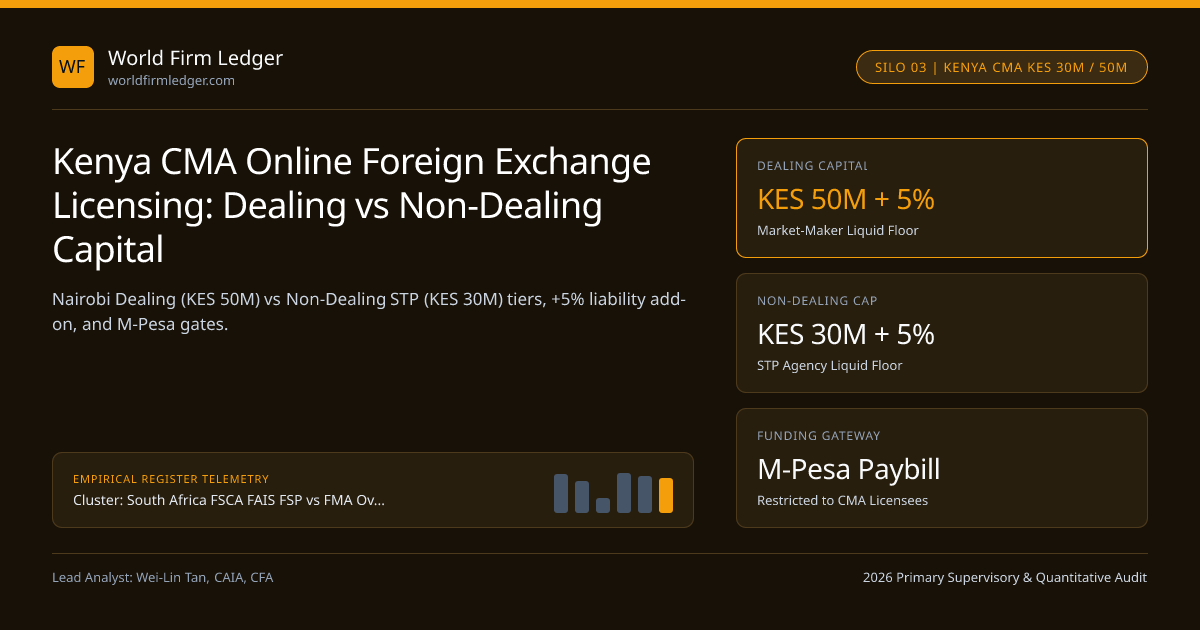
While Pretoria anchors Southern Africa, Nairobi stands as East Africa's undisputed regulated retail FX and multi-asset hub under The Capital Markets (Online Foreign Exchange Trading) Regulations, 2017 administered by Kenya's Capital Markets Authority (CMA portal reference). Within our South Africa FSCA FAIS vs FMA ODP licensing guide, Kenya CMA resolved from Day 1 the exact agency-versus-principal ambiguity that plagued South Africa's pre-2018 FAIS market: explicitly splitting licenses into Non-Dealing Online Foreign Exchange Brokers (STP Agency = KES 30,000,000 minimum capital) and Dealing Online Foreign Exchange Brokers (Market Makers = KES 50,000,000 minimum capital)!
Three Distinct License Classes Under Kenya's 2017 Online FX Regulations#
Every online FX/CFD intermediary soliciting Kenyan residents—including users funding instantly via Safaricom M-Pesa corporate paybills—must hold one of three dedicated CMA licenses in Nairobi:
- Dealing Online Foreign Exchange Broker (Market Maker — KES 50,000,000 Paid-Up Capital): Authorized to act as principal counterparty quoting two-way prices and internalizing market risk, plus maintaining ongoing minimum liquid capital of KES 50,000,000 plus 5% of total liabilities to clients in excess of KES 50,000,000!
- Non-Dealing Online Foreign Exchange Broker (STP / ECN Agency — KES 30,000,000 Paid-Up Capital): Authorized strictly to link Kenyan retail clients to foreign liquidity providers on an agency/STP basis without taking principal market positions, maintaining KES 30,000,000 plus 5% of total client liabilities exceeding KES 30,000,000! (The majority of international groups operating in Nairobi—nearly a dozen licensed entities—choose the Non-Dealing KES 30M tier routed to their FCA, ASIC, or FSCA FMA ODP group liquidity hub!)
- Online Foreign Exchange Money Manager (KES 10,000,000 Paid-Up Capital): Authorized solely to manage discretionary client portfolios opened inside a CMA-licensed Dealing or Non-Dealing FX Broker—never permitted to hold client cash directly (mirroring South Africa's FAIS Category II discretionary model)!
Safaricom M-Pesa Integration: Kenya CMA's Ultimate Enforcement Weapon#
Why do global retail FX giants apply formally for a Nairobi CMA license rather than soliciting Kenyans offshore from Seychelles or Mauritius? Safaricom M-Pesa! Over 85% of retail deposits and instant withdrawals in Kenya flow through M-Pesa mobile money. Working hand-in-hand with the Central Bank of Kenya (CBK) and Safaricom Compliance, Kenya CMA ensures only active CMA-licensed Online FX Brokers can maintain direct M-Pesa Paybill / API collection rails, while unlicensed payment-aggregator mules get disconnected and publicly named on CMA cease-and-desist notices!
| African FX Regulatory Hub | Agency / STP Broker License | Principal Market-Maker License | Retail Leverage Ceiling | Mobile Money / Local Rail Gate | Reference / Peer |
|---|---|---|---|---|---|
| Kenya — CMA Nairobi | Non-Dealing FX (KES 30M + 5%) | Dealing FX (KES 50M + 5%) | 400:1 Cut -> Hard 20:1 Cap! | M-Pesa Paybill License Check | CMA Portal |
| South Africa — FSCA | FAIS Cat I FSP (4/52 OpEx) | FMA ODP (ZAR 50M+ / 6-Mo OpEx) | Appropriateness / ODP Risk | SARB AD / AVS-R EFT Screening | FSCA Ministry |
| Mauritius — FSC | Inv. Dealer Broker (MUR 1.5M) | Full Service Dealer (MUR 10M) | Flexible Offshore Tiers | International Wire / Card PSP | Mauritius Corridor |
| Nigeria — SEC / CBN | Emerging Digital/FX Rules | Bank CBN FX Monopoly | Strict Naira FX Controls | CBN NIBSS / P2P Clampdown | Nigeria SEC Rules |
Modeling Kenya CMA's Dynamic "+5% of Excess Client Liabilities" Buffer#
Unlike static minimum-capital jurisdictions where a broker holding USD 50M of client deposits keeps the exact same regulatory capital as a tiny startup, Regulation 11 of Kenya's Online FX Regulations scales liquid capital dynamically at 5% of client balances above the KES 30M/50M base:
- Worked Fast-Growing Nairobi Non-Dealing STP Broker Capital Audit (1 USD ~ 129 KES):
- StatutoryBaseKES (Non-Dealing STP Broker) = KES 30,000,000 (~USD 232,558)
- Total Segregated Kenyan Client Equity (M-Pesa + USD Bank Accounts) = KES 950,000,000 (~USD 7,364,341)
- Excess Client Liabilities Above Base = 950,000,000 - 30,000,000 = KES 920,000,000
- Dynamic 5% Solvency Add-On = 0.05 * 920,000,000 = KES 46,000,000!
- RequiredKenyaCMALiquidCapital_KES = 30,000,000 + 46,000,000 = KES 76,000,000 (~USD 589,147 unencumbered liquid capital — 2.53x Base!)
Local Governance Substance & Foreign Parent Qualification Gates#
Kenya CMA does not issue Non-Dealing or Dealing licenses to brass-plate startups: an international applicant relying on a foreign liquidity provider or parent group must prove the foreign affiliate has operated under a recognized capital-markets regulator (such as FCA, ASIC, MAS, DFSA, or FSCA) with clean compliance records, while appointing a Kenyan-resident CEO, local Compliance Officer, and physical Nairobi office!
Pairing Nairobi CMA and Johannesburg FSCA for Sub-Saharan Scale#
Because Kenya permits 100% free capital convertibility (zero SARB-style resident exchange controls on KES-to-USD conversions!) alongside instant M-Pesa funding and strict 20:1 retail leverage and 80% domestic bank custody rules, Tier-1 global brokers routinely pair a Johannesburg FSCA ODP/FSP with a Nairobi CMA Non-Dealing/Dealing Broker—creating a compliant two-hub Sub-Saharan strategy across our South Africa FSCA and ODP licensing topic hub.
Frequently asked questions
What is the difference between a Kenya CMA Dealing FX Broker and a Non-Dealing FX Broker?
A Dealing Online FX Broker (KES 50M minimum capital) acts as a principal market maker taking the opposite side of client trades, whereas a Non-Dealing Online FX Broker (KES 30M minimum capital) operates strictly on an STP/agency model routing client orders to a regulated liquidity provider without warehousing market risk.
Why do Kenyan retail traders overwhelmingly prefer CMA-licensed brokers over offshore high-leverage sites?
Instant, low-cost Safaricom M-Pesa deposits and withdrawals denominated in KES (or USD sub-accounts), onshore Kenyan bank client-money protection, and direct Nairobi CMA dispute supervision.
Can a Kenya CMA Money Manager accept M-Pesa deposits directly from investors?
No. An Online Foreign Exchange Money Manager (KES 10M capital) is strictly barred from receiving or holding client cash; clients must deposit directly into their own segregated account at a CMA-licensed Dealing or Non-Dealing FX Broker and grant limited trading power-of-attorney.
Are Introducing Brokers (IBs) allowed under Kenya’s Online Foreign Exchange Regulations?
Yes, under strict rules: Introducing Brokers must be vetted and registered through the licensed CMA FX Broker, cannot hold client funds or execute discretionary trades, and may only be compensated directly by the broker without adding secret markups to client spreads.
Publication record
- Published
- 14 November 2026
- Updated
- 15 November 2026
- Author
- Wei-Lin Tan, CAIA, CFA
- Review
- Review not recorded
- Automated fact check
- Passed in the stored pipeline record
- Source URLs
- 3 recorded
AI assistance recorded: anthropic/claude-opus-4.6. This field does not establish human review or source verification.
Academic & Institutional Attribution
Cite This Research & Embed Live Data Card
Standard academic & institutional research paper citation format.
Wei-Lin Tan, CAIA, CFA. (2026, November 14). Kenya CMA Online Foreign Exchange Licensing: Dealing vs Non-Dealing Capital. World Firm Ledger. https://worldfirmledger.com/almanac/kenya-cma-dealing-vs-non-dealing-online-fx-kes-capitalRegulatory Directory Cross-Reference
Referenced Institutions & Regulatory Registries
Top Regulated Institutions in This Coverage Slice
Related South Africa Fsca Fais Odp Licensing & Institutional Briefings
Explore South Africa Fsca Fais Odp Licensing Hub (20) →South Africa Fsca Fais Odp Licensing
South Africa FSCA FAIS FSP vs FMA Over-the-Counter Derivative Provider (ODP) GuideSouth Africa Fsca Fais Odp Licensing
Kenya CMA 20:1 Retail Leverage Cap & 80% Onshore Bank Client Trust RulesSouth Africa Fsca Fais Odp Licensing
Nigeria SEC & Central Bank (CBN): Digital Asset & FX Intermediation RulesSouth Africa Fsca Fais Odp Licensing
Mauritius FSC Investment Dealer + South Africa FSCA Dual-Hub ArchitectureSouth Africa Fsca Fais Odp Licensing
Southern Africa CMA Peg & Cross-Border Rules: Namibia NAMFISA & Botswana NBFIRASouth Africa Fsca Fais Odp Licensing
South Africa COFI Bill: Activity-Based FSCA Licensing & Twin Peaks Phase 2South Africa Fsca Fais Odp Licensing
FSCA FSP Search Portal Forensic Audit: Verifying Product Codes & ODP StatusSouth Africa Fsca Fais Odp Licensing
FSCA FAIS Category I FSP Trap: Why Agency Intermediaries Cannot Act as PrincipalJapan Fsa Fibo Margin Segregation
Japan FIEA Article 38(4): Unsolicited FX & CFD Cold-Calling ProhibitionJapan Fsa Fibo Margin Segregation
JFSA System Risk & FISC Guidelines: Tokyo Dual-Datacenter FIBO ResilienceJapan Fsa Fibo Margin Segregation
South Korea FSC & FSS Rules: 10:1 Retail FX Cap & KRW 10M Derivative GatesJapan Fsa Fibo Margin Segregation
Taiwan FSC & TPEx Leveraged Transaction Merchant (LTM) Retail FX/CFD Rules
World Firm Ledger Data, Benchmarks & Contributor Records
CC BY 4.0 Open Data
Open Institutional Datasets (CSV / JSON) →
Download desk-compiled quantitative series & schemas.
2026 Reference Matrix
2026 Institutional Benchmarks & Thresholds →
Statutory capital, clearing, margin & rate conventions.
Editorial Records
Authors & Review Records →
View named contributors where those records are available.
Complete Index
Master Research & Dossier Archive →
Browse all published briefings by topic pillar & date.