
Difc Dfsa Adgm Fsra Gulf Categories
Gulf Financial Licensing Guide: DIFC DFSA, ADGM FSRA, UAE SCA & Saudi CMA
Across Gulf Cooperation Council emerging markets, English common-law hubs under Dubai DFSA and Abu Dhabi ADGM FSRA enforce USD 10k to USD 10M prudential tiers alongside UAE SCA and Saudi CMA.
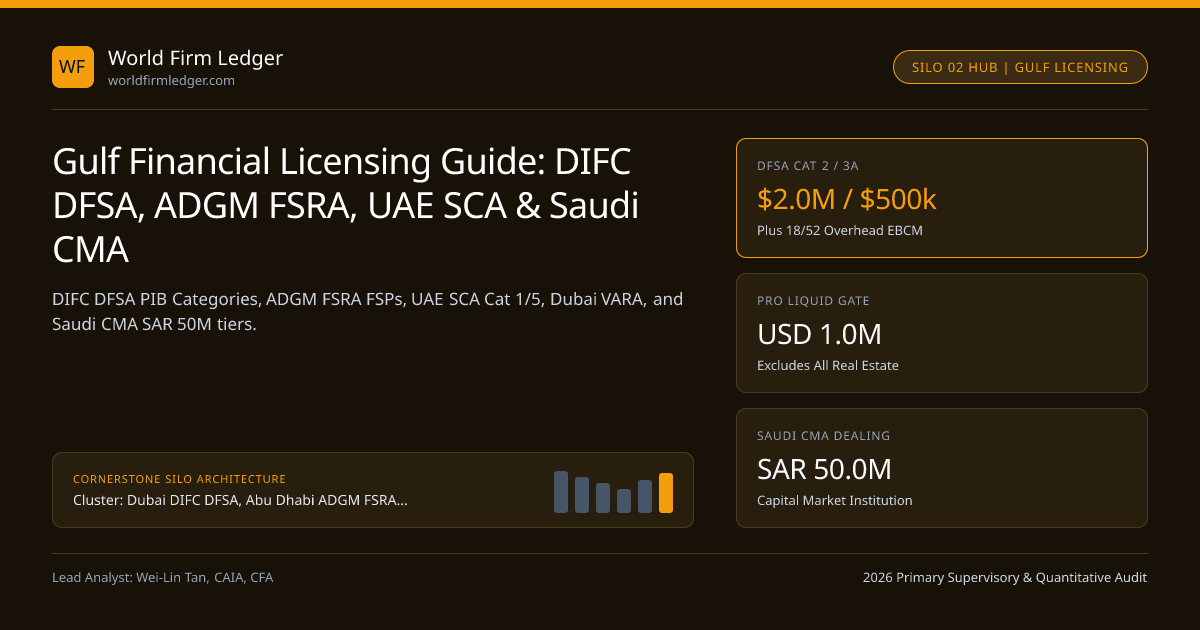
Gulf Cooperation Council financial architecture splits sharply between two English common-law financial free zones inside the United Arab Emirates—the Dubai International Financial Centre supervised by the Dubai Financial Services Authority (DFSA) and the Abu Dhabi Global Market supervised by the ADGM Financial Services Regulatory Authority (FSRA)—and civil-law / Sharia-codified onshore federal authorities led by the UAE Securities and Commodities Authority (SCA), the Central Bank of the UAE (CBUAE), the Saudi Capital Market Authority (CMA), and the Saudi Central Bank (SAMA). Allocators navigating our Gulf regulatory licensing topic hub must verify not merely whether a broker holds a UAE trade certificate, but which exact territorial perimeter, prudential capital tier, and retail endorsement governs client execution.
Constitutional Separation: Common-Law Free Zones vs Onshore Mainland#
UAE Federal Constitutional Amendment No. 1 of 2004 and Federal Law No. 8 of 2004 carved DIFC and ADGM out of onshore UAE civil and commercial codes, equipping each financial free zone with independent common-law courts, USD-denominated prudential rulebooks, and separate statutory regulators—documented in our Dubai DFSA common-law compendium and ADGM FSRA authority profile. Crucially, ADGM goes so far as to apply English common law directly via its Application of English Law Regulations 2015, whereas DIFC codifies common-law contract, trust, and insolvency statutes augmented by DIFC Courts jurisprudence.
Yet free-zone authorization carries strict geographic ring-fencing. A DIFC or ADGM broker is prohibited from holding physical UAE Dirham (AED) retail deposits or clearing onshore AED accounts directly without licensed onshore partner banks, a structural boundary dissected in DIFC and ADGM onshore AED clearing rules. Conversely, firms soliciting mainland residents outside DIFC and ADGM across Dubai, Abu Dhabi, or Sharjah require federal licensing from the UAE SCA under Category 1 (Dealing) or Category 5 (Arrangement and Promotion), analyzed in onshore UAE SCA Category 1 versus Category 5 promotion rules, while virtual-asset operators in mainland Dubai answer to the Dubai Virtual Assets Regulatory Authority (VARA) as mapped in Dubai VARA AED paid-up capital rules.
DFSA PIB Categories 1 to 4 and ADGM FSRA PRU Capital Architecture#
Inside DIFC, the DFSA's Prudential — Investment, Insurance Intermediation and Banking (PIB) module assigns Authorized Firms into risk-weighted prudential categories—ranging from Category 1 (deposit-taking banks at USD 10,000,000 base capital) and Category 2 (principal market makers at USD 2,000,000) to Category 3A (matched-principal and agency brokers at USD 500,000), Category 3C (asset/fund managers and client-money custodians at USD 70,000–500,000), and Category 4 (pure arrangers/advisers at USD 10,000)—examined in full in our DFSA PIB Category 1 to 4 base capital and EBCM matrix.
Across both DIFC and ADGM, static base capital is paired with an Expenditure-Based Capital Minimum (EBCM)—typically 13/52 (25%) or 18/52 (34.6%) of annual fixed overheads when holding client money—plus Risk Capital Requirements and Pillar 2 supervisory add-ons audited in DFSA IRAP and ICAAP supervisory capital buffers. International FX and CFD brokers overwhelmingly target DFSA Category 3A matched-principal permissions or ADGM FSRA Dealing as Principal vs Agent permissions, operating alongside established DIFC investment groups like Arqaam Group and regional financial houses such as Al Sharq.
| Gulf Regulatory Authority | Core Broker License Class | Statutory Base Capital Floor | Expenditure / Liquidity Runway | Retail CFD / FX Access Rule | Official Registry / Profile |
|---|---|---|---|---|---|
| Dubai DIFC — DFSA | PIB Category 2 (Principal) / Cat 3A (Matched) | USD 2,000,000 / USD 500,000 | Max(Base, EBCM 13/52–18/52, RCR) | Mandatory Retail Endorsement + Caps | DFSA Ministry |
| Abu Dhabi ADGM — FSRA | FSP Cat 2 (Principal) / Cat 3A (Matched/Agent) | USD 2,000,000 / USD 500,000 | PRU EBCM + Liquid Assets Floor | Retail Endorsement + Appropriateness | ADGM FSRA |
| UAE Onshore — SCA | Cat 1 Dealing / Cat 5 Arrangement & Promo | AED 30,000,000 (Cat 1) / AED 1M–3M (Cat 5) | Continuous Solvency & Bank Guarantee | Onshore Dirham Retail Permitted | UAE SCA |
| Dubai Mainland — VARA | VA Exchange / Broker-Dealer VASP | AED 500,000 – AED 1,500,000 (or % OpEx) | 1.2x Quarterly OpEx Net Liquid Assets | Strict Suitability & Margin Curbs | Dubai VARA |
| Saudi Arabia — CMA | Capital Market Institution (Dealing) | SAR 50,000,000 (~USD 13.33M) | Prudential Pillar 1 + Pillar 2 Adequacy | Tadawul & Authorized Derivatives | Saudi CMA |
| Qatar Financial Centre | QFCRA Dealing in Investments | USD 500,000 – USD 5,000,000+ | Risk-Based Capital Adequacy | Professional Focus / Strict Retail | QFCRA Compendium |
Retail Client Endorsements, Professional USD 1M Opt-Ups, and Client Money#
Holding a DFSA Category 3A or ADGM FSP license does not automatically permit onboarding retail traders! By default, DIFC and ADGM authorizations restrict firms exclusively to Professional Clients and Market Counterparties—where an individual "Assessed Professional Client" must prove at least USD 1,000,000 in net liquid assets (strictly excluding primary residence property and illiquid real estate!), dissected in our DFSA Professional Client USD 1M liquid asset test.
To serve retail traders, an Authorized Firm must apply separately for a Retail Endorsement under DFSA Conduct of Business (COB) rules—triggering leverage caps (typically 30:1 major FX / 20:1 minor FX & gold), mandatory Negative Balance Protection, 50% margin close-out, and incentive bans covered in DFSA COB Retail Client Endorsement protections, alongside daily T+1 segregated client-money reconciliations detailed in DFSA COB 6.12 client money segregation. Furthermore, Muslim retail and institutional investors across the Gulf scrutinize Sharia-compliant swap-free CFD structures (Wa'd and Murabaha fee mechanics) analyzed in Islamic swap-free CFD governance in DIFC and ADGM alongside Sharia fintech peers such as Adab Solutions and Islamic banking networks like Al Baraka Bank.
- where:
- ExpenditureBasedCapitalMinimum (EBCM) = (18 / 52) * AnnualAuditedFixedOverheads [for Client-Money Holding Cat 3A Firm]
- LiquidEBCMConstraint: Liquid_Assets >= EBCM at all times
- Worked DIFC Category 3A Retail-Endorsed Matched-Principal Broker Audit (USD):
- BaseCapitalRequirement (Cat 3A) = USD 500,000
- AnnualAuditedFixed_Overheads (DIFC rent, staff, connectivity, compliance) = USD 4,160,000
- EBCM (Holding Client Money = 18/52 weeks) = (18 / 52) * 4,160,000 = USD 1,440,000
- TotalRiskCapital_Requirement (CRCOM + ORCOM + MRCOM slippage residual) = USD 1,180,000
- Binding MCR = max(500,000, 1,440,000, 1,180,000) = USD 1,440,000 (2.88x higher than the headline USD 500k Base Capital!)
- EligibleCET1Capital = USD 2,150,000 -> Capital Surplus = +USD 710,000 (149.3% of MCR)
Paid-Up Capital Benchmarks Across Gulf Licensing Hubs#
Normalizing statutory equity floors from Riyadh and Mainland UAE down to DIFC and ADGM free zones highlights how expenditure-based rules reshape broker capital.
Broader GCC Convergence: Saudi Arabia, Qatar, Bahrain, Kuwait, Oman & Jordan#
Institutional expansion across the Middle East rarely stops at Dubai Creek or Al Maryah Island. Global banks and multi-asset groups compare DIFC/ADGM institutional multilateral digital venues—covered in ADGM FSRA virtual asset MTF and custody rules—against Riyadh's Saudi CMA SAR 50M Capital Market Institution rules and Saudi SAMA FX banking perimeters. Neighboring sovereigns maintain distinct licensing ladders examined across our cluster: Qatar QFCRA versus onshore QFMA dual regimes, Central Bank of Bahrain Volume 4 Category 1–3 rules (alongside Bahraini institutions like Bahrain Credit), Kuwait CMA Module 5 and Oman FSA brokerage standards, and Levant margin regulations under Jordan JSC foreign exchange capital rules. Finally, every allocator must screen out mainland commercial shells using our Dubai DED versus DFSA and SCA register forensic guide and World Firm Ledger verification.
Frequently asked questions
Can a DIFC DFSA or ADGM FSRA broker accept UAE Dirham (AED) deposits directly inside the free zone?
Under UAE Constitutional Amendment No. 1 of 2004 and Federal Law No. 8 of 2004, DIFC and ADGM Authorized Firms cannot take retail deposits in UAE Dirhams inside the free zone, though client money settlement in foreign currencies (USD/EUR/GBP) and regulated onshore bank clearing rails operate under strict CBUAE/SCA rules.
What is the difference between DFSA Category 2 and Category 3A for a forex and CFD broker?
Category 2 (USD 2,000,000 base capital) authorizes Dealing in Investments as Principal on a proprietary B-book/market-making basis, whereas Category 3A (USD 500,000 base capital) restricts principal dealing strictly to Matched Principal (back-to-back STP) or pure Agency execution.
Does a Dubai Department of Economy and Tourism (DED) commercial license authorize forex brokerage?
No. A mainland Dubai DED commercial license for "commercial brokerage" or "financial consultancy" grants zero permission to execute securities, leveraged FX, CFDs, or crypto trades; legitimate mainland firms must hold active UAE SCA, CBUAE, or Dubai VARA licenses.
Why is actual regulatory capital in DIFC often 2x to 3x higher than the USD 500,000 Category 3A base capital?
Because DFSA PIB sets the Minimum Capital Requirement at the highest of Base Capital, Risk Capital, or the Expenditure-Based Capital Minimum (18/52 of annual fixed overheads when holding client money)—meaning a USD 4.2M DIFC cost base locks USD 1.44M+ in liquid CET1 equity.
Publication record
- Published
- 15 November 2026
- Updated
- 15 November 2026
- Author
- Wei-Lin Tan, CAIA, CFA
- Review
- Review not recorded
- Automated fact check
- Passed in the stored pipeline record
- Source URLs
- 4 recorded
AI assistance recorded: anthropic/claude-opus-4.6. This field does not establish human review or source verification.
Academic & Institutional Attribution
Cite This Research & Embed Live Data Card
Standard academic & institutional research paper citation format.
Wei-Lin Tan, CAIA, CFA. (2026, November 14). Gulf Financial Licensing Guide: DIFC DFSA, ADGM FSRA, UAE SCA & Saudi CMA. World Firm Ledger. https://worldfirmledger.com/almanac/dubai-dfsa-adgm-fsra-uae-sca-saudi-cma-licensing-guide-2026Regulatory Directory Cross-Reference
Referenced Institutions & Regulatory Registries
Mentioned Regulated Institutions
Related Difc Dfsa Adgm Fsra Gulf Categories & Institutional Briefings
Explore Difc Dfsa Adgm Fsra Gulf Categories Hub (20) →Difc Dfsa Adgm Fsra Gulf Categories
DFSA PIB Rulebook Categories 1 to 4: Base Capital & Expenditure-Based MinimumsDifc Dfsa Adgm Fsra Gulf Categories
DFSA Category 3A Matched Principal Dealing: USD 500k Capital & Risk SlippageDifc Dfsa Adgm Fsra Gulf Categories
DFSA Retail Client Endorsement: COB Leverage Caps, Negative Balance & Close-OutDifc Dfsa Adgm Fsra Gulf Categories
DFSA Professional Client Classification: USD 1M Liquid Assets & Opt-Up AuditsDifc Dfsa Adgm Fsra Gulf Categories
DFSA Client Money Provisions: COB Chapter 6 Segregation & Daily ReconciliationDifc Dfsa Adgm Fsra Gulf Categories
ADGM FSRA Financial Services Permission: Dealing as Principal vs Agent PRU RulesDifc Dfsa Adgm Fsra Gulf Categories
ADGM FSRA Virtual Asset Framework: MTF Matching, Accepted Assets & Custody CapitalDifc Dfsa Adgm Fsra Gulf Categories
Onshore UAE SCA Category 1 Dealing vs Category 5 Financial Promotion & FinfluencersSouth Africa Fsca Fais Odp Licensing
South Africa FSCA FAIS FSP vs FMA Over-the-Counter Derivative Provider (ODP) GuideJapan Fsa Fibo Margin Segregation
Japan FSA Type I FIBO Guide: 25x FX Margin, 120% Capital & Trust SegregationBrazil Cvm Mexico Cnbv Emerging Hubs
Brazil CVM, Mexico CNBV, Chile CMF & Emerging Hub Licensing Almanac 2026Mas Singapore Cms Psa Accredited Rules
MAS SF(FMR)R Base Capital Tiers: SGD 500k to SGD 5M Dealing Thresholds
World Firm Ledger Data, Benchmarks & Contributor Records
CC BY 4.0 Open Data
Open Institutional Datasets (CSV / JSON) →
Download desk-compiled quantitative series & schemas.
2026 Reference Matrix
2026 Institutional Benchmarks & Thresholds →
Statutory capital, clearing, margin & rate conventions.
Editorial Records
Authors & Review Records →
View named contributors where those records are available.
Complete Index
Master Research & Dossier Archive →
Browse all published briefings by topic pillar & date.