
South Africa Fsca Fais Odp Licensing
JSE Clear Currency Futures vs OTC ODP CFDs: Rand Hedging & Margin Rules
Institutional treasurers and active Rand traders choose between central-counterparty JSE Currency Derivatives cleared via JSE Clear and bilateral OTC contracts issued by South African FMA ODPs.
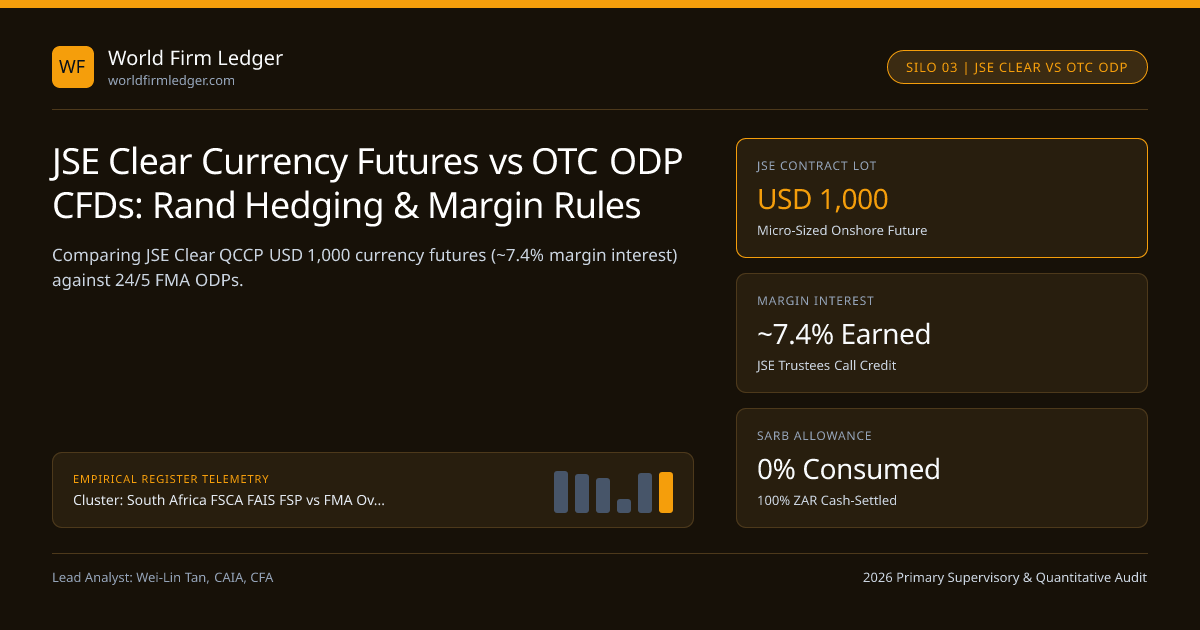
Long before retail MT4/MT5 CFD platforms entered Southern Africa, Johannesburg operated one of the emerging world's deepest onshore listed derivative venues—originating on the South African Futures Exchange (SAFEX) and Yield-X, and consolidated today as JSE Currency Derivatives cleared through JSE Clear, an independent Qualified Central Counterparty (QCCP) supervised jointly by the FSCA and the Prudential Authority at the South African Reserve Bank. Within our South Africa FSCA FAIS vs FMA ODP licensing guide—much like Brazil's B3 mini-dollar futures ecosystem—comparing JSE-cleared Rand currency futures (USD/ZAR, EUR/ZAR, GBP/ZAR) against bilateral FMA ODP rolling CFDs reveals critical differences in SARB exchange-control exemptions, counterparty default waterfalls, and overnight carry pricing!
Why JSE Currency Futures Bypass Individual SARB Foreign Allowance Quotas#
Here is a structural breakthrough prized by South African corporate importers, family offices, and active traders:
- Because JSE Currency Futures and Options (1 standard contract = USD 1,000 notional; Maxi contracts = USD 100,000 notional) are cash-settled onshore in South African Rand (ZAR) against the official WM/Refinitiv spot fixing without any cross-border outflow of foreign reserves, South African resident individuals, trusts, and companies can trade unlimited notional size on JSE Currency Derivatives WITHOUT consuming a single Rand of their ZAR 1M SDA or ZAR 10M FIA SARB exchange-control allowances!
- Even South African trusts and private companies—which do NOT receive the natural-person ZAR 1M/10M SDA/FIA buckets—can hedge ZAR 500,000,000 of USD currency depreciation directly on the JSE order book onshore in Rand!
Comparing Listed JSE Currency Futures vs Onshore FMA ODP Rolling FX CFDs#
While JSE Clear eliminates bilateral broker credit risk and earns full JIBAR call interest on posted Rand Initial Margin, OTC ODPs retain advantages in 24/5 continuous Asian/NY trading hours outside JSE market sessions and non-ZAR cross pairs (EUR/JPY, AUD/CAD):
| Structural Attribute | JSE Currency Futures (JSE Clear QCCP) | Authorized South African FMA ODP (CFD) | Offshore Unregulated MT5 Broker | Reference / Portal |
|---|---|---|---|---|
| Central Counterparty Novation | Yes — JSE Clear + Bank Clearing Members | No (Bilateral Principal Risk vs ODP) | Zero (High Insolvency Default Risk) | FSCA Ministry |
| Trading Hours (SAST = UTC+2) | 08:30 – 17:00 SAST (Business Days) | 24 Hours / 5 Days (Sun 23:00 – Fri 23:00) | 24/5 (24/7 Crypto) | SARB Prudential |
| Interest Earned on ZAR Margin? | Yes! JSE Clear Credits Call Rate (~7.5%+) | Usually 0% on Retail Margin (Check Sec 10) | 0% | Sec 19(3) Trust Rules |
| Forward Carry Pricing | Transparent JIBAR vs SOFR Implied Basis | Broker Overnight Swap Markup (+/- Admin) | Wide Asymmetric Swap Markups | B3 Emerging Peer |
| Uses SARB R1M / R10M Allowance? | No (100% Onshore ZAR Cash-Settled) | No (If ZAR-Settled Onshore SA ODP) | Yes! Consumes SDA/FIA Quota | AccuMarkets |
Modeling All-In Carry & Margin Yield: JSE USD/ZAR Future vs Retail OTC CFD#
In emerging markets with high domestic interest rates (SA Repo/JIBAR ~7.75% vs US SOFR ~4.50%), holding a long USD/ZAR hedge incurs negative forward points (~3.25% p.a.), BUT on JSE Clear your posted ZAR Initial Margin simultaneously earns ~7.50% JSE Trustees call interest, whereas many OTC CFD brokers charge an inflated swap spread and pay 0% on your posted margin!
- NetAnnualizedCarryOTCCFDZAR = (0InterestonMargin) - (NotionalZAR * (SAJIBARRate - USSOFRRate + BrokerSwap_Markup))
- Worked 90-Day USD 500,000 (~ZAR 9,000,000) Long USD/ZAR Importer Hedge (10x Effective Margin = ZAR 900,000 Posted):
- 1. JSE Currency Future (500 Standard Contracts; JIBAR-SOFR = 3.25%; JSE Margin Interest = 7.40%; Exchange/Broker Fee = 4 bps):
- Forward Basis Cost (90/365) = -ZAR 72,123; Earned Margin Interest (90/365 on R900k) = +ZAR 16,422; Fees = -ZAR 3,600
- Net 90-Day Cost = -ZAR 59,301!
- 2. Retail OTC CFD (1.60% p.a. Broker Swap Markup -> 4.85% Total Long Swap; 0% Paid on Margin):
- 90-Day Swap Debit = -9,000,000 * 0.0485 * (90/365) = -ZAR 107,630!
- Institutional Execution Saving on JSE Clear = +ZAR 48,329 per Quarter (+44.9% Lower Hedging Drag)!
Comparing JSE Clear VaR Initial Margin Against Bilateral CFD Leverage#
JSE Clear transitioned from legacy JSPAN to value-at-risk portfolio margining, calibrating initial margin dynamically per currency pair (~ZAR 1,050 to ZAR 1,450 per USD 1,000 contract, ~12:1 to 17:1 effective leverage) while netting cross-currency spreads automatically.
JSE "Can-Do" Exotic Currency Options: Bridging OTC Flexibility and CCP Safety#
What if an institutional fund needs a bespoke barrier option or non-standard expiry date normally available only over-the-counter from an FMA ODP, yet its investment mandate prohibits bilateral OTC counterparty credit risk? JSE Derivatives offers "Can-Do" Listed Custom Options—allowing two counterparties to negotiate custom strikes, barriers, and maturities while novating and clearing the contract directly through JSE Clear, uniting bilateral flexibility with QCCP safety across our South Africa FSCA and ODP licensing topic hub.
Frequently asked questions
Can a South African family trust trade USD/ZAR futures on the JSE even though trusts get zero SARB foreign investment allowance?
Yes! Because JSE Currency Derivatives are listed domestic Rand-settled contracts with zero cross-border movement of foreign currency, South African trusts, companies, and individuals can trade unlimited notional exposure onshore without SARB FinSurv permits.
What happens to my margin if my JSE Derivative Trading Member broker goes bankrupt?
Initial margin is lodged via a General Clearing Member (typically one of South Africa’s major banks) with JSE Clear Trustees in segregated statutory accounts, backed by the Clearing Member guarantee and JSE Clear’s multi-hundred-million-Rand Default Fund.
Why is the minimum JSE USD/ZAR currency future only USD 1,000 instead of CME’s USD 100,000?
The JSE deliberately designed its standard Currency Future at USD 1,000 (~ZAR 18,000 notional, requiring ~ZAR 1,200 margin) so SME importers, farmers, and retail investors could access institutional interbank spreads without resorting to unregulated offshore CFD buckets.
What is the main disadvantage of JSE Currency Futures compared to an FSCA-licensed ODP CFD account?
Overnight gap risk outside JSE hours: because the JSE order book closes at 17:00 SAST and reopens at 08:30 SAST, stop-loss orders cannot trigger during 20:00 SAST US Federal Reserve announcements, whereas 24/5 ODP desks stream continuous overnight liquidity.
Publication record
- Published
- 14 November 2026
- Updated
- 15 November 2026
- Author
- Wei-Lin Tan, CAIA, CFA
- Review
- Review not recorded
- Automated fact check
- Passed in the stored pipeline record
- Source URLs
- 3 recorded
AI assistance recorded: anthropic/claude-opus-4.6. This field does not establish human review or source verification.
Academic & Institutional Attribution
Cite This Research & Embed Live Data Card
Standard academic & institutional research paper citation format.
Wei-Lin Tan, CAIA, CFA. (2026, November 14). JSE Clear Currency Futures vs OTC ODP CFDs: Rand Hedging & Margin Rules. World Firm Ledger. https://worldfirmledger.com/almanac/jse-safex-yield-x-cleared-currency-futures-vs-otc-odpRegulatory Directory Cross-Reference
Referenced Institutions & Regulatory Registries
Top Regulated Institutions in This Coverage Slice
Referenced Supervisory Authorities
Related South Africa Fsca Fais Odp Licensing & Institutional Briefings
Explore South Africa Fsca Fais Odp Licensing Hub (20) →South Africa Fsca Fais Odp Licensing
South Africa FSCA FAIS FSP vs FMA Over-the-Counter Derivative Provider (ODP) GuideSouth Africa Fsca Fais Odp Licensing
South Africa FIC Act Compliance: RMCP, DPIP/FPPO & Beneficial Ownership RulesSouth Africa Fsca Fais Odp Licensing
Kenya CMA Online Foreign Exchange Licensing: Dealing vs Non-Dealing CapitalSouth Africa Fsca Fais Odp Licensing
Kenya CMA 20:1 Retail Leverage Cap & 80% Onshore Bank Client Trust RulesSouth Africa Fsca Fais Odp Licensing
Nigeria SEC & Central Bank (CBN): Digital Asset & FX Intermediation RulesSouth Africa Fsca Fais Odp Licensing
Mauritius FSC Investment Dealer + South Africa FSCA Dual-Hub ArchitectureSouth Africa Fsca Fais Odp Licensing
Southern Africa CMA Peg & Cross-Border Rules: Namibia NAMFISA & Botswana NBFIRASouth Africa Fsca Fais Odp Licensing
South Africa COFI Bill: Activity-Based FSCA Licensing & Twin Peaks Phase 2Japan Fsa Fibo Margin Segregation
Japan Investor Protection Fund (JIPF): JPY 10M Cap & Why OTC FX Is ExcludedJapan Fsa Fibo Margin Segregation
JFSA High-Speed Trading (HST) Registration: FIEA Article 66-50 Algo RulesJapan Fsa Fibo Margin Segregation
Japan FIEA Article 38(4): Unsolicited FX & CFD Cold-Calling ProhibitionJapan Fsa Fibo Margin Segregation
JFSA System Risk & FISC Guidelines: Tokyo Dual-Datacenter FIBO Resilience
World Firm Ledger Data, Benchmarks & Contributor Records
CC BY 4.0 Open Data
Open Institutional Datasets (CSV / JSON) →
Download desk-compiled quantitative series & schemas.
2026 Reference Matrix
2026 Institutional Benchmarks & Thresholds →
Statutory capital, clearing, margin & rate conventions.
Editorial Records
Authors & Review Records →
View named contributors where those records are available.
Complete Index
Master Research & Dossier Archive →
Browse all published briefings by topic pillar & date.