
Mas Singapore Cms Psa Accredited Rules
MAS Digital Payment Token Custody: 90% Cold-Storage & Statutory Trust Amendments
Phased in across 2024 under Payment Services Regulations amendments, Singapore MAS requires Digital Payment Token providers to hold 90% of customer tokens in cold wallets under statutory trust.
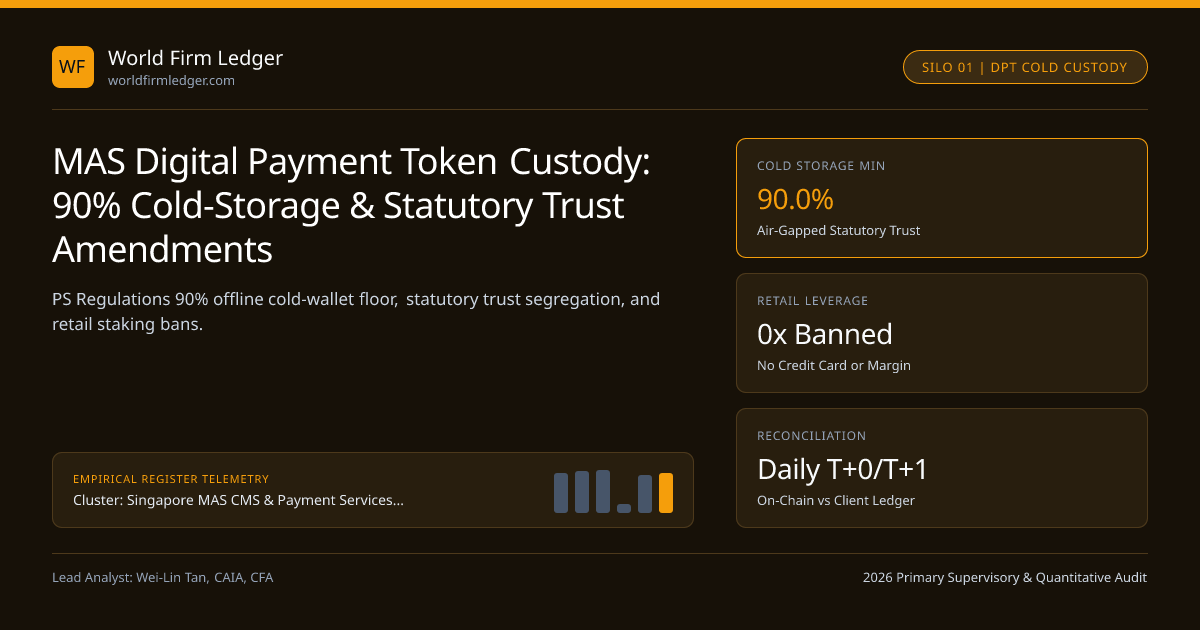
Amendments to Singapore's Payment Services Regulations phased in across April and October 2024 require every Digital Payment Token (DPT) service provider licensed under the PS Act to segregate customer assets inside a legally enforceable statutory trust and keep at least 90% of customer DPTs in offline cold wallets disconnected from external networks. Within our Singapore MAS CMS & MPI prudential guide, these user-protection mandates closed the historical statutory gap whereby MAS PS Act Section 23 fiat safeguarding covered e-money and remittances while leaving customer digital tokens exposed as unsecured claims during regional exchange bankruptcies.
Statutory Trust Ring-Fencing and Operational Independence of Custody#
Under the amended Payment Services Regulations, a DPT intermediary must hold customer tokens on a dedicated blockchain address—or omnibus set of customer-only addresses—strictly separate from the firm's proprietary treasury wallets, accompanied by daily ledger-to-chain reconciliations every business day. Written pre-contractual disclosures must explain trust mechanics, insolvency distribution rules, and the residual operational risk of omnibus wallet pooling before accepting a single token deposit.
Equally decisive is organizational separation: MAS mandates that the custody function within a DPT licensee operate independently from commercial trading, market-making, or brokerage units. Key-ceremony signers, multi-party computation (MPC) quorum administrators at institutional specialists like Atato, and hardware security module (HSM) custodians cannot report into revenue-generating dealing heads—eliminating the internal governance failure that enabled unauthorized balance-sheet transfers at collapsed offshore exchanges.
Complete Ban on Retail Lending, Staking, and Credit-Funded Purchases#
Beyond wallet architecture, the Monetary Authority of Singapore enacted conduct rules that sharply curtail retail speculative contagion on DPT platforms—including regional market participants evaluated alongside Affyn, Aevo, and ASEAN comparators like Binance TH:
- Prohibition on Retail DPT Lending and Staking: DPT service providers are forbidden from facilitating lending, hypothecation, or protocol staking of a retail customer's tokens. Only customers verified and opted in under our Singapore Accredited Investor SGD 2M opt-in audit or Institutional Investors may participate in yield/staking arrangements, and only after clear written risk disclosures and explicit transaction consent.
- Zero Retail Leverage or Credit-Card Funding: DPT providers cannot provide margin, credit facilities, or leveraged trading in DPTs to retail customers, nor accept locally issued credit cards for DPT purchases, nor offer monetary/token incentives ("refer-a-friend bonuses") to entice retail onboarding.
| DPT Regulatory Safeguard | Singapore MAS (PS Act DPT) | Hong Kong SFC (VATP Regime) | Dubai VARA (Custody/Exchange) | Japan JFSA / JVCEA (PSA/FIEA) | Supervisory Path |
|---|---|---|---|---|---|
| Mandatory Cold Wallet Floor | 90% of Customer DPTs | 98% of Customer Virtual Assets | Cold Majority + Insurance Cover | 95% Cold Storage Mandate | MAS Ministry |
| Statutory Trust Insolvency Shield | Mandatory Statutory Trust | Mandatory Associated Entity Trust | Segregated VA Client Wallets | Domestic Trust / Cold Equivalent | HK SFC |
| Retail Staking & Lending | Strictly Prohibited | Prohibited Without Specific Approval | Separate Regulated VA Lending License | Restricted Under PSA Custody | Dubai VARA |
| Retail DPT Margin / Leverage | 0x (Strictly Prohibited) | 0x (Spot Only on VATP) | Tightly Restricted / Prohibited | Capped at 2:1 (50% Margin FIEA) | JFSA / JVCEA |
| Independent Custody Governance | Mandatory Functional Separation | Wholly Owned Associated Entity | Separate Custody Controls | Certified Segregation Audit | Atato |
Modeling Daily Cold-to-Hot Rebalancing Under Price Spikes#
Because the 90% cold-wallet minimum applies across the aggregate fiat-equivalent value of held customer tokens, an intraday altcoin rally inside the 10% hot withdrawal wallet can temporarily push hot exposure above 10% unless automated sweep thresholds trigger at 7.5%–8.0%:
- RequiredColdSweepSGD = max(0, TotalHotWalletValueSGD - (0.08 * TotalCustomerDPTValue_SGD))
- Worked Daily Custody Rebalancing Audit:
- Total Customer DPTs Held = SGD 320,000,000 (Cold = SGD 292,800,000 [91.5%]; Hot = SGD 27,200,000 [8.5%])
- Intraday Volatility Event: Hot-wallet SOL/ETH withdrawal float rallies +32% while BTC cold reserve stays flat
- Updated Hot Value = SGD 35,904,000; Updated Total Value = 292,800,000 + 35,904,000 = SGD 328,704,000
- HotWalletRatio_T = 35,904,000 / 328,704,000 = 10.92% (> 10.0% Statutory Cap -> Sweep Triggered!)
- Sweep to 8.0% House Target: 35,904,000 - (0.08 * 328,704,000) = SGD 9,607,680 transferred offline to Cold HSM Vault
Cold-to-Hot Custody Allocation Under PS Act Rules#
Auditing the 90% offline storage floor alongside multi-signature key residency and statutory token trusts establishes institutional digital-asset hygiene.
Singapore Key-Control Residency and External Custody Audits#
Crucially, MAS requires private-key shards or operational recovery controls for Singapore-booked DPTs to remain operationally accessible and governed in Singapore rather than outsourced exclusively to overseas parent entities—ensuring a Singapore court-appointed liquidator can recover trust tokens without foreign jurisdictional blockades across the Singapore MAS regulatory topic hub and MAS Single-Currency Stablecoin framework.
Frequently asked questions
Can a Singapore MAS-licensed crypto exchange offer staking yields to retail customers?
No. Under MAS’s DPT user-protection rules, DPT service providers are prohibited from facilitating staking, lending, or hypothecation of retail customers’ tokens; staking services may only be offered to verified Accredited and Institutional Investors who have opted in.
May a Singapore DPT licensee use an overseas third-party custodian instead of self-custody?
MAS expects Singapore-licensed DPT providers to safekeep customer assets under stringent local statutory trust and key-governance controls; outsourcing custody to unregulated foreign entities that prevent Singapore insolvency recovery is non-compliant.
Why did MAS choose a 90% cold-storage floor rather than Hong Kong’s 98% rule?
MAS calibrated 90% cold storage to protect the vast majority of customer assets from online exploits while leaving up to 10% operational hot-wallet liquidity so high-throughput payment and remittance settlement firms avoid frequent manual cold-vault key ceremonies.
Are retail customers in Singapore allowed to buy Bitcoin or USDT with a Singapore-issued credit card on an MPI platform?
No. MAS retail conduct rules prohibit DPT service providers from accepting locally issued credit cards or extending any credit or leverage to retail customers for DPT purchases.
Publication record
- Published
- 14 November 2026
- Updated
- 15 November 2026
- Author
- Wei-Lin Tan, CAIA, CFA
- Review
- Review not recorded
- Automated fact check
- Passed in the stored pipeline record
- Source URLs
- 3 recorded
AI assistance recorded: anthropic/claude-opus-4.6. This field does not establish human review or source verification.
Academic & Institutional Attribution
Cite This Research & Embed Live Data Card
Standard academic & institutional research paper citation format.
Wei-Lin Tan, CAIA, CFA. (2026, November 14). MAS Digital Payment Token Custody: 90% Cold-Storage & Statutory Trust Amendments. World Firm Ledger. https://worldfirmledger.com/almanac/mas-digital-payment-token-dpt-cold-wallet-90-custody-ruleRegulatory Directory Cross-Reference
Referenced Institutions & Regulatory Registries
Top Regulated Institutions in This Coverage Slice
Referenced Supervisory Authorities
Related Mas Singapore Cms Psa Accredited Rules & Institutional Briefings
Explore Mas Singapore Cms Psa Accredited Rules Hub (20) →Mas Singapore Cms Psa Accredited Rules
Singapore MAS CMS & Payment Services Act MPI Capital, Risk & Safeguarding GuideMas Singapore Cms Psa Accredited Rules
MAS Notice PSN01 Cross-Border Money Transfer: Wire Travel Rule & AML ScreeningMas Singapore Cms Psa Accredited Rules
MAS Recognized Market Operator Tiers: RMO-1 vs RMO-2 Private Venue CapitalMas Singapore Cms Psa Accredited Rules
MAS OTC Derivatives Dealing License & Notice SFA 04-N15 Non-Cleared MarginMas Singapore Cms Psa Accredited Rules
MAS Representative Notification Framework & CMFAS Examination Module MappingMas Singapore Cms Psa Accredited Rules
FIDReC Singapore Dispute Resolution: Jurisdiction & SGD 150,000 Award MechanicsMas Singapore Cms Psa Accredited Rules
MAS Financial Institutions Directory vs ACRA BizFile UEN Shell-Entity ForensicsMas Singapore Cms Psa Accredited Rules
MAS SFA Section 339 Extra-Territorial Reach & Reverse Solicitation BoundariesDifc Dfsa Adgm Fsra Gulf Categories
DIFC & ADGM Onshore Boundary: AED Dirham Clearing & CBUAE Ring-Fencing RulesDifc Dfsa Adgm Fsra Gulf Categories
Dubai VARA Rulebooks: Virtual Asset Broker-Dealer vs Exchange Paid-Up AED CapitalDifc Dfsa Adgm Fsra Gulf Categories
Saudi CMA Capital Market Institutions: SAR 50M Dealing vs SAR 2M Advising TiersDifc Dfsa Adgm Fsra Gulf Categories
Saudi SAMA vs CMA Jurisdiction: FX Spot Banking Perimeters & Tadawul Derivatives
World Firm Ledger Data, Benchmarks & Contributor Records
CC BY 4.0 Open Data
Open Institutional Datasets (CSV / JSON) →
Download desk-compiled quantitative series & schemas.
2026 Reference Matrix
2026 Institutional Benchmarks & Thresholds →
Statutory capital, clearing, margin & rate conventions.
Editorial Records
Authors & Review Records →
View named contributors where those records are available.
Complete Index
Master Research & Dossier Archive →
Browse all published briefings by topic pillar & date.