
Mas Singapore Cms Psa Accredited Rules
MAS Recognized Market Operator Tiers: RMO-1 vs RMO-2 Private Venue Capital
Singapore MAS stratifies multilateral trading venues into Approved Exchanges and two Recognized Market Operator tiers (RMO-1 and RMO-2), calibrating capital for tokenized platforms like ADDX.
Part 2 of Singapore's Securities and Futures Act 2001 replaces rigid exchange monopolies with a three-tier market-infrastructure hierarchy supervised by the Monetary Authority of Singapore: systemically important Approved Exchanges (AEs) such as SGX, retail-capable Recognized Market Operators Tier 1 (RMO-1), and wholesale-only Recognized Market Operators Tier 2 (RMO-2) tailored for institutional bond ECNs, private-equity secondary books, and tokenized securities platforms like ADDX. Within our Singapore MAS CMS & MPI prudential guide, distinguishing a multilateral RMO from a bilateral CMS dealer is essential whenever an electronic platform matches multiple third-party buying and selling interests via non-discretionary rules.
Why Multilateral Matching Triggers Part 2 RMO Recognition#
A broker holding only a Part 4 CMS dealing license—governed by our MAS SF(FMR)R base capital tier matrix—may execute bilateral quotes as principal or route orders to external exchanges, not operate an internal central limit order book (CLOB) or periodic auction crossing engine bringing multiple unrelated participants together. Once a venue systematically matches multiple buyers and sellers in securities, units in collective investment schemes, or derivatives, SFA Section 7 requires formal recognition as an AE or RMO (unless operating as an overseas RMO restricted purely to institutional participants).
To encourage private-market digitization and fintech venue formation without imposing systemic stock-exchange overhead on wholesale platforms, MAS split local RMOs into two distinct operational regimes based on investor access and systemic footprint.
Solvency & Liquid Asset Formulas: RMO-2 vs RMO-1 vs Approved Exchanges#
Instead of applying dealer position-risk weights (since pure market operators do not hold proprietary directional books), MAS calibrates RMO prudential requirements around operating-cost wind-down runways so an orderly market closure or participant migration can occur over 3 to 6 months without freezing matched trades:
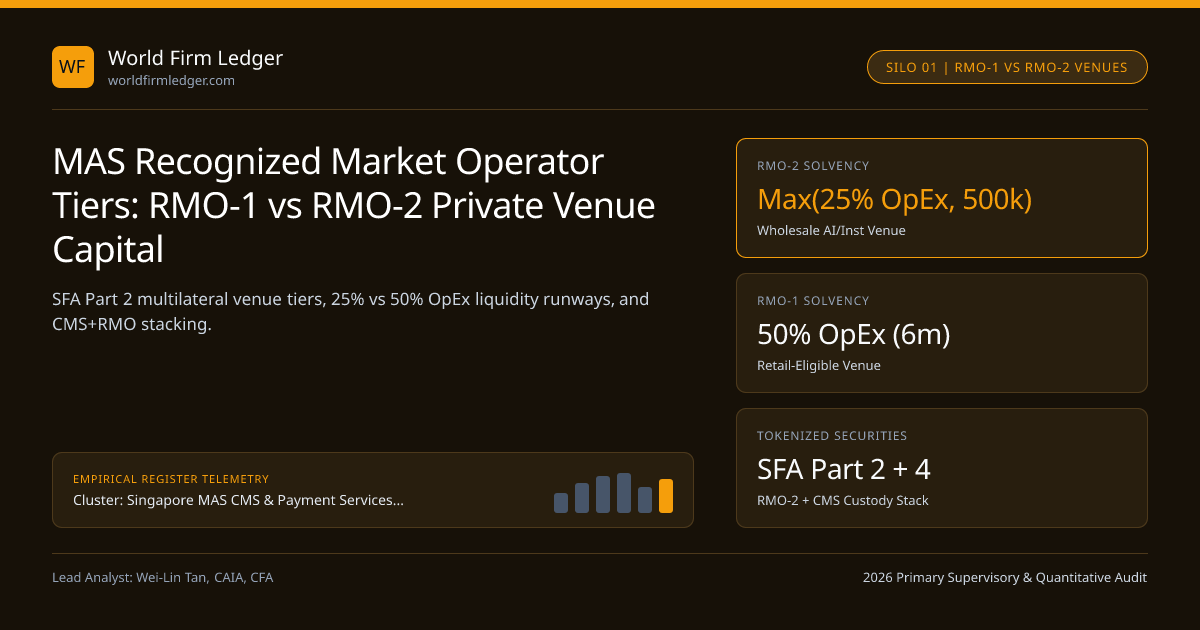
- RMO-2 (Wholesale Only): Restricted strictly to Accredited, Institutional, and Expert Investors verified under our Singapore Accredited Investor SGD 2M opt-in audit. Minimum financial resources / liquid net assets are calibrated at the higher of 25% of annual operating costs (3 months runway) or SGD 500,000, lowering startup capital barriers by roughly half compared with legacy exchange rules.
- RMO-1 (Retail Eligible): Permitted to admit retail investors subject to strict product-complexity caps and enhanced market surveillance. Requires substantially higher financial resources—typically 50% of annual operating costs (6 months liquid runway) subject to higher absolute SGD floors and MAS supervisory add-ons.
- Dual CMS + RMO Stacking: Tokenized private-market pioneers such as ADDX and smart-contract innovators like Attores show why private venues often stack a CMS Dealing + Custodial license alongside RMO-2 recognition: primary private placement origination and post-trade fractional token safekeeping require Part 4 CMS permissions, whereas the secondary order-matching board requires Part 2 RMO-2 status.
| Market Venue Category | Statutory SFA Basis | Permitted Participant Cohort | Typical Solvency / Runway Benchmark | Order-Book Surveillance Duty | Exemplar / Peer Reference |
|---|---|---|---|---|---|
| Approved Exchange (AE) | SFA s.8 / s.9 | Full Retail & Institutional Public | Systemic Paid-Up + 6–12m Liquid Buffer | Statutory Listing & Market Enforcement | MAS Ministry |
| Local RMO Tier 1 (RMO-1) | SFA s.9(1) Retail | Retail (Capped Volume) + Wholesale | >= 50% Annual OpEx (6m Liquid Assets) | Real-Time Spoofing & Insider Alerts | MAS Compendium |
| Local RMO Tier 2 (RMO-2) | SFA s.9(1) Wholesale | AI, Institutional & Expert Only | Max(25% Annual OpEx, SGD 500,000) | Rulebook Fair-Access & Audit Trail | ADDX |
| Overseas RMO | SFA s.9(2) | Singapore Institutional / Wholesale | Home-Regulator Equivalence (CFTC/FCA/ESMA) | Home Market Surveillance MoU | HK SFC Peer |
| ADGM MTF Comparator | ADGM FSMR | Wholesale / Qualified Virtual & TradFi | 6–12 Months OpEx Prudential Floor | Real-Time Surveillance Engine | ADGM FSRA |
Calculating Wind-Down Liquid Assets for a Dual RMO-2 + CMS Platform#
When a fractional private-credit and fund tokenization venue operates both RMO-2 secondary matching and CMS custody, finance teams must ensure unencumbered cash and Singapore Government Securities cover the higher combined prudential runway excluding restricted customer assets:
- CombinedDualEntitySolvencyFloor = max(CMSFirstScheduleBaseCapital, RMO2MinimumEquityAndLiquidAssets, 1.20 * CMSTRR)
- Worked Tokenized Private-Markets Venue Solvency Audit:
- AnnualOperatingExpenditure (Cloud, Matching Engine, Compliance, Staff) = SGD 9,600,000
- Non-Cash Depreciation Excluded = SGD 800,000 -> CashOpExBase = SGD 8,800,000
- RMO2MinimumRequirement = max(0.25 * 8,800,000, 500,000) = SGD 2,200,000 (3-Month Liquid Runway)
- CMS Custodial Base Capital Floor = SGD 1,000,000; 120% CMS TRR = SGD 1,680,000
- Binding Solvency Floor = max(1,000,000, 2,200,000, 1,680,000) = SGD 2,200,000 in Unencumbered Liquid Assets
Venue Solvency Benchmarks: RMO-2, RMO-1, and Approved Exchanges#
Contrasting six-month operating-cost runways across Recognized Market Operator tiers shows how Singapore scales multilateral trading venue capital.
Rulebook Transparency, Fair Access, and Technology Uptime Duties#
Even wholesale RMO-2 operators must publish objective, non-discriminatory participant admission rules, pre- and post-trade price transparency standards, conflict-of-interest walls (prohibiting preferential order routing to affiliated market makers without disclosure), and disaster-recovery plans meeting MAS TRM 4-hour critical availability rules across our Singapore MAS regulatory topic hub.
Frequently asked questions
Why does a tokenized securities exchange in Singapore need an RMO license instead of a PS Act DPT license?
Tokens representing shares, debentures, bonds, or units in a collective investment scheme are legally Capital Markets Products under the SFA rather than Digital Payment Tokens under the PS Act, requiring SFA Part 2 RMO recognition for multilateral matching.
Can retail investors in Singapore trade fractional private equity on an RMO Tier 2 platform?
No. RMO-2 venues are statutorily prohibited from onboarding retail investors; every individual participant must satisfy SFA Section 4A Accredited Investor wealth thresholds (such as SGD 2M net personal assets or SGD 300k income) and sign the opt-in consent.
When do Overseas Recognized Market Operators need Singapore recognition under SFA Section 9(2)?
Foreign multilateral trading facilities (such as Bloomberg MTF, Tradeweb, or MarketAxess entities) providing direct electronic access terminals to institutional banks and dealers located in Singapore obtain Overseas RMO recognition based on home-regulator equivalence.
Does an RMO-2 license automatically allow the venue operator to hold customer cash and tokenized securities?
Not automatically; unless settlement occurs externally at a licensed bank/custodian, platforms holding customer cash and safeguarding security tokens normally hold concurrent Part 4 CMS Dealing and Custodial Services permissions subject to SFA Regulation 16 trust rules.
Publication record
- Published
- 14 November 2026
- Updated
- 15 November 2026
- Author
- Wei-Lin Tan, CAIA, CFA
- Review
- Review not recorded
- Automated fact check
- Passed in the stored pipeline record
- Source URLs
- 3 recorded
AI assistance recorded: anthropic/claude-opus-4.6. This field does not establish human review or source verification.
Academic & Institutional Attribution
Cite This Research & Embed Live Data Card
Standard academic & institutional research paper citation format.
Wei-Lin Tan, CAIA, CFA. (2026, November 14). MAS Recognized Market Operator Tiers: RMO-1 vs RMO-2 Private Venue Capital. World Firm Ledger. https://worldfirmledger.com/almanac/mas-recognized-market-operator-rmo-tier-capital-privateRegulatory Directory Cross-Reference
Referenced Institutions & Regulatory Registries
Top Regulated Institutions in This Coverage Slice
Related Mas Singapore Cms Psa Accredited Rules & Institutional Briefings
Explore Mas Singapore Cms Psa Accredited Rules Hub (20) →Mas Singapore Cms Psa Accredited Rules
Singapore MAS CMS & Payment Services Act MPI Capital, Risk & Safeguarding GuideMas Singapore Cms Psa Accredited Rules
MAS OTC Derivatives Dealing License & Notice SFA 04-N15 Non-Cleared MarginMas Singapore Cms Psa Accredited Rules
MAS Representative Notification Framework & CMFAS Examination Module MappingMas Singapore Cms Psa Accredited Rules
FIDReC Singapore Dispute Resolution: Jurisdiction & SGD 150,000 Award MechanicsMas Singapore Cms Psa Accredited Rules
MAS Financial Institutions Directory vs ACRA BizFile UEN Shell-Entity ForensicsMas Singapore Cms Psa Accredited Rules
MAS SFA Section 339 Extra-Territorial Reach & Reverse Solicitation BoundariesMas Singapore Cms Psa Accredited Rules
MAS Technology Risk Management Guidelines: Critical System 4-Hour Unscheduled CapMas Singapore Cms Psa Accredited Rules
MAS Customer Knowledge Assessment (CKA) for Unlisted CFDs & Leveraged FXDifc Dfsa Adgm Fsra Gulf Categories
Saudi CMA Capital Market Institutions: SAR 50M Dealing vs SAR 2M Advising TiersDifc Dfsa Adgm Fsra Gulf Categories
Saudi SAMA vs CMA Jurisdiction: FX Spot Banking Perimeters & Tadawul DerivativesDifc Dfsa Adgm Fsra Gulf Categories
Qatar QFCRA Authorized Firms vs Onshore QFMA: Dual-Jurisdiction Capital & ScopeDifc Dfsa Adgm Fsra Gulf Categories
Central Bank of Bahrain Volume 4 Investment Business: Category 1, 2 & 3 Capital
World Firm Ledger Data, Benchmarks & Contributor Records
CC BY 4.0 Open Data
Open Institutional Datasets (CSV / JSON) →
Download desk-compiled quantitative series & schemas.
2026 Reference Matrix
2026 Institutional Benchmarks & Thresholds →
Statutory capital, clearing, margin & rate conventions.
Editorial Records
Authors & Review Records →
View named contributors where those records are available.
Complete Index
Master Research & Dossier Archive →
Browse all published briefings by topic pillar & date.