
Mas Singapore Cms Psa Accredited Rules
MAS Technology Risk Management Guidelines: Critical System 4-Hour Unscheduled Cap
Singapore’s legally binding MAS Notice on Technology Risk Management caps cumulative unscheduled critical-system downtime at 4 hours per rolling 12 months with 1-hour incident alerts.
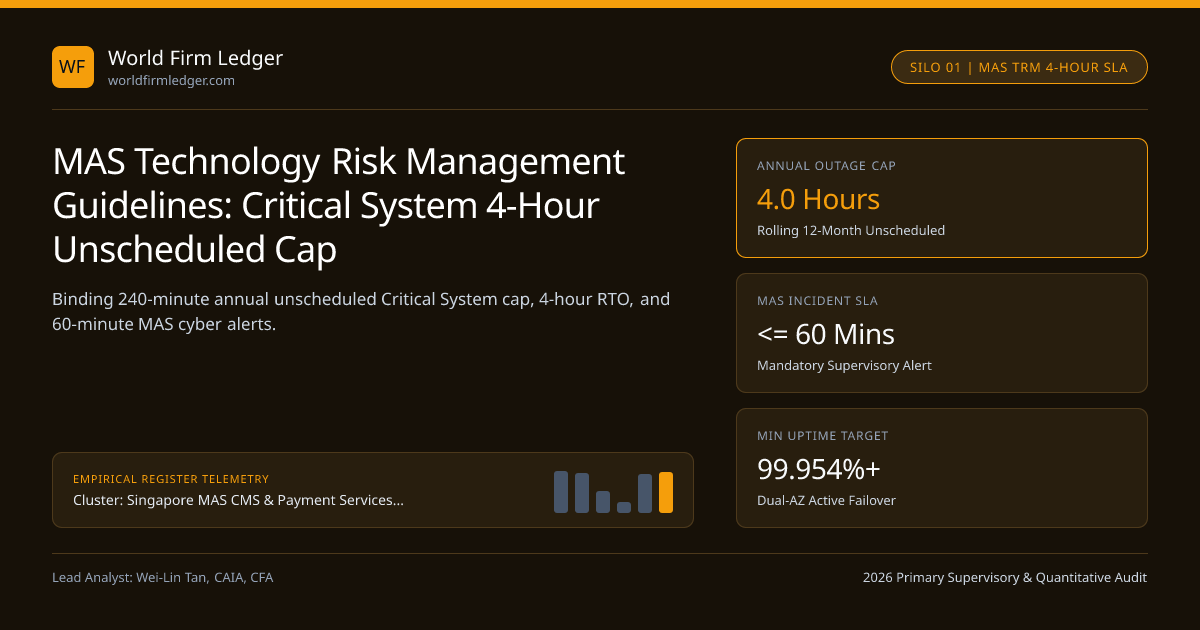
Unlike non-binding IT best-practice circulars issued in softer offshore hubs, the Monetary Authority of Singapore enforces a legally binding Notice on Technology Risk Management (consolidated across financial sectors under FSM-N21 / Notice SFA 04-N19 / PSN05) carrying statutory penalties for uptime breaches. Within our Singapore MAS CMS & MPI prudential guide, any trading matching engine, margin liquidation module, statutory trust payment gateway, or customer authentication portal whose failure causes widespread customer disruption qualifies as a Critical System—subject to a hard 4-hour maximum unscheduled downtime cap within any rolling 12-month period (99.954% minimum annual availability).
Four Binding Quantitative SLAs Inside the MAS TRM Notice#
Engineering and compliance heads at CMS dealers, Recognized Market Operators like ADDX, and Major Payment Institutions like 2C2P must architect multi-availability-zone failovers around four non-negotiable statutory metrics:
- Cumulative 12-Month Unscheduled Downtime <= 4 Hours: Across any rolling 365-day window, total unscheduled outages affecting a Critical System cannot exceed 240 minutes. A single botched database migration during New York/London FX overlap that freezes client stop-loss modifications for 4 hours and 15 minutes constitutes a statutory breach—often triggering supervisory capital add-ons or customer compensation claims at FIDReC as analyzed in FIDReC SGD 150,000 dispute mechanics.
- Maximum Recovery Time Objective (RTO) <= 4 Hours per Incident: Every Critical System must possess validated disaster-recovery failover verified at least annually to restore service within 4 hours of any single outage event.
- Near-Zero Recovery Point Objective (RPO): Order books, trade executions, and customer ledger mutations require synchronous or near-zero-data-loss replication so post-failover margin balances match pre-crash reality without phantom fills.
- 1-Hour MAS Incident Notification SLA: Upon discovering a relevant IT incident or cyber intrusion adversely impacting Critical Systems or customer data, the institution must notify MAS no later than 1 hour (60 minutes!), followed by a comprehensive Root Cause and Impact Analysis (RCIA) report within 14 days.
Cloud Outsourcing, Penetration Testing, and Source-Code Controls#
Alongside the hard Notice SLAs, the broader MAS Technology Risk Management Guidelines and Guidelines on Outsourcing govern how brokerages deploy workloads on AWS ap-southeast-1, Google Cloud Singapore, or third-party white-label trading cores (such as MetaTrader, cTrader, or proprietary MPC custody stacks like Atato):
- Right to Audit Cloud & Core Vendors: Outsourcing contracts for material/critical workloads must preserve explicit audit and inspection rights for both the licensee and MAS, alongside strict data-residency incident isolation.
- Annual Independent Penetration Testing & VAPT: Internet-facing trading APIs, mobile apps, and payment webhooks must undergo almeno annual independent red-team / penetration testing, remediating critical CVEs prior to production promotion.
- Segregation of Production & Development Environments: Developers writing pricing algorithms or smart contracts (as at Attores) are strictly barred from holding unmonitored standing write credentials to live production databases or hot-wallet signing enclaves.
| Operational Resilience Metric | Singapore MAS (TRM Notice) | Hong Kong SFC / HKMA (Cyber/E-Trading) | Japan JFSA / FISC Standards | EU DORA Comparator | Reference Path |
|---|---|---|---|---|---|
| Rolling 12m Unscheduled Cap | <= 4 Hours (Statutory Hard Cap) | Strict Material Outage Scrutiny | Near-Zero Duplexed Core Target | Firm-Set Impact Tolerance | MAS Ministry |
| Per-Incident Max RTO | <= 4 Hours (Validated Annually) | Rapid Secondary Site Failover | Hot/Warm Standby Mandatory | Tested TLPT & Failover | MAS Compendium |
| Regulator Notification Clock | <= 1 Hour from Discovery | Prompt / Immediate Notification | Immediate Preliminary Report | <= 4 Hours Initial ICT Alert | HKMA |
| Root Cause Report Deadline | <= 14 Calendar Days | Within Prescribed Supervisory Window | Formal Business Improvement | <= 1 Month Final Report | ADDX |
| Retail Outage Redress | FIDReC up to SGD 150,000 | FDRC up to HKD 500,000 | Civil / FINMAC Mediation | National Ombudsman | FIDReC |
Modeling Rolling 12-Month Error Budget Consumption for Trading Engines#
Site reliability engineers (SREs) at Singapore CMS brokers convert the 240-minute rolling 12-month statutory cap into a strict internal 120-minute (99.977%) engineering error budget so two minor network blips never push the license into regulatory breach:
- ParallelDualAZExpectedDowntimeMin = (8760 * 60) * ((1 - SingleAZAvailability) ^ 2) + FailoverSwitch_Minutes
- Worked SRE Architecture Audit (Singapore FX/CFD Matching Engine):
- Single-Node Cloud Instance Availability = 99.90% -> Expected Downtime = 525.6 min/yr (> 240 min MAS Cap -> Non-Compliant!)
- Active-Active Dual-AZ Singapore Architecture (Each AZ = 99.95% independent availability; 2 automatic 4-minute BGP/DNS failovers/yr):
- Simultaneous Dual-AZ Failure = 525,600 * ((0.0005) ^ 2) = 0.13 minutes/yr
- Total Expected Annual Unscheduled Downtime = 0.13 + (2 * 4.0) = 8.13 minutes/yr (Consumes only 3.39% of 240-minute MAS statutory cap!)
Critical System Uptime Budgets and Incident Reporting Gates#
Comparing the rolling four-hour annual unscheduled downtime limit and one-hour incident notification rule benchmarks broker operational resilience.
Binding Cyber Hygiene Notice Complement and Supervisory Penalties#
Complementing the TRM Notice, MAS's legally binding Notice on Cyber Hygiene mandates multi-factor authentication (MFA) on all administrative accounts and internet-facing trading portals, timely security patching, network perimeter firewalls, and malware protection. When major Singapore financial institutions suffered prolonged digital outages in 2023–2024, MAS imposed multi-million-dollar additional regulatory capital multipliers and six-month pauses on non-essential business expansion—reinforcing MAS RMO-1 and RMO-2 market venue uptime rules across our Singapore MAS regulatory topic hub.
Frequently asked questions
Does scheduled weekend maintenance count toward MAS’s 4-hour annual Critical System downtime limit?
No. Properly pre-notified scheduled maintenance windows fall outside unscheduled downtime, provided maintenance finishes within the communicated window; if a weekend upgrade fails and overruns into Monday market open, every minute of overrun counts as unscheduled downtime.
How fast must an MAS-licensed broker notify the regulator during a major DDoS attack or trading outage?
Under the MAS Notice on Technology Risk Management, the financial institution must notify MAS as soon as possible and no later than 1 hour (60 minutes) upon discovering a relevant system malfunction or IT security incident.
Can a Singapore CMS broker host its primary trading server on a single cloud virtual machine?
While MAS is cloud-neutral, a single virtual machine without automated cross-zone failover typically averages ~99.9% uptime (~8.7 hours downtime/year), virtually guaranteeing a breach of both the 4-hour RTO and 4-hour rolling annual downtime rules.
What enforcement measures has MAS taken when financial institutions breached the 4-hour TRM availability rule?
MAS has publicly imposed mandatory operational-risk capital multipliers (locking hundreds of millions in extra capital for banks or raising TRR for brokers), mandated independent third-party architectural audits, and paused non-essential IT changes.
Publication record
- Published
- 14 November 2026
- Updated
- 16 November 2026
- Author
- Wei-Lin Tan, CAIA, CFA
- Review
- Review not recorded
- Automated fact check
- Passed in the stored pipeline record
- Source URLs
- 3 recorded
AI assistance recorded: anthropic/claude-opus-4.6. This field does not establish human review or source verification.
Academic & Institutional Attribution
Cite This Research & Embed Live Data Card
Standard academic & institutional research paper citation format.
Wei-Lin Tan, CAIA, CFA. (2026, November 16). MAS Technology Risk Management Guidelines: Critical System 4-Hour Unscheduled Cap. World Firm Ledger. https://worldfirmledger.com/almanac/mas-trm-guidelines-system-availability-4-hour-mttr-capRegulatory Directory Cross-Reference
Referenced Institutions & Regulatory Registries
Top Regulated Institutions in This Coverage Slice
Referenced Supervisory Authorities
Related Mas Singapore Cms Psa Accredited Rules & Institutional Briefings
Explore Mas Singapore Cms Psa Accredited Rules Hub (20) →Mas Singapore Cms Psa Accredited Rules
Singapore MAS CMS & Payment Services Act MPI Capital, Risk & Safeguarding GuideMas Singapore Cms Psa Accredited Rules
MAS Customer Knowledge Assessment (CKA) for Unlisted CFDs & Leveraged FXMas Singapore Cms Psa Accredited Rules
ASEAN CIS Cross-Border Fund Passport: MAS, SC Malaysia & SEC Thailand RulesMas Singapore Cms Psa Accredited Rules
MAS Single-Currency Stablecoin Framework: SGD 1M Capital & 5-Day Par RedemptionMas Singapore Cms Psa Accredited Rules
MAS SF(FMR)R Base Capital Tiers: SGD 500k to SGD 5M Dealing ThresholdsMas Singapore Cms Psa Accredited Rules
MAS Risk-Based Capital Adequacy: Total Risk Requirement & 120% Warning FloorMas Singapore Cms Psa Accredited Rules
MAS Notice SFA 04-N12: Retail 5% FX Margin Floor & 20:1 Leverage MechanicsMas Singapore Cms Psa Accredited Rules
Singapore Accredited Investor Opt-In: SGD 2M Net Asset & Consent VerificationDifc Dfsa Adgm Fsra Gulf Categories
Jordan Securities Commission Foreign Margin Rules: Paid-Up JOD Capital & GuaranteesDifc Dfsa Adgm Fsra Gulf Categories
UAE Regulatory Forensics: Dubai DED Commercial Licenses vs DFSA & SCA RegistersDifc Dfsa Adgm Fsra Gulf Categories
DFSA IRAP & ICAAP Pillar 2 Add-Ons: Supervisory Capital Buffers for DIFC BrokersSouth Africa Fsca Fais Odp Licensing
FSCA FAIS Category I FSP Trap: Why Agency Intermediaries Cannot Act as Principal
World Firm Ledger Data, Benchmarks & Contributor Records
CC BY 4.0 Open Data
Open Institutional Datasets (CSV / JSON) →
Download desk-compiled quantitative series & schemas.
2026 Reference Matrix
2026 Institutional Benchmarks & Thresholds →
Statutory capital, clearing, margin & rate conventions.
Editorial Records
Authors & Review Records →
View named contributors where those records are available.
Complete Index
Master Research & Dossier Archive →
Browse all published briefings by topic pillar & date.