
Mas Singapore Cms Psa Accredited Rules
MAS Risk-Based Capital Adequacy: Total Risk Requirement & 120% Warning Floor
Singapore MAS SF(FMR)R Regulations 6 and 7 require Capital Markets Services dealers to hold Financial Resources above 100% of Total Risk Requirement with mandatory central bank alerts below 120%.
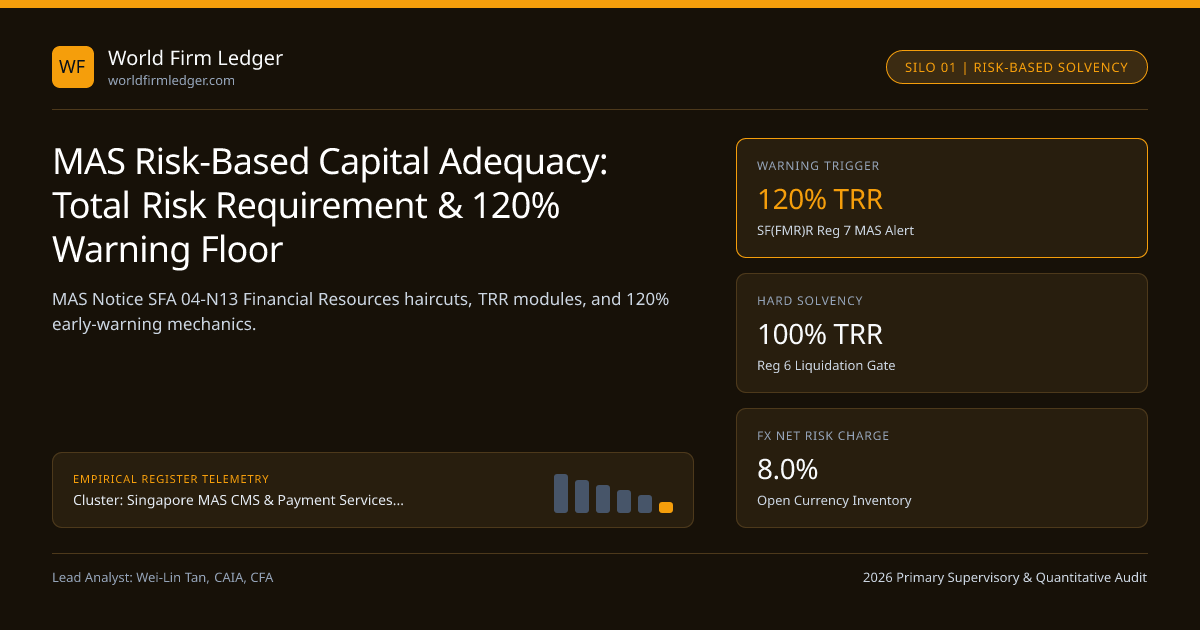
Regulations 6 and 7 of Singapore's SF(FMR)R compel Capital Markets Services licensees to maintain liquid Financial Resources at or above 100% of their dynamically computed Total Risk Requirement (TRR) every business day, backed by a statutory 120% early-warning threshold that activates supervisory intervention before insolvency threatens customer balances. While permanent paid-up equity is governed by our MAS SF(FMR)R base capital tier matrix, ongoing solvency under the Singapore MAS CMS & MPI prudential guide turns on how aggressively illiquid balance-sheet items are deducted from Financial Resources and how volatile market positions expand TRR intraday.
Decomposing Financial Resources and Non-Allowable Asset Haircuts#
Financial Resources start with base capital plus eligible Tier-2 items—such as irredeemable cumulative preference shares, revaluation reserves subject to haircuts, and MAS-approved qualifying subordinated loans carrying a minimum two-year initial term and a supervisory lock-in clause preventing repayment if FR/TRR would drop below 120%. From this gross capital pool, MAS Notice SFA 04-N13 forces full 100% deductions for non-liquid assets that cannot be converted into cash within days during a broker run.
Deducted items include intangible software capitalization, goodwill, right-of-use office lease assets, prepaid vendor expenses, unsecured loans to related group companies, and proprietary deposits held at unregulated offshore liquidity venues. When regional fintech brokerages capitalize millions of Singapore dollars in custom order-management code or park hedging margin with unlicensed Caribbean prime-of-prime entities, those balances vanish completely from Eligible Financial Resources, frequently surprising foreign CFOs transitioning into supervision under the Monetary Authority of Singapore.
The Four Pillars of Total Risk Requirement (TRR)#
Under MAS Notice SFA 04-N13, Total Risk Requirement aggregates four distinct quantitative risk modules tailored to a dealer's business model:
- Operational Risk Requirement (ORR): Set for most custodial and principal dealers at the higher of 5% of average annual gross income over the preceding three financial years, 10% of prior-year fixed overheads, or SGD 100,000. High-burn trading desks with heavy data-center and personnel overheads see ORR dominate baseline capital consumption.
- Counterparty Risk Requirement (CRR): Captures unsettled delivery-versus-payment trades, free deliveries, over-the-counter derivative replacement cost plus potential future exposure, and—critically for margin brokers—any client account equity deficit where collateral falls short of statutory initial margin under MAS Notice SFA 04-N12 retail FX margin rules.
- Position Risk Requirement (PRR): Applies currency, equity, interest-rate, and commodity market-risk charges to net unhedged proprietary ("B-book") exposures. Unhedged major currency net open positions attract an 8% capital charge, while emerging-market or volatile commodity exposures carry steeper add-ons.
- Large Exposure Risk Requirement (LERR): Penalizes concentration whenever exposure to a single counterparty or issuer exceeds 20% of Financial Resources.
| TRR Risk Module / Capital Deduction | Statutory Rule Reference | Primary Quantitative Charge | Broker Business Model Most Exposed | Comparative Supervisory Registry |
|---|---|---|---|---|
| Operational Risk (ORR) | Notice SFA 04-N13 Part III | Max(5% 3Yr Gross Rev, 10% Fixed Overhead, SGD 100k) | High-overhead agency & wealth platforms (ADDX) | MAS Ministry |
| Counterparty Risk (CRR) | Notice SFA 04-N13 Part IV | 100% of client margin shortfall + CVA/CCR weights | Leveraged FX/CFD margin brokers | MAS Compendium |
| Position Risk (PRR) | Notice SFA 04-N13 Part V | 8% standard FX net open position + equity beta charges | Principal market makers & B-book dealers | HKMA Peer |
| Large Exposure (LERR) | Notice SFA 04-N13 Part VI | Incremental charge above 20% FR single-name concentration | Desks hedging with a single prime broker | HK SFC Peer |
| Illiquid Asset Deduction | Notice SFA 04-N13 Part II | 100% deduction of software, leases & offshore unreg cash | Tech-heavy fintech entrants (Atato) | ACRA Registry |
Modeling IntradayFX Volatility Shock on the 120% Warning Band#
Consider how a sudden 6% currency gap during an Asian Monday open transmits directly into a Singapore market maker's FR/TRR ratio. Even if client cash remains safely segregated in statutory trust accounts, negative client balances create immediate Counterparty Risk charges while net warehouse delta inflates Position Risk.
- Worked Intraday Volatility Stress Test (SGD):
- Base_Capital = SGD 4,800,000
- QualifyingSubDebt = SGD 1,200,000
- DeductedIlliquidAssets (Software + Prepaid + Lease ROU) = SGD 1,550,000
- EligibleFinancialResources (FR) = 4,800,000 + 1,200,000 - 1,550,000 = SGD 4,450,000
- Pre-Shock TRR: ORR (900k) + CRR (850k) + PRR (1,100k) + LERR (150k) = SGD 3,000,000
- Pre-Shock Ratio = 4,450,000 / 3,000,000 = 148.33% (Healthy > 120%)
- Post-6% FX Gap Shock:
- Client under-margined deficits add +SGD 620,000 to CRR; unhedged FX delta adds +SGD 330,000 to PRR
- Post-Shock TRR = 3,000,000 + 620,000 + 330,000 = SGD 3,950,000
- Post-Shock Ratio = 4,450,000 / 3,950,000 = 112.66% (< 120% Early-Warning Breach -> Immediate MAS Reg 7 Notice Required)
Stress-Testing Buffer Margins Across Solvency Thresholds#
Tracking how intraday position and counterparty charges compress excess Financial Resources toward the 120% warning line guides daily treasury liquidity buffers.
Remediation Playbooks Under Regulation 7 Supervisory Directions#
Crossing below 120% does not automatically revoke a CMS license, provided management files its written Regulation 7 notification immediately and executes pre-committed liquidity contingencies. Standard remediation levers across the Singapore MAS regulatory topic hub include offloading B-book warehouse inventory via straight-through back-to-back prime hedges (collapsing PRR), collecting or writing off aged margin deficits, and converting intercompany payables into ordinary share equity rather than relying on slow debt approvals.
Frequently asked questions
Why do fintech CMS brokers in Singapore frequently underestimate Financial Resources deductions?
Because MAS Notice SFA 04-N13 requires a 100% deduction of intangible capitalized software development costs, IFRS 16 right-of-use office lease assets, and unsecured intercompany receivables when computing liquid Financial Resources.
What actions must a CMS broker take when its FR/TRR ratio drops to 115%?
Under SF(FMR)R Regulation 7, the broker must notify MAS immediately in writing, explain the root cause, submit a capital restoration or risk-reduction plan, halt dividends, and comply with any MAS direction such as daily solvency filings.
How do negative retail client balances affect a Singapore broker’s capital adequacy?
Any under-margined deficit or negative equity in a customer account increases the broker’s Counterparty Risk Requirement dollar-for-dollar unless covered by eligible collateral, directly inflating Total Risk Requirement.
Can a Singapore dealer reduce Position Risk Requirement by hedging with an offshore affiliate?
Offsetting Position Risk via back-to-back hedges shifts exposure into Counterparty Risk Requirement; if the offshore affiliate is unregulated or unrated, punitive counterparty risk weights or full collateral deductions can negate the capital relief.
Publication record
- Published
- 15 November 2026
- Updated
- 15 November 2026
- Author
- Wei-Lin Tan, CAIA, CFA
- Review
- Review not recorded
- Automated fact check
- Passed in the stored pipeline record
- Source URLs
- 3 recorded
AI assistance recorded: anthropic/claude-opus-4.6. This field does not establish human review or source verification.
Academic & Institutional Attribution
Cite This Research & Embed Live Data Card
Standard academic & institutional research paper citation format.
Wei-Lin Tan, CAIA, CFA. (2026, November 14). MAS Risk-Based Capital Adequacy: Total Risk Requirement & 120% Warning Floor. World Firm Ledger. https://worldfirmledger.com/almanac/mas-risk-based-financial-resources-120-early-warning-testRegulatory Directory Cross-Reference
Referenced Institutions & Regulatory Registries
Top Regulated Institutions in This Coverage Slice
Referenced Supervisory Authorities
Related Mas Singapore Cms Psa Accredited Rules & Institutional Briefings
Explore Mas Singapore Cms Psa Accredited Rules Hub (20) →Mas Singapore Cms Psa Accredited Rules
Singapore MAS CMS & Payment Services Act MPI Capital, Risk & Safeguarding GuideMas Singapore Cms Psa Accredited Rules
MAS Notice SFA 04-N12: Retail 5% FX Margin Floor & 20:1 Leverage MechanicsMas Singapore Cms Psa Accredited Rules
Singapore Accredited Investor Opt-In: SGD 2M Net Asset & Consent VerificationMas Singapore Cms Psa Accredited Rules
MAS SF(LCB)R Regulation 16: Customer Money Statutory Trust & Daily ComputationMas Singapore Cms Psa Accredited Rules
Singapore Payment Services Act: MPI vs SPI SGD 3M/6M Volume & Capital TriggersMas Singapore Cms Psa Accredited Rules
MAS PS Act Section 23 Safeguarding: Trust Accounts vs Standby Letters of CreditMas Singapore Cms Psa Accredited Rules
MAS Digital Payment Token Custody: 90% Cold-Storage & Statutory Trust AmendmentsMas Singapore Cms Psa Accredited Rules
MAS Notice PSN01 Cross-Border Money Transfer: Wire Travel Rule & AML ScreeningDifc Dfsa Adgm Fsra Gulf Categories
DFSA Retail Client Endorsement: COB Leverage Caps, Negative Balance & Close-OutDifc Dfsa Adgm Fsra Gulf Categories
DFSA Professional Client Classification: USD 1M Liquid Assets & Opt-Up AuditsDifc Dfsa Adgm Fsra Gulf Categories
DFSA Client Money Provisions: COB Chapter 6 Segregation & Daily ReconciliationDifc Dfsa Adgm Fsra Gulf Categories
ADGM FSRA Financial Services Permission: Dealing as Principal vs Agent PRU Rules
World Firm Ledger Data, Benchmarks & Contributor Records
CC BY 4.0 Open Data
Open Institutional Datasets (CSV / JSON) →
Download desk-compiled quantitative series & schemas.
2026 Reference Matrix
2026 Institutional Benchmarks & Thresholds →
Statutory capital, clearing, margin & rate conventions.
Editorial Records
Authors & Review Records →
View named contributors where those records are available.
Complete Index
Master Research & Dossier Archive →
Browse all published briefings by topic pillar & date.