
Mas Singapore Cms Psa Accredited Rules
MAS SF(LCB)R Regulation 16: Customer Money Statutory Trust & Daily Computation
Singapore SFA Section 104 and SF(LCB)R Regulations 16 to 37 mandate next-business-day customer money deposit into statutory bank trust accounts and ban retail collateral rehypothecation.
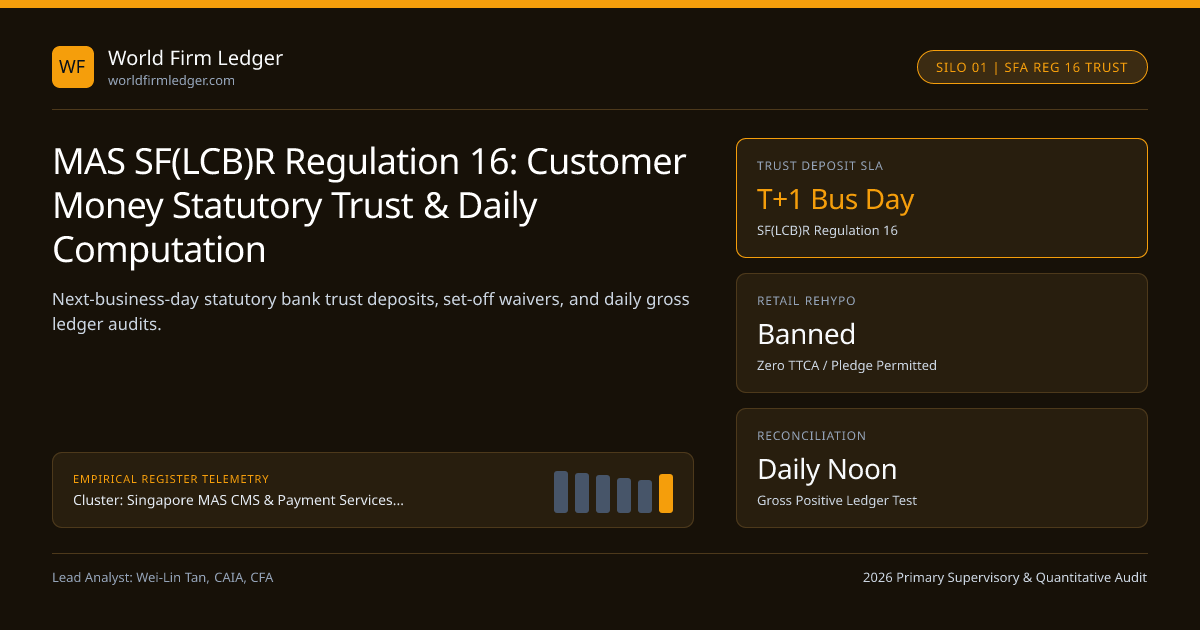
Section 104 of Singapore's Securities and Futures Act 2001, operationalized through Regulations 16 to 37 of the Securities and Futures (Licensing and Conduct of Business) Regulations—cited as SF(LCB)R—establishes an ironclad statutory trust over customer money and custody assets received by any Capital Markets Services licensee. Within our Singapore MAS CMS & MPI prudential guide, statutory trust status means client cash never enters the broker's general corporate estate; if the intermediary enters judicial management or liquidation, general trade creditors cannot attach trust balances under Regulation 17. Counterparty auditors checking records at the Monetary Authority of Singapore examine three operational pillars: next-business-day trust deposit timing, written bank trust acknowledgments, and daily segregated balance computations.
Next-Business-Day Deposit Timing and Bank Trust Acknowledgments#
Under SF(LCB)R Regulation 16, whenever a CMS holder receives money on account of a customer, those funds must be paid no later than the next business day into a designated trust account maintained with a licensed bank, merchant bank, or finance company in Singapore—or, where the money is denominated in a foreign currency and required for overseas settlement, with an appropriately licensed overseas custodian bank after furnishing mandatory cross-border custody risk disclosures to the client.
Crucially, Regulation 18 prohibits a CMS broker from treating an ordinary corporate bank account titled "Client Account" as compliant until the depository bank executes a formal written Trust Account Acknowledgment Letter. In that binding letter, the bank confirms that all balances standing to the credit of the account are held by the CMS licensee on trust for customers and explicitly waives any bank right of set-off, counterclaim, banker's lien, or combination against the broker's own corporate overdrafts or credit facilities.
Enhanced Retail Ring-Fencing and Ban on Title Transfer Collateral#
Following lessons from global futures broker collapses, MAS tightened SF(LCB)R to outlaw two dangerous liquidity practices for retail accounts:
- Absolute Ban on Retail Rehypothecation and Title Transfer: A CMS licensee cannot enter into Title Transfer Collateral Arrangements (TTCAs) with retail customers, nor may it mortgage, charge, pledge, or grant security interests over retail customer assets to fund proprietary trading or cover unrelated omnibus defaults. Even among clients who cleared our Singapore Accredited Investor SGD 2M opt-in audit, rehypothecation requires explicit written consent, clear risk disclosures, and strict leverage caps.
- Omnibus Fellow-Customer Risk Isolation: While omnibus trust accounts are permitted, Regulation 21 forbids using one retail customer's segregated money or securities to settle or margin another customer's trades! To prevent intraday omnibus timing gaps from creating technical fellow-customer borrowing, CMS brokers inject a dedicated firm residual buffer inside—or immediately top up—segregated clearing accounts from corporate cash.
Compare this framework with payment safeguarding in MAS PS Act Section 23 trust versus bank guarantee rules, where payment firms may substitute a bank guarantee for a trust account—an option not permitted for SFA customer money, which must sit inside actual cash trust accounts or Regulation 20 high-grade Singapore Government Securities.
| Safeguarding Parameter | MAS SFA s.104 / SF(LCB)R (CMS Brokers) | MAS PS Act s.23 (MPI Payments) | Hong Kong SFC s.148 Client Money | Japan FIEA Art. 43-2 FX Trust | Registry Link |
|---|---|---|---|---|---|
| Primary Ring-Fence Mechanism | Mandatory Bank Statutory Trust | Trust Account OR Bank Guarantee | Segregated Bank Account in HK | Mandatory Domestic Trust Bank | MAS Ministry |
| Deposit Deadline | Next Business Day (T+1) | Next Business Day (T+1) | Within 1 Business Day (HK) | T+2 Trust Bank Funding | HK SFC |
| Retail Collateral Rehypothecation | Strictly Prohibited | Prohibited on Relevant Money | Restricted Without Standing Auth | Strictly Prohibited | JFSA |
| Reconciliation Frequency | Daily Computation (Reg 37) | Daily Safeguarding Reconcile | Monthly + Daily Ledger Controls | Daily Mark-to-Market Calc | ADDX |
| Set-Off Waiver Letter | Mandatory Written Bank Waiver | Mandatory Trust/Guarantee Terms | Mandatory Written Counter-Notice | Statutory Trust Bankruptcy Shield | FIDReC |
Daily Segregated Balance Computation Under Regulation 37#
Every business day, the CMS licensee's finance operations team must compute total customer money required to be held in segregation as of the close of the previous business day and verify that actual cash and Regulation 20 investments in trust accounts equal or exceed that liability. Any deficit must be topped up immediately from the broker's own corporate cash account.
- TrustExcessOrDeficit = VerifiedBankTrustStatementT + Reg20SGSFairValueT - RequiredTrustBalanceT
- Worked Daily Reg 37 Reconciliation (Retail Multi-Asset CMS Broker):
- SumPositiveClientCashLedgers_T = SGD 42,850,000 (Negative client ledgers of -SGD 310,000 CANNOT be netted!)
- NetUnrealizedOTCClientProfits_T = +SGD 1,640,000
- AccruedDueBrokerage_Commissions = SGD 90,000
- RequiredTrustBalance_T = 42,850,000 + 1,640,000 - 90,000 = SGD 44,400,000
- VerifiedBankTrustStatementT = SGD 39,200,000
- Reg20SGSTreasuryBillsIn_Trust = SGD 5,650,000
- TrustExcessOr_Deficit = (39,200,000 + 5,650,000) - 44,400,000 = +SGD 450,000 Surplus (Zero Deficit Top-Up Needed)
Statutory Ring-Fencing Milestones Across Custody Tiers#
Evaluating T+1 deposit windows, trust acknowledgment letters, and retail title-transfer bans demonstrates how SFA Regulation 16 insulates client cash.
External Auditor Form 5 Assurance and Overseas Sub-Custodian Risks#
Notice how negative client accounts (-SGD 310,000 in the worked model above) cannot reduce the broker's trust obligation toward positive-balance clients: the house must fund that gap itself while absorbing the Counterparty Risk capital charge. Every year, independent auditors inspect daily Regulation 37 logs, test bank set-off waiver letters, and file statutory custody assurance reports directly with MAS, providing verifiable protection across our Singapore MAS regulatory topic hub and institutional profiles on World Firm Ledger.
Frequently asked questions
Can a Singapore CMS broker offset one client’s negative balance against other clients’ positive cash in its daily trust calculation?
No. SF(LCB)R requires customer trust obligations to be calculated on a gross positive-balance basis; any negative equity in an individual customer account must be covered by the broker’s own corporate funds rather than reducing total segregated trust cash.
May an MAS-licensed broker hold US dollar or Yen client funds with an overseas custodian bank?
Yes, where foreign currency funds or foreign securities require overseas settlement, provided the overseas institution is appropriately licensed in its home jurisdiction and the broker delivers prior written disclosure warning clients of foreign insolvency law differences.
Are Singapore CMS brokers allowed to invest customer trust balances to earn interest yield?
Under SF(LCB)R Regulation 20, customer trust money may only be placed in bank deposits or specified ultra-safe liquid instruments such as Singapore Government Securities, subject to clear prior disclosure of how interest income is shared or retained.
Why is a bank set-off waiver letter critical to SFA Section 104 insolvency protection?
Without an explicit written waiver under Regulation 18, a bank where the broker also maintains corporate credit lines might attempt to freeze or set off client deposits against defaulted corporate loans during a sudden brokerage bankruptcy.
Publication record
- Published
- 14 November 2026
- Updated
- 15 November 2026
- Author
- Wei-Lin Tan, CAIA, CFA
- Review
- Review not recorded
- Automated fact check
- Passed in the stored pipeline record
- Source URLs
- 3 recorded
AI assistance recorded: anthropic/claude-opus-4.6. This field does not establish human review or source verification.
Academic & Institutional Attribution
Cite This Research & Embed Live Data Card
Standard academic & institutional research paper citation format.
Wei-Lin Tan, CAIA, CFA. (2026, November 14). MAS SF(LCB)R Regulation 16: Customer Money Statutory Trust & Daily Computation. World Firm Ledger. https://worldfirmledger.com/almanac/mas-sfa-section-104-customer-money-statutory-trust-rulesRegulatory Directory Cross-Reference
Referenced Institutions & Regulatory Registries
Top Regulated Institutions in This Coverage Slice
Related Mas Singapore Cms Psa Accredited Rules & Institutional Briefings
Explore Mas Singapore Cms Psa Accredited Rules Hub (20) →Mas Singapore Cms Psa Accredited Rules
Singapore MAS CMS & Payment Services Act MPI Capital, Risk & Safeguarding GuideMas Singapore Cms Psa Accredited Rules
Singapore Payment Services Act: MPI vs SPI SGD 3M/6M Volume & Capital TriggersMas Singapore Cms Psa Accredited Rules
MAS PS Act Section 23 Safeguarding: Trust Accounts vs Standby Letters of CreditMas Singapore Cms Psa Accredited Rules
MAS Digital Payment Token Custody: 90% Cold-Storage & Statutory Trust AmendmentsMas Singapore Cms Psa Accredited Rules
MAS Notice PSN01 Cross-Border Money Transfer: Wire Travel Rule & AML ScreeningMas Singapore Cms Psa Accredited Rules
MAS Recognized Market Operator Tiers: RMO-1 vs RMO-2 Private Venue CapitalMas Singapore Cms Psa Accredited Rules
MAS OTC Derivatives Dealing License & Notice SFA 04-N15 Non-Cleared MarginMas Singapore Cms Psa Accredited Rules
MAS Representative Notification Framework & CMFAS Examination Module MappingDifc Dfsa Adgm Fsra Gulf Categories
ADGM FSRA Financial Services Permission: Dealing as Principal vs Agent PRU RulesDifc Dfsa Adgm Fsra Gulf Categories
ADGM FSRA Virtual Asset Framework: MTF Matching, Accepted Assets & Custody CapitalDifc Dfsa Adgm Fsra Gulf Categories
Onshore UAE SCA Category 1 Dealing vs Category 5 Financial Promotion & FinfluencersDifc Dfsa Adgm Fsra Gulf Categories
DIFC & ADGM Onshore Boundary: AED Dirham Clearing & CBUAE Ring-Fencing Rules
World Firm Ledger Data, Benchmarks & Contributor Records
CC BY 4.0 Open Data
Open Institutional Datasets (CSV / JSON) →
Download desk-compiled quantitative series & schemas.
2026 Reference Matrix
2026 Institutional Benchmarks & Thresholds →
Statutory capital, clearing, margin & rate conventions.
Editorial Records
Authors & Review Records →
View named contributors where those records are available.
Complete Index
Master Research & Dossier Archive →
Browse all published briefings by topic pillar & date.