
Mas Singapore Cms Psa Accredited Rules
MAS Notice SFA 04-N12: Retail 5% FX Margin Floor & 20:1 Leverage Mechanics
Implemented in October 2019 under MAS Notice SFA 04-N12, Singapore requires CMS brokers to collect at least 5% initial margin on retail FX contracts, capping leverage at 20:1 across global markets.
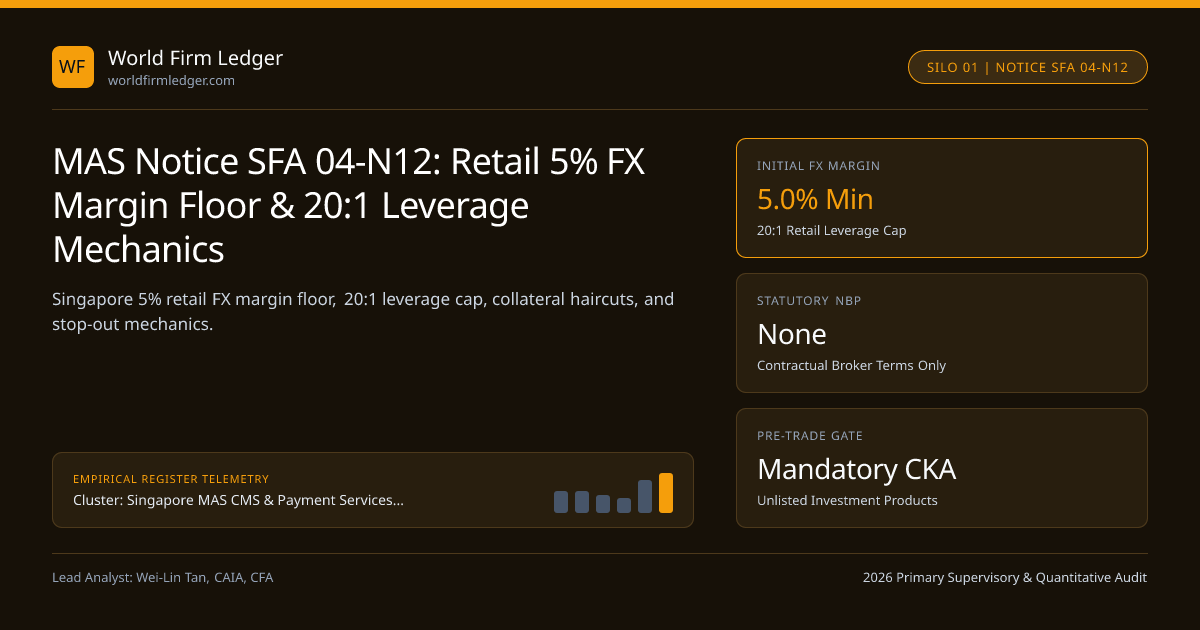
Effective October 8, 2019, amendments to MAS Notice SFA 04-N12 (Sale of Investment Products) raised Singapore's mandatory initial margin on unlisted foreign exchange contracts and FX contracts-for-difference for retail customers from 2% to 5%—instituting a hard 20:1 leverage ceiling across every CMS-licensed brokerage. Within our Singapore MAS CMS & MPI prudential guide, this 5% margin floor acts as a macro-prudential circuit breaker designed both to curb retail over-leverage during central bank policy surprises and to shield broker balance sheets from under-margined counterparty deficits analyzed in our MAS 120% risk-based financial resources test.
Scope of MAS Notice SFA 04-N12 Across FX, Indices, and Equities#
Notice SFA 04-N12 governs both spot foreign exchange contracts traded on margin and unlisted contracts-for-difference offered to retail investors—defined strictly as clients who have neither qualified for nor explicitly opted into Institutional, Expert, or Accredited Investor status under our Singapore Accredited Investor SGD 2M opt-in audit. Remarkably, Singapore sets a uniform 5% minimum margin across all retail currency pairs—whether G10 majors such as USD/SGD and EUR/USD or volatile emerging-market crosses—unlike Europe's ESMA regime, which splits retail FX between 3.33% (30:1) on majors and 5% (20:1) on non-majors.
For non-FX CFDs, Notice SFA 04-N12 and exchange-linked margin schedules impose differentiated floors reflecting underlying asset volatility: major equity-index and gold CFDs typically require 5% to 10% margin, single-stock equity CFDs require 10% to 20% depending on index membership and liquidity, and cryptocurrency CFDs face far stricter 50% (2:1) or higher house margins alongside payment token restrictions.
Why Singapore Lacks Statutory Negative Balance Protection#
Traders migrating to Singapore from London or Sydney frequently assume that a 20:1 retail leverage cap automatically includes statutory Negative Balance Protection (NBP). In reality, unlike FCA COBS 22.5 or ASIC's CFD Product Intervention Order, the Monetary Authority of Singapore does not legally mandate that CMS brokers forgive negative account equity after an extreme market gap. While several retail-focused CMS dealers offer contractual NBP up to a capped dollar limit as a commercial feature, standard Singapore client agreements preserve the broker's legal right to pursue unpaid margin deficits—subject to dispute review at FIDReC if the broker's liquidation engine malfunctioned.
Instead of statutory debt forgiveness, MAS enforces discipline through capital charges: under SF(FMR)R, if a retail account falls below required maintenance margin and stays uncollected past the prescribed settlement grace window, the broker must take an immediate 100% Counterparty Risk charge against its own Financial Resources. Consequently, Singapore CMS risk engines configure automated stop-out thresholds aggressively—typically closing positions at 50% to 75% of initial margin (i.e., when equity drops to 2.5%–3.75% of notional exposure).
| APAC & Global Regulator | Retail Major FX Cap | Retail Minor/EM FX Cap | Statutory Negative Balance Protection | Retail Investor Opt-Up Threshold | Supervisory Link |
|---|---|---|---|---|---|
| Singapore MAS (SFA 04-N12) | 20:1 (5.0% Margin) | 20:1 (5.0% Margin) | Not Statutory (Commercial Only) | SGD 2.0M Net Assets / SGD 300k Inc | MAS Ministry |
| Hong Kong SFC (Type 3 LFET) | 20:1 (5.0% Margin) | 20:1 (5.0% Margin) | Not Statutory (Strict Margin Call) | HKD 8.0M Portfolio (Professional) | HK SFC |
| Japan JFSA (FIEA Retail FX) | 25:1 (4.0% Margin) | 25:1 (4.0% Margin) | Prohibited (Loss Compensation Ban!) | Weekly Vol Corporate Model Only | Japan FSA |
| Australia ASIC (CFD PIO) | 30:1 (3.33% Margin) | 20:1 (5.0% Margin) | Mandatory Statutory NBP | AUD 2.5M Net Assets / AUD 250k Inc | ASIC |
| Malaysia BNM / SC | Onshore Bank Interbank | Restricted Offshore | N/A (Unlicensed Retail FX Barred) | Institutional Treasury Only | BNM |
Modeling Retail Margin Utilization and Stop-Out Buffer Elasticity#
To evaluate liquidation distance on a SGD 25,000 retail account trading USD/SGD under Notice SFA 04-N12, compliance and quantitative desks model exact pip tolerance between initial margin posting and automated 50% close-out execution.
- CloseOutEquityFloor = RequiredInitialMargin * HouseStopOutRatio
- AdverseMovePctToCloseOut = (AccountDepositSGD - CloseOutEquityFloor) / NotionalExposureSGD
- Worked Retail USD/SGD Position Audit:
- AccountDepositSGD = SGD 25,000
- PositionSize = USD 300,000 long USD/SGD at spot 1.3400 -> NotionalExposure_SGD = SGD 402,000
- RequiredInitialMargin (5.0%) = 402,000 * 0.05 = SGD 20,100 (Effective Leverage = 16.08x <= 20x Cap)
- FreeMarginBuffer = 25,000 - 20,100 = SGD 4,900
- CloseOutEquityFloor (at 50% stop-out) = 20,100 * 0.50 = SGD 10,050
- AdverseMovePctToCloseOut = (25,000 - 10,050) / 402,000 = 3.719% (498 pips drop to USD/SGD 1.2902 before auto-liquidation)
Comparative Initial Margin Floors Across Product Classes#
Contrasting the 5% spot FX margin floor against equity CFD, index CFD, and wholesale opt-in schedules illustrates how MAS calibrates retail leverage.
Non-Cash Collateral Haircuts and Cross-Margining Restrictions#
Notice SFA 04-N12 strictly defines what assets satisfy the 5% initial margin gate: cash in acceptable settlement currencies counts at 100% (subject to small FX mismatch haircuts when margin currency differs from contract currency), Singapore Government Securities take minimal 1% to 5% haircuts, and Qualifying Straits Times Index equities incur steeper valuation haircuts. Digital tokens held on external platforms such as Aevo or wallet providers in the World Firm Ledger directory cannot be pledged as statutory retail FX margin at a CMS broker, reinforcing the perimeter across the Singapore MAS regulatory topic hub.
Frequently asked questions
Does MAS Notice SFA 04-N12 allow 30:1 leverage on major currency pairs like EUR/USD or USD/JPY?
No. Unlike ESMA and ASIC—which permit 30:1 (3.33% margin) on major currency pairs—MAS Notice SFA 04-N12 applies a flat 5% minimum initial margin (20:1 maximum leverage) across all retail foreign exchange pairs, both G10 majors and emerging crosses.
Are retail CFD traders in Singapore protected by law against negative account balances?
MAS does not mandate statutory Negative Balance Protection. Unless the CMS broker’s client agreement explicitly includes a contractual negative-balance waiver, a trader can owe deficit balances resulting from extreme weekend or central-bank price gaps.
Can a retail trader in Singapore unlock higher FX leverage above 20:1 legally?
Higher leverage with an MAS-licensed CMS broker is available only if the client independently meets statutory Accredited, Expert, or Institutional Investor financial thresholds (such as SGD 2M net personal assets or SGD 300k income) and signs the formal opt-in consent.
Can CMS brokers offer deposit bonuses or trading rebates that reduce the 5% initial margin requirement?
Notice SFA 04-N12 prohibits CMS licensees from using promotional credits, rebates, or illusory loans to fund or offset a retail customer’s mandatory 5% initial margin requirement.
Publication record
- Published
- 15 November 2026
- Updated
- 15 November 2026
- Author
- Wei-Lin Tan, CAIA, CFA
- Review
- Review not recorded
- Automated fact check
- Passed in the stored pipeline record
- Source URLs
- 3 recorded
AI assistance recorded: anthropic/claude-opus-4.6. This field does not establish human review or source verification.
Academic & Institutional Attribution
Cite This Research & Embed Live Data Card
Standard academic & institutional research paper citation format.
Wei-Lin Tan, CAIA, CFA. (2026, November 14). MAS Notice SFA 04-N12: Retail 5% FX Margin Floor & 20:1 Leverage Mechanics. World Firm Ledger. https://worldfirmledger.com/almanac/mas-notice-sfa-04-n12-retail-fx-5-percent-margin-20x-capRegulatory Directory Cross-Reference
Referenced Institutions & Regulatory Registries
Top Regulated Institutions in This Coverage Slice
Related Mas Singapore Cms Psa Accredited Rules & Institutional Briefings
Explore Mas Singapore Cms Psa Accredited Rules Hub (20) →Mas Singapore Cms Psa Accredited Rules
Singapore MAS CMS & Payment Services Act MPI Capital, Risk & Safeguarding GuideMas Singapore Cms Psa Accredited Rules
Singapore Accredited Investor Opt-In: SGD 2M Net Asset & Consent VerificationMas Singapore Cms Psa Accredited Rules
MAS SF(LCB)R Regulation 16: Customer Money Statutory Trust & Daily ComputationMas Singapore Cms Psa Accredited Rules
Singapore Payment Services Act: MPI vs SPI SGD 3M/6M Volume & Capital TriggersMas Singapore Cms Psa Accredited Rules
MAS PS Act Section 23 Safeguarding: Trust Accounts vs Standby Letters of CreditMas Singapore Cms Psa Accredited Rules
MAS Digital Payment Token Custody: 90% Cold-Storage & Statutory Trust AmendmentsMas Singapore Cms Psa Accredited Rules
MAS Notice PSN01 Cross-Border Money Transfer: Wire Travel Rule & AML ScreeningMas Singapore Cms Psa Accredited Rules
MAS Recognized Market Operator Tiers: RMO-1 vs RMO-2 Private Venue CapitalDifc Dfsa Adgm Fsra Gulf Categories
DFSA Professional Client Classification: USD 1M Liquid Assets & Opt-Up AuditsDifc Dfsa Adgm Fsra Gulf Categories
DFSA Client Money Provisions: COB Chapter 6 Segregation & Daily ReconciliationDifc Dfsa Adgm Fsra Gulf Categories
ADGM FSRA Financial Services Permission: Dealing as Principal vs Agent PRU RulesDifc Dfsa Adgm Fsra Gulf Categories
ADGM FSRA Virtual Asset Framework: MTF Matching, Accepted Assets & Custody Capital
World Firm Ledger Data, Benchmarks & Contributor Records
CC BY 4.0 Open Data
Open Institutional Datasets (CSV / JSON) →
Download desk-compiled quantitative series & schemas.
2026 Reference Matrix
2026 Institutional Benchmarks & Thresholds →
Statutory capital, clearing, margin & rate conventions.
Editorial Records
Authors & Review Records →
View named contributors where those records are available.
Complete Index
Master Research & Dossier Archive →
Browse all published briefings by topic pillar & date.