
South Africa Fsca Fais Odp Licensing
South Africa COFI Bill: Activity-Based FSCA Licensing & Twin Peaks Phase 2
Completing Phase 2 of South Africa’s Twin Peaks reform, the Conduct of Financial Institutions (COFI) Bill repeals the legacy FAIS Act in favor of unified activity-based FSCA licensing.
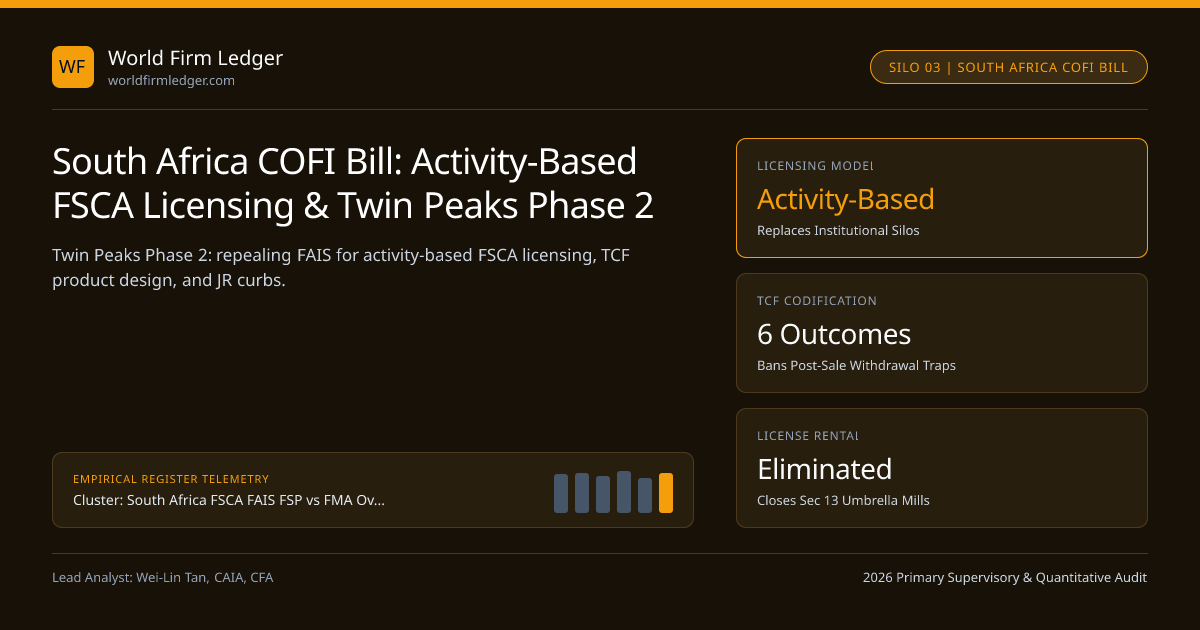
Phase 1 of South Africa's historic Twin Peaks overhaul launched on 1 April 2018 under the Financial Sector Regulation Act 9 of 2017 (FSRA)—splitting prudential solvency oversight into the Prudential Authority at the South African Reserve Bank and market-conduct oversight into the Financial Sector Conduct Authority (FSCA). Now, Phase 2—the Conduct of Financial Institutions (COFI) Bill prepared by National Treasury—replaces over a dozen fragmented legacy sector laws (including repealing the entire FAIS Act 37 of 2002!) with a single, holistic activity-based licensing framework! Within our South Africa FSCA FAIS vs FMA ODP licensing guide, compliance directors must understand how existing FAIS Category I/II FSPs and FMA ODPs map onto COFI's new Schedule 1 Activity Matrix.
Why National Treasury Is Repealing the FAIS Act in Favor of COFI#
For two decades, South Africa regulated institutions by institutional label (one statute for banks, another for insurers, FAIS for intermediaries, CISCA for unit trusts, FMA for exchanges/ODPs)—creating dangerous regulatory arbitrage loopholes exploited by unlicensed CFD B-books and Juristic Representative license-hosting mills! The COFI Bill eliminates institutional silos through four structural shifts:
- Single Overarching Conduct License With Activity Authorizations: Every financial institution—whether a retail bank, CFD issuer, robo-advisor, crypto CASP, or corporate pension administrator—holds one unified FSCA COFI License specifying exact Licensed Activities and Product/Instrument Sub-Categories!
- Proportional, Outcome-Based Supervision (Codifying TCF): Shifts compliance from tick-box disclosure forms to enforceable Treating Customers Fairly (TCF) product-design governance—requiring brokers to prove before launching a high-leverage retail product that its fee, spread, and stop-out design delivers fair target-market outcomes!
- End of Commercial "Juristic Representative License Rental": Tightens representative appointment rules so umbrella representation is restricted to genuine tied distribution or group structures with direct operational control—permanently shutting down third-party white-label FSP hosting!
- Expanded Supply-Chain Reach (Tech & Third-Party Service Providers): Brings critical outsourced trading-platform, algorithmic-scoring, and payment-gateway vendors inside direct FSCA conduct standards!
Mapping Existing Brokerage Licenses Into COFI's Activity Framework#
To ensure market stability, the FSCA has already begun restructuring its supervisory divisions and Omni-CBR (Cross-Sectoral Conduct of Business Return) data templates to mirror COFI's activity taxonomy ahead of formal parliamentary commencement:
| Legacy South African License | Current Statute | Future COFI Activity Classification | Key Supervisory Upgrade Under COFI | Reference / Peer |
|---|---|---|---|---|
| FAIS Category I FSP (Advice / Intermed.) | FAIS Act 37 of 2002 | Financial Advice / Sales & Execution | Bans third-party JR license-rental mills; strict TCF | FSCA Ministry |
| FAIS Category II Discretionary FSP | FAIS Act 37 of 2002 | Discretionary Investment Management | Harmonized portfolio-management & copy-trade rules | Cat II Copy Rules |
| FMA Authorized ODP (CFD Principal) | Financial Markets Act 2012 | Providing a Financial Instrument (OTC Issuer) | Explicit Product Design & Distribution (DDO) gates! | ASIC DDO Peer |
| FAIS Sub-Category 1.26 Crypto CASP | FAIS General Notice 1350 | Crypto Asset Trading / Custody / Advice Activities | Bespoke CASP custody, market-abuse & staking standards | Crypto 1.26 Rules |
Quantitative Omni-CBR Conduct Risk Scoring Under FSCA's New Supervisory Model#
Ahead of COFI's cutover, the FSCA rolled out data-driven conduct risk scoring across South African financial institutions—weighting retail loss concentrations, complaint-to-client ratios, fee drag, and Key Individual span-of-control to prioritize onsite inspections:
- Worked Sandton Multi-Asset Broker COFI Readiness Self-Audit:
- 1. Target Market & Product Governance (DDO Equivalent): Documented appropriateness gate blocking negative-disposable-income retail applicants -> Low Risk (18/100)
- 2. Ombud Escalation Rate: 96% of complaints resolved internally within 6 weeks; 0 upheld FAIS Ombud determinations -> Low Risk (10/100)
- 3. Representative Span: 12 Direct Employed Reps overseen by 2 Full-Time Resident Key Individuals (6:1 ratio; zero external rented JRs) -> Low Risk (12/100)
- 4. Liquid Capital Headroom: 185% of required ODP/FAIS threshold -> Composite Conduct Priority Score = 14.5 / 100 (Tier-1 Low-Intervention Rating!)
Comparing COFI's Product Design Duties Against Australia's ASIC DDO & UK Consumer Duty#
Notice how closely National Treasury modeled COFI's Product Design and Suitability pillar on the UK FCA's Consumer Duty and Australia ASIC's Design and Distribution Obligations (DDO)—empowering the FSCA to restrict or ban toxic retail derivative features directly!
Outcome 6: Statutory Weapon Against Unjustified Broker Withdrawal Holds#
For retail FX and crypto traders, TCF Outcome 6 ("Customers do not face unreasonable post-sale barriers imposed by firms to change product, switch provider, submit a claim or make a complaint") gives the FSCA direct statutory teeth against rogue platforms that accept deposits in 30 seconds without KYC, yet suddenly invent 45-day "notarized selfie audit delays" the day a profitable trader requests a withdrawal—elevating investor protection across our South Africa FSCA and ODP licensing topic hub.
Frequently asked questions
Will my broker’s existing FSCA FAIS FSP number suddenly become invalid when the COFI Bill is signed into law?
No. National Treasury and the FSCA designed a multi-year phased transition schedule mapping existing compliant FAIS FSPs and FMA ODPs smoothly onto equivalent COFI activity authorizations without abrupt license cancellations.
Does the COFI Bill merge the FSCA and the SARB Prudential Authority back together?
No! Twin Peaks remains permanently divided: the Prudential Authority inside the South African Reserve Bank regulates systemic solvency and liquidity, while the COFI Bill modernizes the market-conduct rulebook administered by the FSCA.
How does COFI affect small independent financial advisors compared to billion-Rand CFD platforms?
COFI embeds an explicit statutory principle of "proportionality," calibrating governance, reporting, and compliance-function burdens to the nature, scale, complexity, and retail risk impact of each licensee’s activities.
Why are offshore white-label brokers worried about COFI’s representative reforms?
Because COFI closes the Section 13 Juristic Representative loophole used by license-hosting mills to rent out one South African FSP number to dozens of unrelated foreign websites lacking independent FSCA vetting.
Publication record
- Published
- 14 November 2026
- Updated
- 15 November 2026
- Author
- Wei-Lin Tan, CAIA, CFA
- Review
- Review not recorded
- Automated fact check
- Passed in the stored pipeline record
- Source URLs
- 3 recorded
AI assistance recorded: anthropic/claude-opus-4.6. This field does not establish human review or source verification.
Academic & Institutional Attribution
Cite This Research & Embed Live Data Card
Standard academic & institutional research paper citation format.
Wei-Lin Tan, CAIA, CFA. (2026, November 14). South Africa COFI Bill: Activity-Based FSCA Licensing & Twin Peaks Phase 2. World Firm Ledger. https://worldfirmledger.com/almanac/south-africa-cofi-bill-twin-peaks-fsca-prudential-shiftRegulatory Directory Cross-Reference
Referenced Institutions & Regulatory Registries
Top Regulated Institutions in This Coverage Slice
Referenced Supervisory Authorities
Related South Africa Fsca Fais Odp Licensing & Institutional Briefings
Explore South Africa Fsca Fais Odp Licensing Hub (20) →South Africa Fsca Fais Odp Licensing
South Africa FSCA FAIS FSP vs FMA Over-the-Counter Derivative Provider (ODP) GuideSouth Africa Fsca Fais Odp Licensing
FSCA FSP Search Portal Forensic Audit: Verifying Product Codes & ODP StatusSouth Africa Fsca Fais Odp Licensing
FSCA FAIS Category I FSP Trap: Why Agency Intermediaries Cannot Act as PrincipalSouth Africa Fsca Fais Odp Licensing
South Africa FMA ODP License: Conduct Standard 1 & ZAR 50M+ Liquid Capital RulesSouth Africa Fsca Fais Odp Licensing
FSCA & Prudential Authority Joint Standard 2: OTC Derivative Margin RulesSouth Africa Fsca Fais Odp Licensing
FSCA FAIS Sub-Category 1.25 (Derivatives) & 1.26 (Crypto Assets) CASP RulesSouth Africa Fsca Fais Odp Licensing
FSCA FAIS Category II Discretionary FSP: Copy-Trading, PAMM & MAM RulesSouth Africa Fsca Fais Odp Licensing
FSCA Section 13 Juristic Representatives: White-Label License Rental RisksJapan Fsa Fibo Margin Segregation
Indonesia Bappebti-to-OJK Transition: JFX/ICDX & 70% Clearinghouse SegregationBrazil Cvm Mexico Cnbv Emerging Hubs
Brazil CVM Parecer 32 & 33: Foreign Forex Solicitation Stop Orders & FinesBrazil Cvm Mexico Cnbv Emerging Hubs
Brazil B3 Mini-Dolar (WDO) Futures: CORE Clearing Margin & RLP Retail RulesBrazil Cvm Mexico Cnbv Emerging Hubs
Brazil CVM BDR Rules: Retail Access to Global Stocks & ETFs on B3 in Reais
World Firm Ledger Data, Benchmarks & Contributor Records
CC BY 4.0 Open Data
Open Institutional Datasets (CSV / JSON) →
Download desk-compiled quantitative series & schemas.
2026 Reference Matrix
2026 Institutional Benchmarks & Thresholds →
Statutory capital, clearing, margin & rate conventions.
Editorial Records
Authors & Review Records →
View named contributors where those records are available.
Complete Index
Master Research & Dossier Archive →
Browse all published briefings by topic pillar & date.