
South Africa Fsca Fais Odp Licensing
FSCA FAIS Category I FSP Trap: Why Agency Intermediaries Cannot Act as Principal
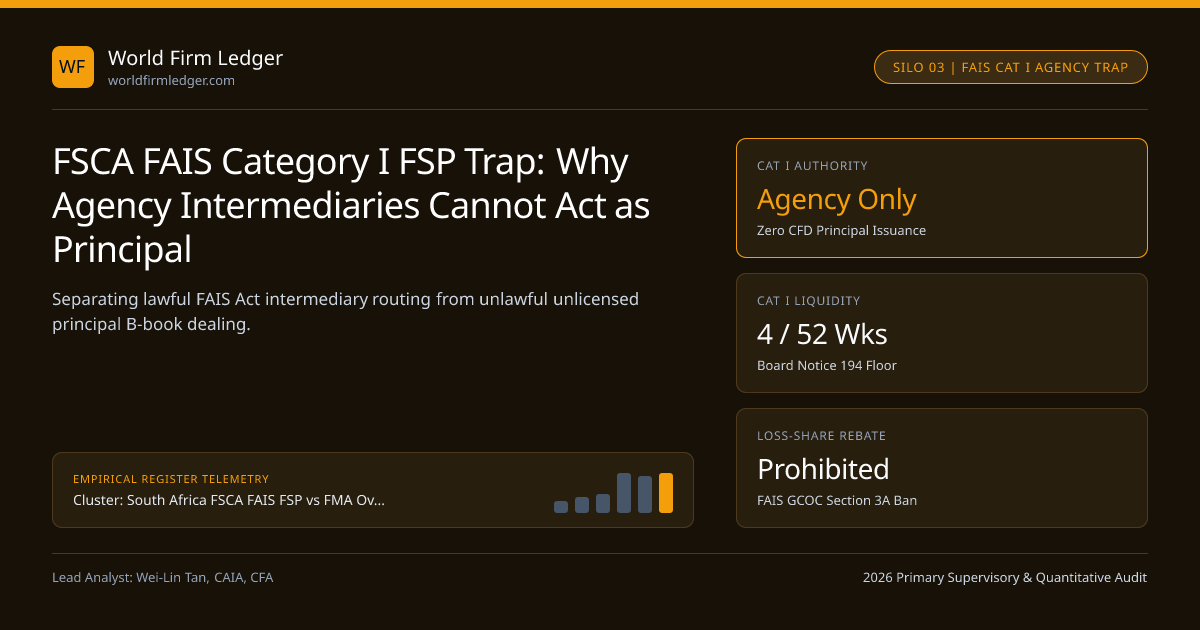
Under Section 1 of South Africa’s FAIS Act, a Category I Financial Services Provider license grants intermediary agency authority only, barring principal CFD issuance enforced by the FSCA.
Section 1(1) of South Africa's Financial Advisory and Intermediary Services Act 37 of 2002 defines an "intermediary service" as any act performed by a person for or on behalf of a client or product supplier with a view to buying, selling, or dealing in a financial product—a statutory phrasing that legally excludes acting as the product supplier (principal counterparty) originating bilateral CFDs! Within our South Africa FSCA FAIS vs FMA ODP licensing guide, uncovering whether a broker boasting "FSCA Regulated — FSP #xxxxx" is genuinely routing agency orders or unlawfully running a principal B-book without an ODP license is the single most consequential audit performed on the FSCA ministry registry.
How the "FSP + Offshore Principal" Structure Actually Works#
When an international brokerage acquires or registers a South African FAIS Category I FSP (holding Sub-Category 1.25 Derivative Instruments) without obtaining an FMA Over-the-Counter Derivative Provider (ODP) license, only two operational structures exist—one lawful under strict disclosure, and one flagrantly unlawful:
- Lawful Disclosed Agency / Straight-Through Introducer Model: The South African FSP acts purely as a marketing, KYC onboarding, and order-receiving intermediary that introduces the client to an authorized domestic ODP (such as a tier-1 South African bank or licensed non-bank ODP) OR—subject to strict FSCA cross-border conflict, counterparty-solvency, and SARB FinSurv exchange-control rules—transmits orders to a clearly disclosed, equivalently regulated foreign principal counterparty. Crucially, the FSP cannot absorb client trading losses as house revenue!
- Unlawful Unlicensed ODP Disguise (Enforcement Target): The South African entity signs the Client Agreement in its own name as counterparty, internalizes net retail CFD flow on a proprietary MetaTrader B-book, or passes 95% of net client losses via a "profit-share service invoice" to an unregulated St. Vincent or Mauritius sister shell—triggering immediate FSCA license suspension, debarment of Key Individuals, and administrative penalties under Section 167 of the Financial Sector Regulation Act!
FSCA Crackdown on "PnL Rebate" Conflicts Between Local FSPs and Offshore Principals#
Between 2022 and 2026, FSCA Enforcement published landmark enforcement determinations exposing a widespread conflict-of-interest scheme: a Sandton Category I FSP formally introduced South African retail clients to an offshore group entity, claiming "pure intermediary status," yet signed an intra-group SLA paying the South African FSP 50% to 80% of net client trading losses! Under Section 3A of the FAIS General Code of Conduct, an FSP is prohibited from receiving any non-cash incentive or conflicted financial interest other than transparent brokerage commission/fees commensurate with intermediary service—meaning sharing in client B-book losses violates core FAIS fiduciary duties even if the principal book sits offshore!
Comparing Counterparty Rights: Authorized ODP vs Pure FAIS Cat I vs Offshore Clone#
Reviewing how legal privity, solvency buffers, and dispute remedies shift across intermediary structures protects retail and institutional allocators evaluating firms listed alongside AccuMarkets and Allied Top FX.
| Operational Counterparty Model | Required FSCA Permissions | Who Bears Client Winning Trade Payout Risk? | Permitted Broker Compensation | FAIS Ombud Redress Scope | Benchmark / Reference |
|---|---|---|---|---|---|
| Onshore Principal CFD Market Maker | FMA Authorized ODP + FAIS Cat I (1.25) | Regulated SA ODP (ZAR 50M+ Liquid Cap) | Spread, Financing & Commission | Full Conduct & Execution Scope | FSCA Ministry |
| Pure Onshore Agency Introducer | FAIS Category I FSP (Sub-Cat 1.25) | Disclosed Third-Party ODP / Prime Dealer | Volume Commission / Flat Fee ONLY | Advice & Intermediary Conduct | AccuMarkets |
| White-Label Juristic Rep Introducer | Sec 13 Juristic Rep under Principal FSP | Underlying Authorized ODP | Disclosed Split of Agency Brokerage | Principal FSP Vicariously Liable! | FAIS Ombud |
| Unlawful B-Book Under Cat I Alone | Operating Illegally Without FMA ODP! | Undercapitalized Shell (High Default Risk) | Unlawful Client Loss Retention | Enforcement Freeze / Liquidation | FSCA Compendium |
Quantitative Counterparty Exposure & Conflict Ratio Test#
Compliance officers and institutional operational due-diligence teams audit an FSP's audited income statement and liquidity ratios to detect disguised principal dealing or prohibited PnL rebates:
- FAISCat1LiquidityMargin = LiquidAssetsZAR - ((4 / 52) * AnnualFixedExpenditureZAR)
- Worked Forensic Audit of Suspect Sandton FSP #99999 (FAIS Cat I Only, No ODP License):
- Reported Client Trading Volume Routed to Sister Mauritius Dealer = USD 1,200,000,000 / year
- Standard Institutional STP Rebate ($6 per $1M notional) = USD 7,200 (~ZAR 130,000)
- Actual "Marketing & Support Fee" Received from Mauritius Sister Entity = ZAR 48,000,000!
- RevenueConflictIndex = (48,000,000 - 130,000) / 48,000,000 = 99.73% Non-Volume Excess -> Immediate Red Flag for Disguised B-Book Loss Sharing!
Solvency Gap Between FAIS Category I Working Capital and FMA ODP Reserves#
Contrasting the four-week operating-expense working-capital test of a Category I FSP against the ZAR 50M+ FMA ODP liquid capital rule explains why unlicensed principal dealing endangers client withdrawals.
Key Individual Personal Liability and Debarment Consequences#
Every FAIS FSP must appoint at least one resident Key Individual (KI) who has passed the RE1 Regulatory Examination and meets strict product-specific experience hurdles under Board Notice 194 of 2017 (Determination of Fit and Proper Requirements). When an FSP fronts for an unlicensed principal CFD book or misleads traders via Section 13 Juristic Representatives, the FSCA debars the Key Individual personally from working anywhere in South Africa's banking, insurance, or investment industry for 5 to 15 years—anchoring accountability across our South Africa FSCA and ODP licensing topic hub.
Frequently asked questions
Why do so many international forex websites advertise an FSCA FSP number if it only covers intermediary services?
Because acquiring or applying for a FAIS Category I FSP is far faster and requires a fraction of the ZAR 50M+ liquid capital demanded of an FMA Over-the-Counter Derivative Provider (ODP); legitimate firms disclose their external executing principal, whereas rogue operators hide an offshore B-book behind the local FSP badge.
Is it legal for a South African FAIS Category I FSP to introduce clients to a foreign ASIC or FCA principal broker?
Yes, provided the foreign principal is properly disclosed in the client agreement, holds equivalent regulatory authorization, no prohibited client-loss-sharing conflict exists under GCOC Section 3A, and cross-border funding complies with SARB FinSurv rules.
What is a Key Individual (KI) in an FSCA-regulated brokerage?
A Key Individual is the natural person approved by the FSCA (holding RE1 exam certification and verified management/product experience under Board Notice 194) who bears personal statutory responsibility for managing and overseeing the FSP’s financial services conduct.
Can I file a FAIS Ombud complaint if a South African FSP tricked me into signing with an insolvent offshore principal?
Yes. Even when trades were booked offshore, if the South African FSP rendered negligent advice, failed to disclose counterparty risks, or breached the FAIS General Code of Conduct during onboarding, the FSP itself remains subject to FAIS Ombud awards up to ZAR 3.5 million.
Publication record
- Published
- 14 November 2026
- Updated
- 15 November 2026
- Author
- Wei-Lin Tan, CAIA, CFA
- Review
- Review not recorded
- Automated fact check
- Passed in the stored pipeline record
- Source URLs
- 3 recorded
AI assistance recorded: anthropic/claude-opus-4.6. This field does not establish human review or source verification.
Academic & Institutional Attribution
Cite This Research & Embed Live Data Card
Standard academic & institutional research paper citation format.
Wei-Lin Tan, CAIA, CFA. (2026, November 14). FSCA FAIS Category I FSP Trap: Why Agency Intermediaries Cannot Act as Principal. World Firm Ledger. https://worldfirmledger.com/almanac/fsca-fais-category-1-fsp-intermediary-principal-ban-trapRegulatory Directory Cross-Reference
Referenced Institutions & Regulatory Registries
Top Regulated Institutions in This Coverage Slice
Referenced Supervisory Authorities
Related South Africa Fsca Fais Odp Licensing & Institutional Briefings
Explore South Africa Fsca Fais Odp Licensing Hub (20) →South Africa Fsca Fais Odp Licensing
South Africa FSCA FAIS FSP vs FMA Over-the-Counter Derivative Provider (ODP) GuideSouth Africa Fsca Fais Odp Licensing
South Africa FMA ODP License: Conduct Standard 1 & ZAR 50M+ Liquid Capital RulesSouth Africa Fsca Fais Odp Licensing
FSCA & Prudential Authority Joint Standard 2: OTC Derivative Margin RulesSouth Africa Fsca Fais Odp Licensing
FSCA FAIS Sub-Category 1.25 (Derivatives) & 1.26 (Crypto Assets) CASP RulesSouth Africa Fsca Fais Odp Licensing
FSCA FAIS Category II Discretionary FSP: Copy-Trading, PAMM & MAM RulesSouth Africa Fsca Fais Odp Licensing
FSCA Section 13 Juristic Representatives: White-Label License Rental RisksSouth Africa Fsca Fais Odp Licensing
SARB FinSurv Exchange Controls: ZAR 1M SDA & ZAR 10M FIA Remittance LimitsSouth Africa Fsca Fais Odp Licensing
SARB Authorised Dealers vs ADLAs: Balance of Payments (BoP) Category CodesJapan Fsa Fibo Margin Segregation
Japan FIBO Article 46-6 Capital Adequacy Ratio: 140%, 120% & 100% TriggersJapan Fsa Fibo Margin Segregation
Japan Kanzen Shintaku Hozen: Mandatory Domestic Trust-Bank Client SegregationJapan Fsa Fibo Margin Segregation
Japan Retail FX 4% Margin (25:1 Cap), Loss-Cut Rule & Zero-Cut ProhibitionJapan Fsa Fibo Margin Segregation
FFAJ Corporate FX Margin in Japan: Weekly Historical Volatility Formula
World Firm Ledger Data, Benchmarks & Contributor Records
CC BY 4.0 Open Data
Open Institutional Datasets (CSV / JSON) →
Download desk-compiled quantitative series & schemas.
2026 Reference Matrix
2026 Institutional Benchmarks & Thresholds →
Statutory capital, clearing, margin & rate conventions.
Editorial Records
Authors & Review Records →
View named contributors where those records are available.
Complete Index
Master Research & Dossier Archive →
Browse all published briefings by topic pillar & date.