
South Africa Fsca Fais Odp Licensing
FSCA & Prudential Authority Joint Standard 2: OTC Derivative Margin Rules
Implementing BCBS-IOSCO uncleared margin reforms across emerging markets, South Africa’s Joint Standard 2 of 2020 enforces daily T+1 Variation Margin and segregated Initial Margin for ODPs.
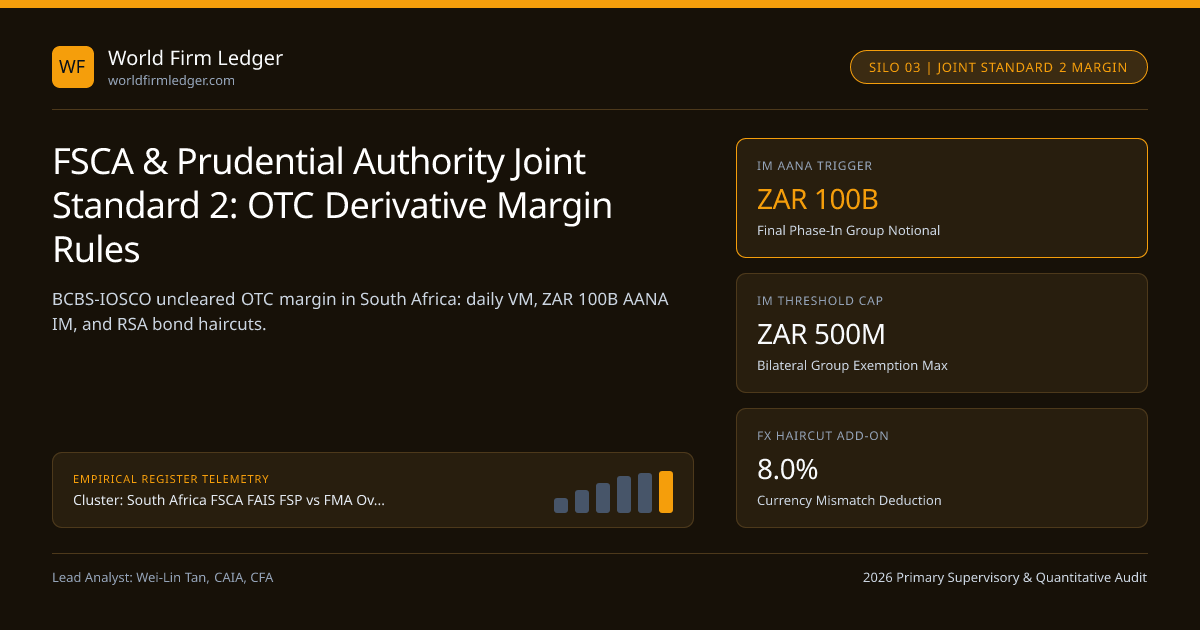
Fulfilling South Africa's G20 and Bank for International Settlements (BIS) commitments on non-centrally cleared over-the-counter derivatives, the Financial Sector Conduct Authority and the Prudential Authority at the South African Reserve Bank enacted Joint Standard 2 of 2020 (Margin Requirements for Non-Centrally Cleared Over-the-Counter Derivative Transactions). Within our South Africa FSCA FAIS vs FMA ODP licensing guide, Joint Standard 2 governs how authorized South African ODPs exchange daily Variation Margin (VM) and bankruptcy-remote Initial Margin (IM) with financial institutions, hedge funds, and cross-border liquidity providers.
Scope of Covered Entities, Excluded FX Contracts, and ZAR Thresholds#
Joint Standard 2 applies whenever an authorized South African ODP transacts non-centrally cleared OTC derivatives (including equity swaps, interest-rate swaps, credit derivatives, commodity forwards, NDFs, and CFDs) with a Covered Entity (banks, insurers, investment funds, pension funds, or foreign financial counterparties):
- Physically Settled FX Forwards & Swaps Exemption: Consistent with global BCBS-IOSCO standards (parallel to MAS Notice SFA 04-N15 in Singapore), physically settled FX forwards and FX swaps are exempt from mandatory Initial Margin, though covered interbank and institutional desks still exchange daily Variation Margin under supervisory risk-management guidance. Crucially, cash-settled rolling FX CFDs and Non-Deliverable Forwards (NDFs) are NOT physically settled FX forwards and remain fully subject to both VM and IM rules!
- Zero-Threshold Daily Variation Margin (VM): Exchanged on a T+1 mark-to-market basis between covered entities, subject to a maximum combined Minimum Transfer Amount (MTA) of ZAR 5,000,000 (~EUR 250k / USD 275k) so small intraday rounding changes do not trigger micro-wire gridlock.
- Phase-In Initial Margin (IM) Aggregate Average Notional Amount (AANA): Final phase-in binds groups whose March-April-May average gross notional of non-centrally cleared OTC derivatives exceeds ZAR 100 billion (scaled down from the initial ZAR 30 trillion Phase 1 bank tier, with bilateral IM exchange thresholds capped at ZAR 500,000,000 per consolidated counterparty group!).
Eligible Collateral Haircuts & Strict Ban on Rehypothecating Initial Margin#
Under Paragraph 7 of Joint Standard 2, collateral posted to satisfy Variation or Initial Margin cannot consist of speculative crypto tokens, unrated corporate notes, or securities issued by the posting counterparty itself ("wrong-way risk"). Approved collateral carries standardized valuation haircuts plus an 8% cross-currency FX haircut whenever collateral currency differs from the termination/settlement currency:
| Eligible Collateral Asset Class (Joint Standard 2) | Standard Valuation Haircut | Cross-Currency FX Add-On | Eligible for Variation Margin? | Eligible for Segregated Initial Margin? | Benchmark Reference |
|---|---|---|---|---|---|
| Cash in Settlement Currency (ZAR, USD, EUR, GBP) | 0.0% | 0.0% (8.0% if mismatched) | Yes (Primary VM Medium) | Yes (If Bankruptcy-Remote Held) | SARB Prudential |
| RSA National Treasury Bonds (<= 1 Year Residual) | 0.5% | 8.0% (vs USD termination) | Yes | Yes (Via Strate CSD Pledge) | FSCA Ministry |
| RSA National Treasury Bonds (1–5 Yr / > 5 Yr) | 2.0% / 4.0% | 8.0% (vs USD termination) | Yes | Yes (Zero Rehypothecation) | FSCA Compendium |
| High-Grade Corporate Bonds / JSE Top 40 Equities | 4%–8% (Bonds) / 15% (Eq) | 8.0% | Restricted by CSA | Yes (Subject to Concentration Caps) | JSE Cleared Peer |
Calculating Haircut-Adjusted RSA Government Bond Collateral Calls#
When a Johannesburg non-bank ODP or hedge fund posts 10-year Republic of South Africa (R2035) sovereign bonds denominated in ZAR to cover a USD-terminated ISDA CSA Initial Margin call with a London swap dealer, both maturity and currency haircuts compound:
- Worked Cross-Border ODP-to-Dealer Initial Margin Posting (ZAR R2035 Bonds -> USD Termination CSA):
- Gross ISDA SIMM Initial Margin Across Equity & FX NDF Book = ZAR 780,000,000
- Consolidated Group IM Threshold (Negotiated Under Joint Standard 2 Cap) = ZAR 500,000,000
- Net IM Call = 780,000,000 - 500,000,000 = ZAR 280,000,000
- AssetHaircut (>5-Yr Sovereign Bond) = 4.0% (0.04); FXMismatch_Haircut (ZAR Bond vs USD Termination) = 8.0% (0.08)
- Effective Collateral Recognition Factor = 1 - 0.04 - 0.08 = 0.88 (88.0%)
- RequiredMarketValuePostedZAR = 280,000,000 / 0.88 = ZAR 318,181,818 (Exceeds ZAR 5M MTA -> Full Segregated Strate Transfer Executed!)
Standardized Schedule vs ISDA SIMM Model Approval#
Comparing standardized notional add-ons against approved quantitative sensitivity models shows why institutional South African ODPs invest heavily in risk-model validation.
Substituted Compliance When Facing Foreign EMIR, UK, or MAS Dealers#
Because South African ODPs hedge the majority of their offshore equity, gold, and G10 FX flow with London, Frankfurt, or Singapore liquidity providers, Paragraph 10 of Joint Standard 2 permits substituted compliance where the foreign counterparty's home margin regime (such as EU/UK EMIR, US CFTC/Prudential, or Singapore MAS) has been assessed as equivalent by the FSCA and Prudential Authority—streamlining global liquidity across our South Africa FSCA and ODP licensing topic hub.
Frequently asked questions
Does Joint Standard 2 of 2020 set retail client CFD leverage caps in South Africa?
Joint Standard 2 directly governs bilateral margin exchange between an authorized ODP and "Covered Entities" (financial institutions and large derivatives users); retail client margining at an ODP is governed by the ODP’s internal risk policy and appropriateness duties under FSCA Conduct Standard 2 of 2018.
Can a South African ODP rehypothecate Initial Margin received under Joint Standard 2 to fund its own liquidity?
No. Joint Standard 2 strictly prohibits rehypothecating, re-pledging, or re-using Initial Margin collected under the standard, and mandates holding it in segregated accounts insulated from the collecting ODP’s insolvency.
Why do South African ODPs apply for Prudential Authority / FSCA approval to use ISDA SIMM instead of the standardized table?
Because the standardized schedule charges flat gross percentages (e.g., 15% on equities/commodities and 6% on FX) with limited 60% Net-to-Gross Ratio netting, whereas ISDA SIMM fully recognizes delta/vega risk offsets across hedged directional portfolios, cutting required IM by 60% to 85%.
Are commercial mining companies hedging gold or diesel prices forced to post Initial Margin under Joint Standard 2?
No. Non-financial entities entering into OTC derivatives predominantly to hedge commercial treasury or physical commodity production risks are carved out of the "Covered Entity" definition under Joint Standard 2.
Publication record
- Published
- 14 November 2026
- Updated
- 15 November 2026
- Author
- Wei-Lin Tan, CAIA, CFA
- Review
- Review not recorded
- Automated fact check
- Passed in the stored pipeline record
- Source URLs
- 3 recorded
AI assistance recorded: anthropic/claude-opus-4.6. This field does not establish human review or source verification.
Academic & Institutional Attribution
Cite This Research & Embed Live Data Card
Standard academic & institutional research paper citation format.
Wei-Lin Tan, CAIA, CFA. (2026, November 14). FSCA & Prudential Authority Joint Standard 2: OTC Derivative Margin Rules. World Firm Ledger. https://worldfirmledger.com/almanac/fsca-conduct-standard-2-bilateral-margin-otc-derivativesRegulatory Directory Cross-Reference
Referenced Institutions & Regulatory Registries
Top Regulated Institutions in This Coverage Slice
Related South Africa Fsca Fais Odp Licensing & Institutional Briefings
Explore South Africa Fsca Fais Odp Licensing Hub (20) →South Africa Fsca Fais Odp Licensing
South Africa FSCA FAIS FSP vs FMA Over-the-Counter Derivative Provider (ODP) GuideSouth Africa Fsca Fais Odp Licensing
FSCA FAIS Sub-Category 1.25 (Derivatives) & 1.26 (Crypto Assets) CASP RulesSouth Africa Fsca Fais Odp Licensing
FSCA FAIS Category II Discretionary FSP: Copy-Trading, PAMM & MAM RulesSouth Africa Fsca Fais Odp Licensing
FSCA Section 13 Juristic Representatives: White-Label License Rental RisksSouth Africa Fsca Fais Odp Licensing
SARB FinSurv Exchange Controls: ZAR 1M SDA & ZAR 10M FIA Remittance LimitsSouth Africa Fsca Fais Odp Licensing
SARB Authorised Dealers vs ADLAs: Balance of Payments (BoP) Category CodesSouth Africa Fsca Fais Odp Licensing
South Africa FAIS Section 19(3) Client Trust Accounts & External Audit RulesSouth Africa Fsca Fais Odp Licensing
South Africa FAIS Ombud Redress: Increased ZAR 3.5M Jurisdictional Limit GuideJapan Fsa Fibo Margin Segregation
Japan Retail FX 4% Margin (25:1 Cap), Loss-Cut Rule & Zero-Cut ProhibitionJapan Fsa Fibo Margin Segregation
FFAJ Corporate FX Margin in Japan: Weekly Historical Volatility FormulaJapan Fsa Fibo Margin Segregation
Japan Non-FX CFD Leverage Caps: 5x Single Stocks, 10x Indices & 20x GoldJapan Fsa Fibo Margin Segregation
FFAJ Monthly OTC FX Statistical Bulletins: Auditing Unpaid Loss-Cut Shortfalls
World Firm Ledger Data, Benchmarks & Contributor Records
CC BY 4.0 Open Data
Open Institutional Datasets (CSV / JSON) →
Download desk-compiled quantitative series & schemas.
2026 Reference Matrix
2026 Institutional Benchmarks & Thresholds →
Statutory capital, clearing, margin & rate conventions.
Editorial Records
Authors & Review Records →
View named contributors where those records are available.
Complete Index
Master Research & Dossier Archive →
Browse all published briefings by topic pillar & date.