
Difc Dfsa Adgm Fsra Gulf Categories
DFSA PIB Rulebook Categories 1 to 4: Base Capital & Expenditure-Based Minimums
Inside the Dubai International Financial Centre, the DFSA PIB Rulebook stratifies financial institutions into Categories 1 through 5, binding capital to the highest of Base Capital, EBCM, or Risk Capital.
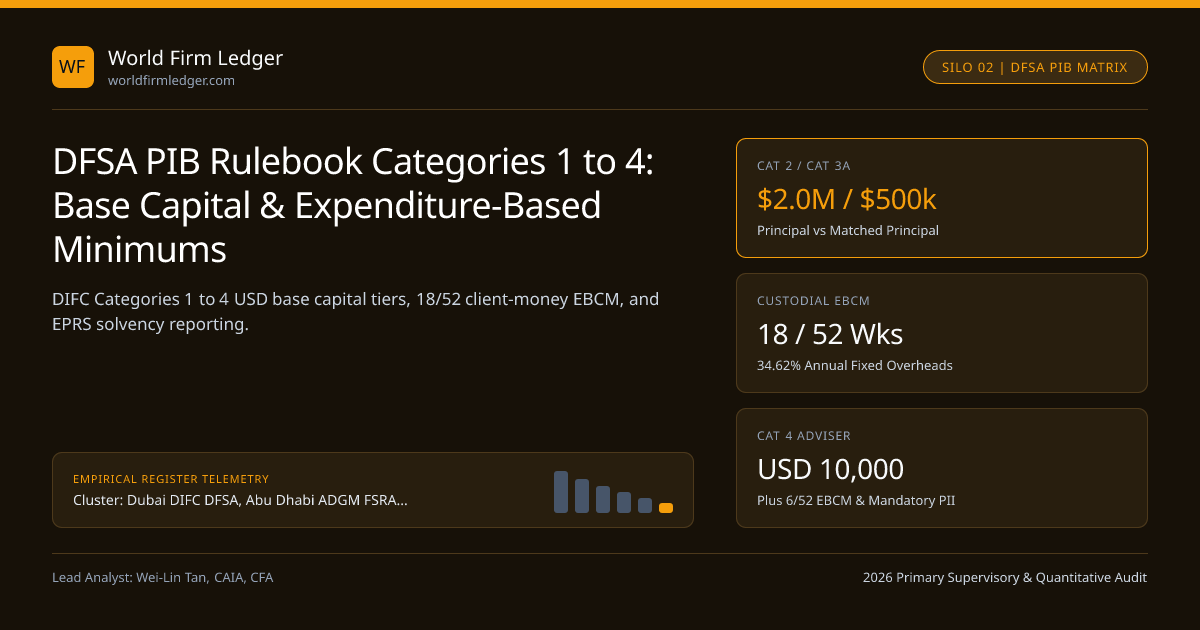
Chapter 3 of the DFSA Prudential — Investment, Insurance Intermediation and Banking (PIB) module classifies every non-insurer Authorized Firm inside the Dubai International Financial Centre into nine granular prudential categories—Categories 1, 2, 3A, 3B, 3C, 3D, 4, and 5—assigning static USD Base Capital floors from USD 10,000 up to USD 10,000,000 alongside live Expenditure-Based Capital Minimum (EBCM) fractions. Within our Gulf DFSA, ADGM, SCA & CMA licensing guide, miscalculating how EBCM overrides headline Base Capital is the leading cause of delayed authorization at the Dubai Financial Services Authority.
Complete Breakdown of DFSA Prudential Categories 1 Through 5#
Under PIB 1.3, an Authorized Firm's prudential category is dictated by its highest-risk Financial Service on its DFSA license—meaning a wealth adviser (Category 4) that adds Matched-Principal execution immediately jumps into Category 3A:
- Category 1 (USD 10,000,000 Base Capital): Accepting Deposits or Managing a Profit Sharing Investment Account (Unrestricted Islamic banking). Full Basel III CET1, Tier 1, Capital Conservation Buffer, LCR, and NSFR ratios apply.
- Category 2 (USD 2,000,000 Base Capital): Dealing in Investments as Principal (not restricted to Matched Principal—i.e., proprietary market makers warehousing B-book FX/CFD risk or bond inventory) or Providing Credit.
- Category 3A (USD 500,000 Base Capital): Dealing in Investments as Principal solely on a Matched Principal basis (examined in DFSA Category 3A matched-principal rules) OR Dealing in Investments as Agent.
- Category 3B (USD 4,000,000 Base Capital): Providing Custody for a Fund or Acting as the Trustee of a Fund, or Operating an Employee Money Purchase Scheme.
- Category 3C (USD 70,000 to USD 500,000 Base Capital): Managing Assets (discretionary portfolio management = USD 500,000), Managing a Collective Investment Fund (USD 140,000 public/domestic or USD 70,000 Exempt/Qualified Investor Fund), Providing Custody (non-fund), or Providing Trust Services.
- Category 3D (USD 200,000 to USD 500,000 Base Capital): Operating a Payment Account, Executing Payment Transactions, or Issuing Payment Instruments (Money Services).
- Category 4 (USD 10,000 Base Capital; Higher for MTF/Crowdfunding): Arranging Deals in Investments, Advising on Financial Products, Arranging Credit, or Operating an MTF/OTF (where operating a Multilateral Trading Facility carries specific 6-month operating-cost EBCM add-ons).
- Category 5 (USD 10,000,000 Base Capital): Islamic Financial Institutions managing Unrestricted Profit-Sharing Investment Accounts on a wholly Sharia basis.
The Expenditure-Based Capital Minimum (EBCM) Multiplier Trap#
Under PIB 3.7, DFSA ties ongoing solvency directly to a DIFC office's fixed burn rate—rent inside DIFC Gate Village or ICD Brookfield Place, base salaries of Senior Executive Officers (SEO), Finance Officers (FO), Compliance/MLRO staff, Bloomberg/FIX connectivity, and audit fees:
- 18/52 (34.62% of Annual Fixed Expenditure): Applies to Category 2, 3A, 3B, or 3C firms authorized to hold or control Client Assets / Client Money under DFSA COB 6.12 client money rules.
- 13/52 (25.00% of Annual Fixed Expenditure): Applies to Category 2, 3A, or 3C firms that do NOT hold or control Client Money, or Category 4 Insurance Intermediaries holding insurance monies.
- 6/52 (11.54% of Annual Fixed Expenditure): Applies to pure Category 4 Advising/Arranging firms that never touch client funds.
Even more stringent is PIB 3.5's Liquid Assets Requirement: an Authorized Firm must maintain high-quality, unencumbered liquid assets (cash or near-cash at rated banks, net of haircuts) at least equal to its EBCM at all times, ensuring an orderly 18-week DIFC wind-down without fire-selling illiquid parent receivables—a benchmark tracked across DIFC investment houses like Arqaam Group.
| DFSA PIB Category | Core Permitted Financial Activity | Static Base Capital (USD) | EBCM Fraction (With / Without Client Money) | Risk Capital (RCR) Applies? | Peer / Registry Link |
|---|---|---|---|---|---|
| Category 1 / Cat 5 | Accepting Deposits / Islamic Bank | USD 10,000,000 | Basel III LCR / NSFR Liquidity | Yes (CRCOM + MRCOM + ORCOM) | DFSA Ministry |
| Category 2 | Dealing as Principal (Market Maker) | USD 2,000,000 | 18/52 (34.6%) / 13/52 (25.0%) | Yes (Full Pillar 1 + IRAP) | DFSA Compendium |
| Category 3A | Matched Principal / Dealing as Agent | USD 500,000 | 18/52 (34.6%) / 13/52 (25.0%) | Yes (Credit + Market + Op) | Arqaam Group |
| Category 3C | Discretionary Asset / Fund Management | USD 500,000 (Assets) / $70k–$140k (Funds) | 18/52 (34.6%) / 13/52 (25.0%) | No (Base vs EBCM Governs) | ADGM FSRA Peer |
| Category 4 | Arranging Deals / Financial Advice | USD 10,000 (MTF = 6m OpEx) | N/A (Cannot Hold Client Money) / 6/52 (11.5%) | No (Plus Mandatory PII Cover) | Alfa Financials |
Modeling Three-Year DIFC Scaling: When EBCM Overtakes Base Capital#
Let us trace a DIFC brokerage scaling from a lean 5-person wholesale desk in Year 1 to a 28-person retail-endorsed regional hub in Year 3:
- BindingMCRUSD = max(PIBBaseCapitalUSD, EBCMUSD, CRCOM + MRCOM + ORCOM)
- Worked DIFC Broker Capital Escalation Audit (Category 3A Holding Client Money -> 18/52 EBCM):
- Year 1 Lean Launch: Fixed Annual Expenditure = USD 1,150,000 -> EBCM = (18/52) * 1,150,000 = USD 398,077
- RCR = USD 290,000; Base Capital = USD 500,000 -> Binding MCR = USD 500,000 (Base Capital Governs)
- Year 3 Regional Hub: Fixed Annual Expenditure = USD 5,200,000 (Excludes USD 1.4M purely discretionary variable sales bonuses)
- EBCM = (18/52) * 5,200,000 = USD 1,800,000!
- RCR = USD 1,310,000; Base Capital = USD 500,000 -> Binding MCR = USD 1,800,000 (+110% DFSA Notification Buffer Target = USD 1,980,000 CET1!)
Benchmarking EBCM Expense Multipliers Across DIFC Tiers#
Comparing 6/52, 13/52, 18/52, and 26/52 overhead lockups illustrates why liquid working-capital planning dominates DIFC prudential compliance.
Electronic Prudential Reporting System (EPRS) & Pillar 2 Overlays#
Every quarter (or monthly for Category 1/2), the DIFC Finance Officer submits XBRL returns through DFSA's Electronic Prudential Reporting System (EPRS), attested annually by a DFSA-registered external audit firm. Moreover, under DFSA IRAP and ICAAP Pillar 2 supervisory reviews, the regulator regularly imposes bespoke Individual Capital Requirements (ICR) above MCR across our Gulf regulatory licensing topic hub.
Frequently asked questions
Can a DIFC Category 4 firm with USD 10,000 capital accept client trading deposits and forward them to an offshore broker?
No. Category 4 Arranging/Advising firms are strictly prohibited from holding or controlling Client Money (except narrow Insurance Intermediation accounts); clients introduced by a Category 4 DIFC firm must wire margin directly to the regulated executing broker.
Why does DFSA require unencumbered liquid assets equal to EBCM in addition to CET1 equity?
A firm could theoretically hold USD 2M in CET1 equity tied up in long-term illiquid equipment or group loans; PIB’s Liquid Assets rule ensures cash at rated banks remains immediately available to pay 13 to 18 weeks of DIFC wind-down salaries and rent.
Which DFSA category covers discretionary wealth managers versus hedge fund managers in DIFC?
Both sit inside Category 3C, but Managing Assets (discretionary client portfolios) carries a USD 500,000 base capital floor, whereas Managing a Collective Investment Fund carries USD 140,000 for Public Funds or USD 70,000 exclusively for Exempt/Qualified Investor Funds.
Do DIFC Category 3A and Category 4 firms need Professional Indemnity Insurance (PII)?
Yes. Under PIB Chapter 4/6, Category 3 and Category 4 Authorized Firms must maintain continuous Professional Indemnity Insurance from a reputable insurer covering civil liability claims arising from negligent advice or execution errors.
Publication record
- Published
- 14 November 2026
- Updated
- 16 November 2026
- Author
- Wei-Lin Tan, CAIA, CFA
- Review
- Review not recorded
- Automated fact check
- Passed in the stored pipeline record
- Source URLs
- 3 recorded
AI assistance recorded: anthropic/claude-opus-4.6. This field does not establish human review or source verification.
Academic & Institutional Attribution
Cite This Research & Embed Live Data Card
Standard academic & institutional research paper citation format.
Wei-Lin Tan, CAIA, CFA. (2026, November 16). DFSA PIB Rulebook Categories 1 to 4: Base Capital & Expenditure-Based Minimums. World Firm Ledger. https://worldfirmledger.com/almanac/dfsa-pib-category-1-2-3a-3c-4-base-capital-ebcm-matrixRegulatory Directory Cross-Reference
Referenced Institutions & Regulatory Registries
Top Regulated Institutions in This Coverage Slice
Related Difc Dfsa Adgm Fsra Gulf Categories & Institutional Briefings
Explore Difc Dfsa Adgm Fsra Gulf Categories Hub (20) →Difc Dfsa Adgm Fsra Gulf Categories
Gulf Financial Licensing Guide: DIFC DFSA, ADGM FSRA, UAE SCA & Saudi CMADifc Dfsa Adgm Fsra Gulf Categories
DFSA Category 3A Matched Principal Dealing: USD 500k Capital & Risk SlippageDifc Dfsa Adgm Fsra Gulf Categories
DFSA Retail Client Endorsement: COB Leverage Caps, Negative Balance & Close-OutDifc Dfsa Adgm Fsra Gulf Categories
DFSA Professional Client Classification: USD 1M Liquid Assets & Opt-Up AuditsDifc Dfsa Adgm Fsra Gulf Categories
DFSA Client Money Provisions: COB Chapter 6 Segregation & Daily ReconciliationDifc Dfsa Adgm Fsra Gulf Categories
ADGM FSRA Financial Services Permission: Dealing as Principal vs Agent PRU RulesDifc Dfsa Adgm Fsra Gulf Categories
ADGM FSRA Virtual Asset Framework: MTF Matching, Accepted Assets & Custody CapitalDifc Dfsa Adgm Fsra Gulf Categories
Onshore UAE SCA Category 1 Dealing vs Category 5 Financial Promotion & FinfluencersSouth Africa Fsca Fais Odp Licensing
South Africa FMA ODP License: Conduct Standard 1 & ZAR 50M+ Liquid Capital RulesSouth Africa Fsca Fais Odp Licensing
FSCA & Prudential Authority Joint Standard 2: OTC Derivative Margin RulesSouth Africa Fsca Fais Odp Licensing
FSCA FAIS Sub-Category 1.25 (Derivatives) & 1.26 (Crypto Assets) CASP RulesSouth Africa Fsca Fais Odp Licensing
FSCA FAIS Category II Discretionary FSP: Copy-Trading, PAMM & MAM Rules
World Firm Ledger Data, Benchmarks & Contributor Records
CC BY 4.0 Open Data
Open Institutional Datasets (CSV / JSON) →
Download desk-compiled quantitative series & schemas.
2026 Reference Matrix
2026 Institutional Benchmarks & Thresholds →
Statutory capital, clearing, margin & rate conventions.
Editorial Records
Authors & Review Records →
View named contributors where those records are available.
Complete Index
Master Research & Dossier Archive →
Browse all published briefings by topic pillar & date.