
Difc Dfsa Adgm Fsra Gulf Categories
DFSA Category 3A Matched Principal Dealing: USD 500k Capital & Risk Slippage
Under Dubai DFSA GEN Rule 2.7 and PIB Category 3A, DIFC brokers save USD 1.5M in base capital over Category 2 only if every principal FX or CFD trade offsets simultaneously back-to-back.
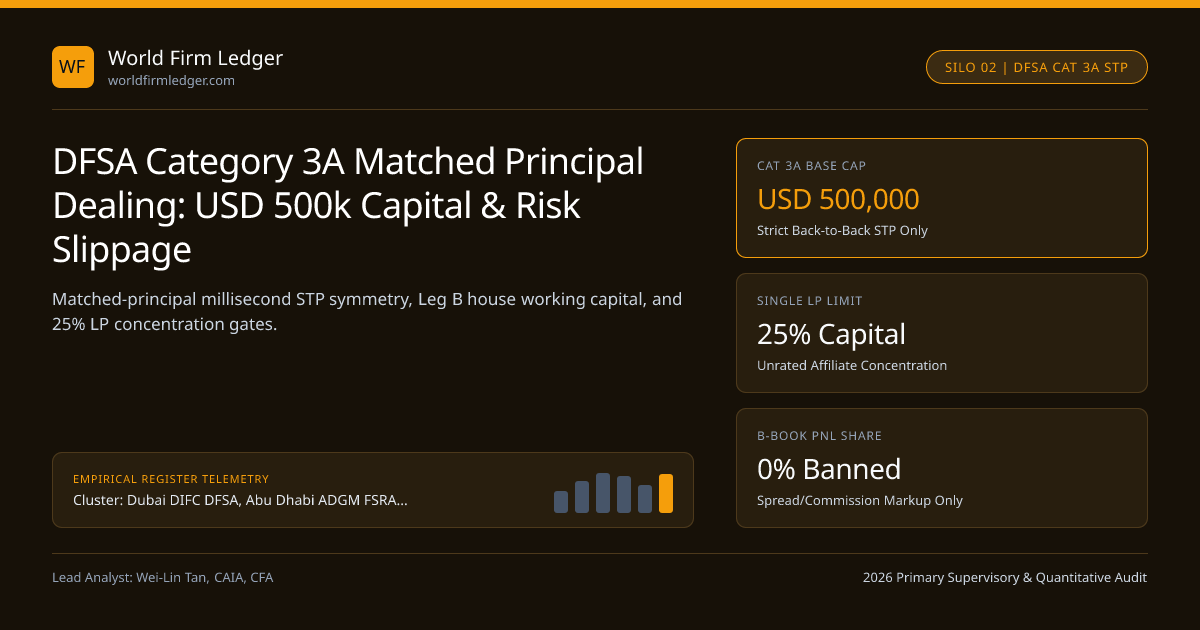
Under DFSA General (GEN) Module Rule 2.7 and PIB Category 3A, global forex and contract-for-difference groups establishing a Dubai International Financial Centre hub can operate with a USD 500,000 Base Capital Requirement—saving USD 1,500,000 compared with Category 2's USD 2,000,000 floor—on one ironclad statutory condition: every single principal transaction entered into with a client must be simultaneously offset back-to-back with a liquidity provider so the DIFC entity assumes zero proprietary market risk (other than settlement/counterparty default risk). Within our Gulf DFSA, ADGM, SCA & CMA licensing guide, supervisory audits by the Dubai Financial Services Authority intensely scrutinize bridge logs (OneZero, PrimeXM, Gold-i) to catch Category 3A brokers secretly running B-book warehouse buckets!
Three Mandatory Conditions of "Matched Principal" Under DFSA GEN#
Unlike pure agency brokers (who match client directly to exchange in the client's name), a Matched Principal broker stands legally as counterparty between the client on Leg A and the liquidity provider (often an investment bank or regulated London/Sydney group affiliate) on Leg B. To stay inside Category 3A mapped in our DFSA PIB Category 1 to 4 base capital matrix, three technical symmetries must hold on 100% of executed tickets:
- Substantially Simultaneous Execution: Leg B (the offsetting hedge) must fire automatically in milliseconds upon Leg A client order fill via straight-through-processing (STP) routing—never batched at end-of-day, netted across opposite retail orders internally for hours, or delayed by dealer discretion.
- Exact Instrument, Quantity, and Maturity Symmetry: If a client buys 3.5 lots of XAU/USD on Leg A, the liquidity bridge must buy 3.5 lots of XAU/USD on Leg B; partial delta hedging or cross-asset correlation hedging violates Matched Principal conditions and constitutes unlicensed Category 2 market making!
- Remuneration Confined to Disclosed Markup or Commission: The DIFC entity's revenue must derive purely from transparent bid/ask spread markups or per-lot commissions between Leg A and Leg B—never from directional client trading losses ("PnL sharing" agreements with an offshore B-book parent!).
The "Affiliate Liquidity Provider" Counterparty Risk Trap (CRCOM)#
Many international brokerage groups route 100% of their DIFC Category 3A STP flow to their own UK FCA, Australian ASIC, or Cypriot parent entity acting as sole Liquidity Provider (LP). While legally permissible if priced at arm's length without back-door B-book profit-and-loss transfers, DFSA's Credit Risk Capital Component (CRCOM) and Large Exposure limits create an acute capital trap:
- Margin cash posted by the DIFC Category 3A broker in a corporate hedge account at an unrated non-bank brokerage affiliate attracts a far steeper credit risk weight (often *100% risk weight 8%–10% capital charge, or full Large Exposure concentration deductions above 25% of Capital Resources**) than margin held at an investment-grade rated Tier-1 prime bank (20% risk weight)!
- Furthermore, under DFSA COB 6.12 client money segregation rules, retail Client Money cannot be swept wholesale into an offshore affiliate's general house account to fund the DIFC firm's own LP margin—the DIFC broker must post its own corporate liquidity to margin Leg B at the LP!
| Execution Parameter | DFSA Cat 3A (Matched Principal) | DFSA Cat 2 (Full Principal / Market Maker) | ADGM FSRA Cat 3A (Matched Principal) | Regional Cohort / Link |
|---|---|---|---|---|
| Base Capital Floor | USD 500,000 | USD 2,000,000 | USD 500,000 | DFSA Ministry |
| Internal Order Crossing / B-Book | Strictly Prohibited | Permitted (Subject to MRCOM Charges) | Strictly Prohibited | ADGM FSRA |
| LP Reject / Out-of-Sync Residual | Incidental Tech Error Only (Must Flatten) | Permitted Within Risk Appetite | Must Flatten Promptly & Log | 365falcon |
| Affiliate LP PnL Revenue Share | Banned (Disguised Market Making) | N/A (Direct Balance Sheet PnL) | Banned Under FSRA PRU/COB | Aimsprime |
| Leg B LP Margin Funding Source | DIFC Firm’s Own Corporate Cash | DIFC Firm’s Own Corporate Cash | ADGM Firm’s Own Corporate Cash | Arqaam Group |
Modeling Working-Capital & CRCOM Needs for Leg B Liquidity Hedging#
CFOs budgeting a DIFC Category 3A launch often fund USD 750,000 in equity—forgetting they also need USD 1.5M–3.0M in unencumbered house working capital to post institutional margin at their Leg B Prime-of-Prime LP when clients all go net long Gold simultaneously!
- AffiliateLPCRCOMCharge = 0.08 * RiskWeightLP * (PostedLPHouseMargin + UnrealizedLegBMTM_Receivable)
- ConcentrationBreach = (TotalAffiliateLPExposure / DIFCEligibleCapital_Resources) > 0.25
- Worked DIFC Cat 3A Gold Surge Liquidity Stress Test:
- Retail & Pro Clients hold USD 45,000,000 net long XAU/USD (Client Money locked safely in Emirates NBD / FAB COB 6.12 Trust Account)
- Leg B Institutional LP Margin Rate (5.0% Gold Prime-of-Prime) -> RequiredLPHouse_Margin = 45,000,000 * 0.05 = USD 2,250,000 corporate cash!
- If LP is an unrated offshore sister broker (100% risk weight) and DIFC Capital = USD 1,800,000:
- Exposure Ratio = 2,250,000 / 1,800,000 = 125% (> 25% Large Exposure Cap -> Requires DFSA Waiver/Parental Guarantee or Multi-Bank Rated LPs!)
Straight-Through Processing Controls and Residual Risk Buffers#
Auditing back-to-back trade timestamps, liquidity-provider credit exposures, and operational risk charges verifies genuine Category 3A matched-principal execution.
Handling Broken Bridges and Asymmetric Slippage Enforcement#
What happens if Leg A fills a client on a "Last Look" quote, and 40 milliseconds later the Tier-1 bank rejects Leg B? DFSA permits pre-execution STP ("A-to-B before confirming A") so Leg A fills only after Leg B confirms; if post-fill rejection creates an accidental unmatched position, compliance logs must record immediate automated market flattening and zero pattern of asymmetric slippage—standards reinforced across DFSA IRAP supervisory reviews and our Gulf regulatory licensing topic hub.
Frequently asked questions
Can a DIFC Category 3A broker net buying and selling retail orders internally for 10 minutes before hedging the residual?
No. Internalized order crossing or time-delayed batch netting exposes the firm to intraday proprietary price risk and violates DFSA GEN Matched Principal conditions, requiring an upgrade to a USD 2,000,000 Category 2 Principal license.
May a DIFC Category 3A broker use segregated retail Client Money to post margin with its institutional Liquidity Provider?
Under DFSA COB Client Money rules, retail segregated funds cannot be transferred into an omnibus house margin account at an unregulated or affiliate LP to finance the broker’s own Leg B principal obligations; house working capital must fund LP margin.
How does DFSA detect whether a Category 3A broker is secretly running a B-book via an offshore sister company?
DFSA supervisors inspect PrimeXM/OneZero bridge routing rules, timestamped Leg A vs Leg B trade tickets, intercompany service/marketing invoices, and group transfer-pricing agreements for hidden PnL kickbacks correlated with client losses.
When does it make financial sense for a DIFC broker to upgrade from Category 3A ($500k) to Category 2 ($2M)?
Once annual DIFC fixed overheads exceed ~USD 5.8 million, the 18/52 EBCM requirement ($2.0M+) already exceeds Category 2’s USD 2,000,000 base capital floor—making a Category 2 upgrade capital-efficient to internalize natural client order flow legally.
Publication record
- Published
- 14 November 2026
- Updated
- 16 November 2026
- Author
- Wei-Lin Tan, CAIA, CFA
- Review
- Review not recorded
- Automated fact check
- Passed in the stored pipeline record
- Source URLs
- 3 recorded
AI assistance recorded: anthropic/claude-opus-4.6. This field does not establish human review or source verification.
Academic & Institutional Attribution
Cite This Research & Embed Live Data Card
Standard academic & institutional research paper citation format.
Wei-Lin Tan, CAIA, CFA. (2026, November 16). DFSA Category 3A Matched Principal Dealing: USD 500k Capital & Risk Slippage. World Firm Ledger. https://worldfirmledger.com/almanac/dfsa-category-3a-matched-principal-fx-cfd-capital-bufferRegulatory Directory Cross-Reference
Referenced Institutions & Regulatory Registries
Top Regulated Institutions in This Coverage Slice
Related Difc Dfsa Adgm Fsra Gulf Categories & Institutional Briefings
Explore Difc Dfsa Adgm Fsra Gulf Categories Hub (20) →Difc Dfsa Adgm Fsra Gulf Categories
Gulf Financial Licensing Guide: DIFC DFSA, ADGM FSRA, UAE SCA & Saudi CMADifc Dfsa Adgm Fsra Gulf Categories
DFSA Retail Client Endorsement: COB Leverage Caps, Negative Balance & Close-OutDifc Dfsa Adgm Fsra Gulf Categories
DFSA Professional Client Classification: USD 1M Liquid Assets & Opt-Up AuditsDifc Dfsa Adgm Fsra Gulf Categories
DFSA Client Money Provisions: COB Chapter 6 Segregation & Daily ReconciliationDifc Dfsa Adgm Fsra Gulf Categories
ADGM FSRA Financial Services Permission: Dealing as Principal vs Agent PRU RulesDifc Dfsa Adgm Fsra Gulf Categories
ADGM FSRA Virtual Asset Framework: MTF Matching, Accepted Assets & Custody CapitalDifc Dfsa Adgm Fsra Gulf Categories
Onshore UAE SCA Category 1 Dealing vs Category 5 Financial Promotion & FinfluencersDifc Dfsa Adgm Fsra Gulf Categories
DIFC & ADGM Onshore Boundary: AED Dirham Clearing & CBUAE Ring-Fencing RulesSouth Africa Fsca Fais Odp Licensing
FSCA & Prudential Authority Joint Standard 2: OTC Derivative Margin RulesSouth Africa Fsca Fais Odp Licensing
FSCA FAIS Sub-Category 1.25 (Derivatives) & 1.26 (Crypto Assets) CASP RulesSouth Africa Fsca Fais Odp Licensing
FSCA FAIS Category II Discretionary FSP: Copy-Trading, PAMM & MAM RulesSouth Africa Fsca Fais Odp Licensing
FSCA Section 13 Juristic Representatives: White-Label License Rental Risks
World Firm Ledger Data, Benchmarks & Contributor Records
CC BY 4.0 Open Data
Open Institutional Datasets (CSV / JSON) →
Download desk-compiled quantitative series & schemas.
2026 Reference Matrix
2026 Institutional Benchmarks & Thresholds →
Statutory capital, clearing, margin & rate conventions.
Editorial Records
Authors & Review Records →
View named contributors where those records are available.
Complete Index
Master Research & Dossier Archive →
Browse all published briefings by topic pillar & date.