
Difc Dfsa Adgm Fsra Gulf Categories
DFSA IRAP & ICAAP Pillar 2 Add-Ons: Supervisory Capital Buffers for DIFC Brokers
Under Chapter 10 of the DFSA PIB Rulebook, DIFC Category 2 and 3A brokers must submit annual board-approved IRAP and ICAAP stress models that frequently trigger Individual Capital Requirements.
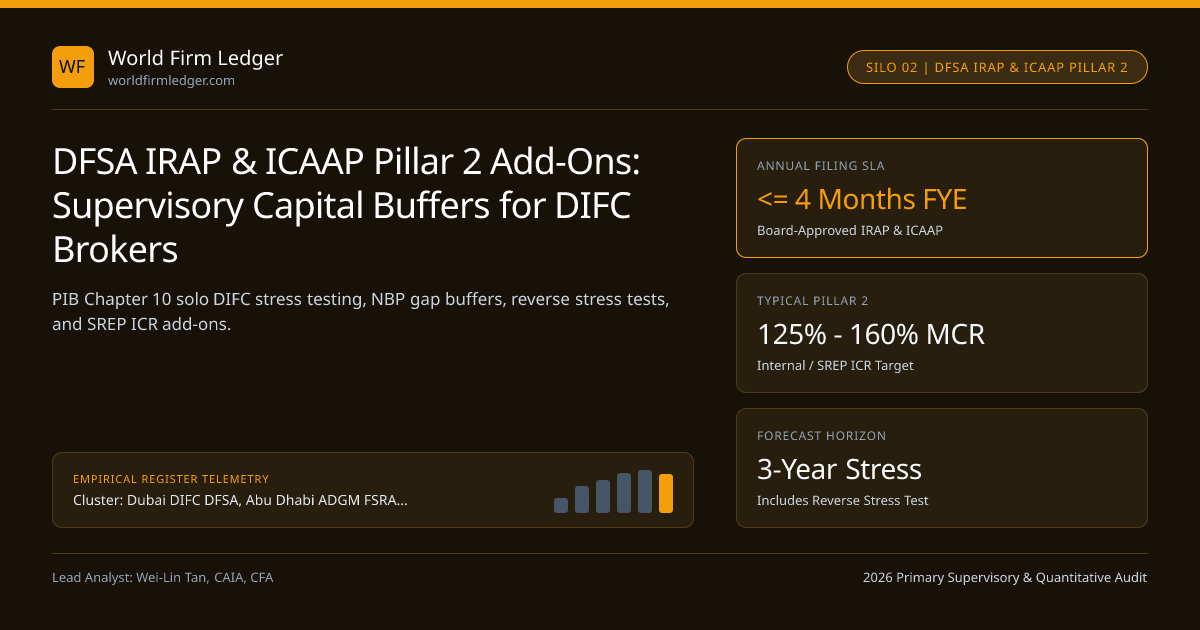
Meeting the Pillar 1 Minimum Capital Requirement mapped in our DFSA PIB Category 1 to 4 base capital matrix satisfies only the baseline statutory formula inside the Dubai International Financial Centre. Under Chapter 10 of the DFSA PIB Module (aligned with Bank for International Settlements Basel Pillar 2 supervisory review principles), every Category 1, 2, 3A, 3B, and 3C Authorized Firm must conduct a rigorous annual Internal Risk Assessment Process (IRAP)—and, for Category 1, 2, and 3A firms, an Internal Capital Adequacy Assessment Process (ICAAP)—documented in writing, signed off formally by the Governing Body (Board), and submitted to the Dubai Financial Services Authority within 4 months of financial year-end! Within our Gulf DFSA, ADGM, SCA & CMA licensing guide, Pillar 2 supervisory add-ons routinely raise a DIFC broker's binding capital floor 25% to 60% above Pillar 1!
Distinguishing IRAP from ICAAP Across DIFC Categories#
New DIFC Finance Officers frequently confuse the two overlapping annual PIB Chapter 10 filings:
- IRAP (Internal Risk Assessment Process — Mandatory for Cat 1, 2, 3A, 3B, 3C, 3D): Forces the Board and Senior Executive Officer to identify, quantify, and stress-test every material risk facing the DIFC firm—specifically risks under-captured or omitted by Pillar 1 formulas, including group contagion risk (if an offshore sister broker fails), single Liquidity Provider bridge failure (critical in DFSA Category 3A matched-principal setups), cyber/ransomware extortion, key-man reliance, legal/mis-selling claims, and disorderly wind-down costs.
- ICAAP (Internal Capital Adequacy Assessment Process — Mandatory for Cat 1, 2, and 3A): Translates those IRAP risk findings into hard forward-looking 3-year capital projections and severe-but-plausible stress scenarios (such as a 50% revenue collapse combined with a CHF/Gold gap event triggering DFSA COB 6.16 Negative Balance Protection write-offs!), proving how much internal Pillar 2 capital buffer the firm must hold above Pillar 1 MCR.
When Does DFSA Impose a Binding Individual Capital Requirement (ICR)?#
Following receipt of a firm's ICAAP and completion of DFSA's Supervisory Review and Evaluation Process (SREP), PIB Rule 10.5 empowers the DFSA to impose a legally binding Individual Capital Requirement (ICR) whenever Pillar 1 MCR inadequately reflects the firm's actual risk profile. Four concrete triggers provoke steep ICR multipliers across DIFC and parallel ADGM FSRA PRU reviews:
- Retail Negative Balance Gap Exposure: High retail Gold (
XAU/USD) or Nas100 open notional relative to house equity, where a 4% weekend price gap leaves the DIFC broker absorbing retail NBP losses while owing full Variation Margin on Leg B to its Prime-of-Prime LP! - 100% Reliance on a Single Group Affiliate LP: Concentrating execution, technology licensing, and bridge liquidity inside one parent group creates acute operational and credit contagion.
- Weak Governance or Repeat Compliance Remediation: Late EPRS returns, under-resourced Compliance/MLRO teams, or prior DFSA COB 6.12 client money reconciliation discrepancies.
- Unrealistic Wind-Down Cost Assumptions: Assuming leases, 3-month UAE labor notice periods, IT contract break clauses, and client asset return audits cost less than 18/52 EBCM when actual contractual break penalties exceed 6 months of burn.
| Risk Vector Audited in SREP | Pillar 1 Treatment (PIB Ch. 3–6) | Pillar 2 ICAAP Stress Requirement | Typical DFSA ICR Add-On Impact | Peer / Reference Link |
|---|---|---|---|---|
| Retail Statutory NBP Gap Loss | Not explicitly priced in Cat 3A Base | Stress 4%–8% FX/Gold gap vs Leg B LP call | +USD 300k – USD 1.5M+ CET1 Buffer | DFSA Ministry |
| Single Affiliate LP Contagion | Capped by 25% Large Exposure / CRCOM | Model 30-day affiliate LP freeze & re-routing | +15%–30% ICR Multiplier until diversified | Arqaam Group |
| Disorderly Wind-Down Costs | Proxied by 13/52 or 18/52 EBCM | Line-by-line DIFC lease + EOSB severance | Raises floor to Full Wind-Down Cost | DFSA Compendium |
| Cyber / Bridge Outage Liability | Basic ORCOM (Cat 1/2/3A formula) | Quantify ransomware, client redress & fines | Supervisory Operational Add-On | ADGM FSRA |
Modeling a Multi-Factor ICAAP Stress Test & Binding ICR Calculation#
Below is an institutional ICAAP stress-test framework for a Retail-Endorsed DIFC Category 3A broker holding USD 2,400,000 in CET1 equity against a USD 1,440,000 Pillar 1 EBCM floor:
- ICRComplianceHeadroom = ActualHeldCET1Capital - max(DFSAImposedICR, InternalBoardICAAPTarget)
- Worked DIFC Cat 3A Combined Revenue-Drop + Gold Gap ICAAP Scenario (USD):
- Pillar1_MCR (18/52 EBCM on $4.16M fixed overheads) = USD 1,440,000
- Contractual Wind-Down Audit (6m Gate Village lease penalty + UAE End-of-Service Gratuity + Audit) = USD 1,690,000 -> WindDown_Excess = +USD 250,000
- Severe 5% Weekend XAU/USD Gap NBP Client Absorption (Net of 50% margin) = +USD 380,000
- 12-Month 45% Volume Drop Operating Deficit (After cutting discretionary ads) = +USD 210,000
- TotalPillar2StressedCapitalNeed = 1,440,000 + 250,000 + 380,000 + 210,000 = USD 2,280,000 (158.3% of Pillar 1 MCR!)
- ActualHeldCET1_Capital = USD 2,650,000 -> Post-Stress Headroom = +USD 370,000 (Passes Board ICAAP & SREP!)
Supervisory Pillar 2 Capital Add-Ons Above Minimum Thresholds#
Tracking how concentration, negative-balance gap risk, and governance findings elevate binding Individual Capital Requirements completes DIFC solvency due diligence.
Reverse Stress Testing & Solo DIFC Entity Ring-Fencing#
Crucially, DFSA rejects copy-pasted London or Sydney Group ICAAP PDFs that fail to model the solo DIFC subsidiary on a standalone basis—and requires Reverse Stress Testing identifying the exact failure event (such as parent bankruptcy or loss of primary USD correspondent bank) that renders the DIFC business model non-viable, crowning prudential governance across our Gulf regulatory licensing topic hub.
Frequently asked questions
Do DIFC Category 3A Matched-Principal brokers have to submit a full ICAAP even though they don’t run a B-book?
Yes. Under DFSA PIB Chapter 10, Category 3A firms are subject to both IRAP and ICAAP because matched-principal brokers still face acute Liquidity Provider counterparty risk, bridge failure risk, retail Negative Balance Protection gap losses, and wind-down liabilities.
Can a DIFC subsidiary rely on its UK FCA parent’s Group ICAAP instead of writing a local DIFC ICAAP?
No. Unless specific written DFSA modification/consolidation relief is granted, every DIFC Authorized Firm must prepare a standalone solo IRAP/ICAAP calibrated specifically to DIFC balance-sheet cash, UAE labor/lease wind-down laws, and parent-contagion scenarios.
What is Reverse Stress Testing inside a DFSA or ADGM ICAAP submission?
Reverse Stress Testing starts from the assumed outcome of business failure or regulatory breach (Point of Non-Viability) and works backward to identify which specific combination of events—such as an LP default plus banking loss—would break the firm, testing management’s recovery triggers.
Is a DFSA Individual Capital Requirement (ICR) published publicly on the DFSA Register?
Individual Capital Requirements set during confidential SREP supervisory letters are generally supervisory parameters between the DFSA and the firm, though failure to maintain capital above an imposed ICR triggers formal enforcement action.
Publication record
- Published
- 14 November 2026
- Updated
- 16 November 2026
- Author
- Wei-Lin Tan, CAIA, CFA
- Review
- Review not recorded
- Automated fact check
- Passed in the stored pipeline record
- Source URLs
- 3 recorded
AI assistance recorded: anthropic/claude-opus-4.6. This field does not establish human review or source verification.
Academic & Institutional Attribution
Cite This Research & Embed Live Data Card
Standard academic & institutional research paper citation format.
Wei-Lin Tan, CAIA, CFA. (2026, November 16). DFSA IRAP & ICAAP Pillar 2 Add-Ons: Supervisory Capital Buffers for DIFC Brokers. World Firm Ledger. https://worldfirmledger.com/almanac/dfsa-irap-icaap-internal-capital-pillar-2-supervisoryRegulatory Directory Cross-Reference
Referenced Institutions & Regulatory Registries
Top Regulated Institutions in This Coverage Slice
Related Difc Dfsa Adgm Fsra Gulf Categories & Institutional Briefings
Explore Difc Dfsa Adgm Fsra Gulf Categories Hub (20) →Difc Dfsa Adgm Fsra Gulf Categories
Gulf Financial Licensing Guide: DIFC DFSA, ADGM FSRA, UAE SCA & Saudi CMADifc Dfsa Adgm Fsra Gulf Categories
DFSA PIB Rulebook Categories 1 to 4: Base Capital & Expenditure-Based MinimumsDifc Dfsa Adgm Fsra Gulf Categories
DFSA Category 3A Matched Principal Dealing: USD 500k Capital & Risk SlippageDifc Dfsa Adgm Fsra Gulf Categories
DFSA Retail Client Endorsement: COB Leverage Caps, Negative Balance & Close-OutDifc Dfsa Adgm Fsra Gulf Categories
DFSA Professional Client Classification: USD 1M Liquid Assets & Opt-Up AuditsDifc Dfsa Adgm Fsra Gulf Categories
DFSA Client Money Provisions: COB Chapter 6 Segregation & Daily ReconciliationDifc Dfsa Adgm Fsra Gulf Categories
ADGM FSRA Financial Services Permission: Dealing as Principal vs Agent PRU RulesDifc Dfsa Adgm Fsra Gulf Categories
ADGM FSRA Virtual Asset Framework: MTF Matching, Accepted Assets & Custody CapitalJapan Fsa Fibo Margin Segregation
Japan FIEA Article 28: Type I vs Type II FIBO Registration & JPY 50M CapitalJapan Fsa Fibo Margin Segregation
Japan FIBO Article 46-6 Capital Adequacy Ratio: 140%, 120% & 100% TriggersJapan Fsa Fibo Margin Segregation
Japan Kanzen Shintaku Hozen: Mandatory Domestic Trust-Bank Client SegregationJapan Fsa Fibo Margin Segregation
Japan Retail FX 4% Margin (25:1 Cap), Loss-Cut Rule & Zero-Cut Prohibition
World Firm Ledger Data, Benchmarks & Contributor Records
CC BY 4.0 Open Data
Open Institutional Datasets (CSV / JSON) →
Download desk-compiled quantitative series & schemas.
2026 Reference Matrix
2026 Institutional Benchmarks & Thresholds →
Statutory capital, clearing, margin & rate conventions.
Editorial Records
Authors & Review Records →
View named contributors where those records are available.
Complete Index
Master Research & Dossier Archive →
Browse all published briefings by topic pillar & date.