
Japan Fsa Fibo Margin Segregation
FFAJ Monthly OTC FX Statistical Bulletins: Auditing Unpaid Loss-Cut Shortfalls
Every month, the Financial Futures Association of Japan publishes G7’s most granular OTC currency market dataset, tracking quadrillion-Yen retail turnover and exact post-Loss-Cut customer deficits.
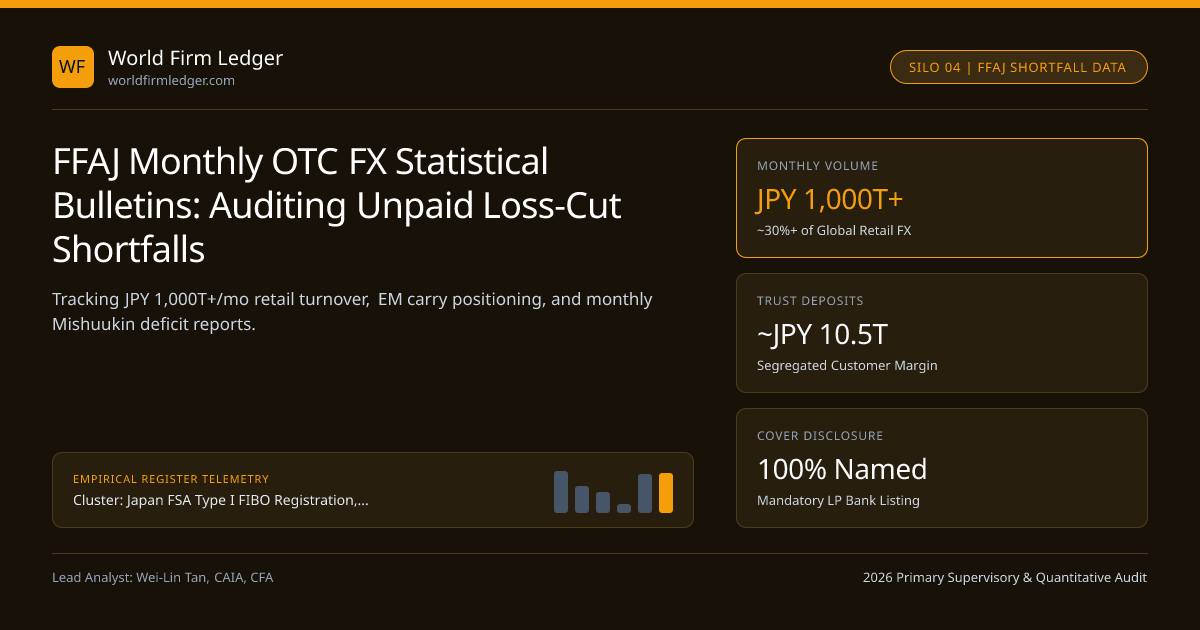
Institutional macro hedge funds in New York and London refresh one public Japanese dataset every single month to track "Mrs. Watanabe" carry positioning: the Monthly Statistical Bulletin on Over-the-Counter Retail FX Margin Trading published by the Financial Futures Association of Japan (FFAJ) under supervision of the Japan FSA! Within our Japan FSA Type I FIBO & trust segregation guide, FFAJ's mandatory reporting regime goes far beyond aggregate trading volume—it publishes the exact monthly count and Yen total of Uncollected Customer Margin Shortfalls (Rosukatto to Mishaishuukin / Mishuukin) across all ~50 OTC FX members, empirically proving how well Japan's 25:1 margin and automated Loss-Cut engines absorb central bank shocks!
Four Institutional Datasets Published Monthly by FFAJ#
Every registered Japanese Type I FIBO executing OTC FX submits granular end-of-month XML telemetry to FFAJ, which aggregates and releases four market-moving tables around the 10th business day of the following month:
- Total Trading Volume & Pair-by-Pair Share (Torihiki Kingaku): Frequently hitting JPY 800 trillion to JPY 1,500+ trillion per single month (~USD 5.3 trillion to USD 10.0 trillion/month!), dominated 75%–85% by USD/JPY, followed by GBP/JPY, EUR/JPY, AUD/JPY, EUR/USD, MXN/JPY, ZAR/JPY, and TRY/JPY!
- Long vs Short Open Interest by Currency Pair (Tategyoku Zandaka): Reveals exact net retail carry positioning (for example, net long billions of Mexican Pesos and Turkish Lira against short Japanese Yen) ahead of Bank of Japan Monetary Policy Meetings!
- Total Segregated Customer Margin Deposits (Azukari Shokokin Zandaka): Tracks the JPY 9.5 trillion to JPY 11.0+ trillion (~USD 65B–72B) sitting safely inside domestic Japanese Trust Banks across individual and corporate accounts!
- Monthly Uncollected Loss-Cut Shortfalls (Mishuukin Hassei Jokyo): Separately breaks out Individual vs Corporate occurrence counts and exact Yen deficit amounts whenever flash crashes or weekend openings breach JPY 0 before Loss-Cut fills!
What FFAJ Shortfall Data Proves About Calm Months vs Flash-Crash Months#
Because FIEA Article 39 bans Zero-Cut forgiveness, FFAJ's public Mishuukin bulletin provides an unvarnished real-world laboratory of tail-risk slippage:
- In Ordinary Months: Across more than 800,000+ active trading accounts clearing JPY 1,000 trillion/month, total unpaid shortfalls routinely register at only 30 to 250 incidents nationwide, totaling mere tens of millions of Yen (~0.0002% of segregated customer deposits!)—confirming that 4% initial margin + 50%–100% Loss-Cut stops 99.98% of losses well above zero!
- During Extreme Macro Dislocations (e.g., Jan 2019 Apple/Yen Thin-Liquidity Flash Crash or Aug 2024 BoJ Carry Unwind): Shortfall incidents temporarily jump into the thousands of accounts totaling JPY 1.5 billion to JPY 5.0+ billion, disproportionately concentrated in illiquid early-morning Sydney rollover windows (06:50–07:15 JST) on high-carry TRY/JPY, ZAR/JPY, and USD/JPY positions!
| Regulatory Transparency Metric | Japan — FFAJ / JFSA | Europe / UK — ESMA / FCA | US — CFTC Retail FX (FCM/RFED) | Offshore Unregulated | Reference |
|---|---|---|---|---|---|
| Pair-by-Pair Monthly Volume Published? | Yes (Exact JPY per Currency Pair) | No (Internal MiFIR Only) | No | Zero | FFAJ Portal |
| Long vs Short Retail Open Interest? | Yes (Monthly Public Table) | Broker Client Sentiment % Only | Weekly CFTC COT (Futures) | Zero | JFSA Ministry |
| Total Customer Deposits Published? | Yes (~JPY 10.5 Trillion Tracked) | No | Yes! Monthly CFTC FCM Retail FX Table | Zero | JFSA Compendium |
| Post-Stop-Out Negative Deficits Logged? | Yes (Exact Count & JPY Individual/Corp!) | Absorbed Silently via NBP | Tracked via RFED Net Capital | Hidden / Disputed | Datasets Hub |
Quantitative Systemic Stress Ratio: Measuring Mishuukin Against Broker CAR & Deposits#
Credit analysts at interbank prime brokers extending USD/JPY liquidity lines to Tokyo Type I FIBOs track two key FFAJ ratios to ensure uncollected retail flash-crash debts never threaten broker solvency:
- BrokerEquityAbsorptionRatio = FirmUncollectedCustomerReceivablesJPY / FirmUnfixedNetCapital_JPY
- Worked August Carry-Unwind Stress Audit Across FFAJ Industry & Sample Broker:
- Total Segregated FFAJ Customer Deposits = JPY 10,600,000,000,000 (JPY 10.6 Trillion)
- Severe BoJ Rate-Hike Volatility Month Industry Uncollected Shortfalls = JPY 2,650,000,000 (Across Individual + Corporate)
- SystemicDepositShortfall_Rate = (2.65B / 10,600B) * 10,000 = 2.50 bps (0.025% of Industry Deposits!)
- Note on FIEA Article 46-6 CAR Treatment:
- Any uncollected customer Mishuukin receivable remaining unpaid becomes a Deducted / 100%-Risk-Weighted Doubtful Asset in the Broker's CAR calculation, incentivizing tight pre-weekend margin hikes on TRY/JPY and ZAR/JPY!
Why Macro Traders Watch FFAJ's MXN/JPY, ZAR/JPY, and TRY/JPY Carry Tables#
Because Japanese domestic bank deposits historically yielded near 0.0%–0.5%, Japanese households hold massive structural long carry positions in high-yielding emerging-market currencies (MXN/JPY, ZAR/JPY, TRY/JPY) documented across institutional datasets. Whenever FFAJ's monthly Open Interest table shows MXN/JPY or ZAR/JPY retail long positioning hitting multi-year extremes, institutional FX desks brace for cascading automated Loss-Cut stop runs during risk-off Yen rallies!
Mandatory Disclosure of Upstream Interbank Cover Counterparties (Kaba Torihikisaki)#
Alongside FFAJ's industry statistics, FIEA conduct rules require every Japanese OTC FX broker to explicitly list by legal name every domestic and foreign bank or liquidity provider (e.g., JPMorgan, Citibank, UBS, Goldman Sachs, MUFG, Nomura) serving as its upstream FX cover counterparty inside its statutory Pre-Contract Document (Keiyaku Teiketsu-mae Kofu Shomen)—eliminating opaque liquidity routing across our Japan FSA FIBO and trust segregation topic hub.
Frequently asked questions
Why is Japan’s retail FX market larger than Europe and the United States combined?
Decades of ultra-low domestic Yen interest rates, ultra-tight interbank spreads (often 0.1 to 0.2 sen [0.1–0.2 pips] on USD/JPY!), 100% domestic Trust Bank safety, and flat 20.315% taxation turned OTC FX into a mainstream household asset class holding over JPY 10 trillion in margin.
What happens to a broker’s Capital Adequacy Ratio if customers refuse to pay post-crash Mishuukin negative balances?
Uncollected customer shortfall receivables cannot be counted as liquid Unfixed Own Capital under FIEA Article 46-6—so the broker’s corporate equity absorbs the hit immediately while its legal department pursues civil debt collection.
Why do most Japanese FX Mishuukin shortfalls happen around 07:00 AM Tokyo time?
Between 06:50 and 07:15 JST (New York close / Wellington-Sydney open), global interbank liquidity is at its thinnest of the 24-hour day, widening bid-ask spreads on TRY/JPY, ZAR/JPY, and GBP/JPY and causing Loss-Cut market orders to slip past zero during news shocks.
Where can global macro researchers download FFAJ’s monthly FX statistics in English?
The Financial Futures Association of Japan publishes English summaries and downloadable monthly OTC Retail FX Margin Trading statistical tables directly on ffaj.or.jp/en/.
Publication record
- Published
- 13 November 2026
- Updated
- 16 November 2026
- Author
- Wei-Lin Tan, CAIA, CFA
- Review
- Review not recorded
- Automated fact check
- Passed in the stored pipeline record
- Source URLs
- 3 recorded
AI assistance recorded: anthropic/claude-opus-4.6. This field does not establish human review or source verification.
Academic & Institutional Attribution
Cite This Research & Embed Live Data Card
Standard academic & institutional research paper citation format.
Wei-Lin Tan, CAIA, CFA. (2026, November 16). FFAJ Monthly OTC FX Statistical Bulletins: Auditing Unpaid Loss-Cut Shortfalls. World Firm Ledger. https://worldfirmledger.com/almanac/ffaj-monthly-otc-fx-statistical-bulletin-shortfall-dataRegulatory Directory Cross-Reference
Referenced Institutions & Regulatory Registries
Top Regulated Institutions in This Coverage Slice
Related Japan Fsa Fibo Margin Segregation & Institutional Briefings
Explore Japan Fsa Fibo Margin Segregation Hub (20) →Japan Fsa Fibo Margin Segregation
Japan FSA Type I FIBO Guide: 25x FX Margin, 120% Capital & Trust SegregationJapan Fsa Fibo Margin Segregation
JFSA Unregistered Foreign Broker Warnings (Mitoroku Gyosha) & Tax PenaltiesJapan Fsa Fibo Margin Segregation
Tokyo Financial Exchange (TFX) Click 365 vs OTC FIBO FX: Clearing & Tax ParityJapan Fsa Fibo Margin Segregation
Japan JVCEA & FIEA Crypto Rules: 2x Derivative Leverage Cap & 95% Cold CustodyJapan Fsa Fibo Margin Segregation
Decoding Kanto Local Finance Bureau (Kinsho) Numbers: JFSA Registry AuditJapan Fsa Fibo Margin Segregation
Japan Investor Protection Fund (JIPF): JPY 10M Cap & Why OTC FX Is ExcludedJapan Fsa Fibo Margin Segregation
JFSA High-Speed Trading (HST) Registration: FIEA Article 66-50 Algo RulesJapan Fsa Fibo Margin Segregation
Japan FIEA Article 38(4): Unsolicited FX & CFD Cold-Calling ProhibitionBrazil Cvm Mexico Cnbv Emerging Hubs
Mexico SIC Global Market: 10% Flat Capital Gains Tax on 3,500+ US/Global ETFsBrazil Cvm Mexico Cnbv Emerging Hubs
Chile CMF Fintech Law (Ley 21.521) & NCG 502: CFD, Crypto & Trading RulesBrazil Cvm Mexico Cnbv Emerging Hubs
Central Bank of Chile Chapter XIV: USD 10,000+ Foreign Investment FX RulesBrazil Cvm Mexico Cnbv Emerging Hubs
Colombia SFC Decree 2555 Part 4: Foreign Broker Promotion & Rep Offices
World Firm Ledger Data, Benchmarks & Contributor Records
CC BY 4.0 Open Data
Open Institutional Datasets (CSV / JSON) →
Download desk-compiled quantitative series & schemas.
2026 Reference Matrix
2026 Institutional Benchmarks & Thresholds →
Statutory capital, clearing, margin & rate conventions.
Editorial Records
Authors & Review Records →
View named contributors where those records are available.
Complete Index
Master Research & Dossier Archive →
Browse all published briefings by topic pillar & date.