
Japan Fsa Fibo Margin Segregation
Japan FSA Type I FIBO Guide: 25x FX Margin, 120% Capital & Trust Segregation
Generating the largest retail foreign exchange volume across G7 global markets, Japan FSA Type I Financial Instruments Business Operators enforce 25:1 retail leverage caps, 120% solvency floors, and domestic trust-bank ring-fencing.
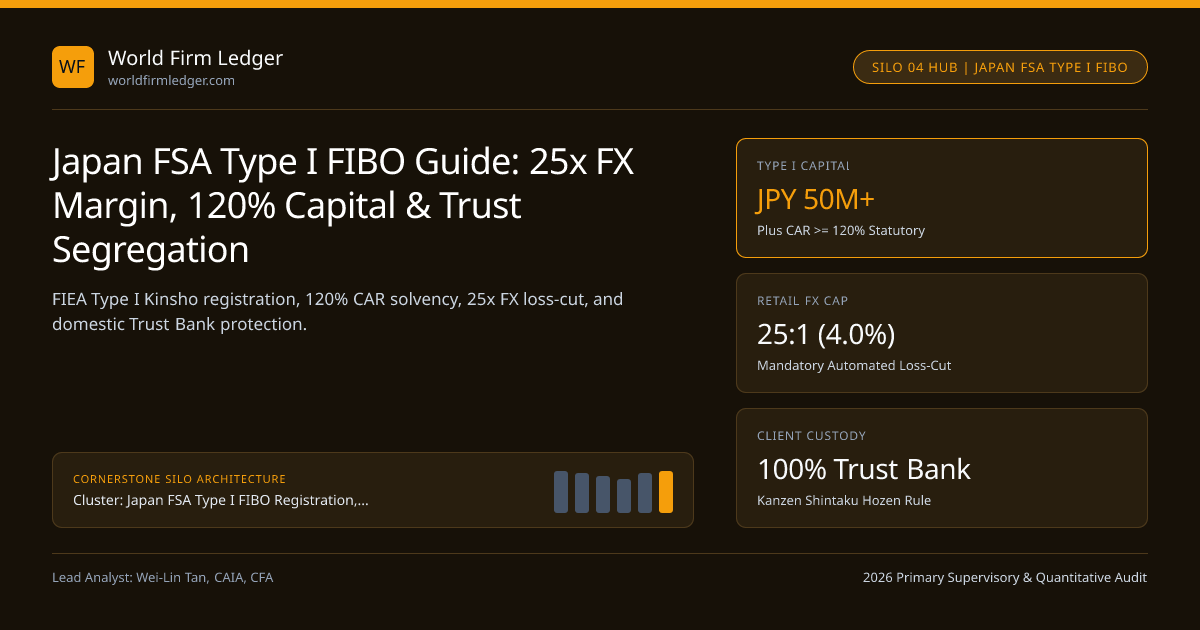
Generating more than quadrillions of Yen in annual retail currency turnover—often exceeding 30% of all global retail spot FX volume during Bank of Japan monetary policy shifts—Tokyo enforces the world's most mathematically prescriptive investor-protection architecture under the Financial Instruments and Exchange Act (FIEA, Act No. 25 of 1948 as amended) supervised by the Financial Services Agency of Japan (JFSA) and the self-regulatory Financial Futures Association of Japan (FFAJ). Across our Japan FSA FIBO and trust segregation topic hub and Japan FIEA regulatory compendium, operating legally onshore requires Type I Financial Instruments Business Operator (FIBO) registration (Dai-Isshu Kinyu Shohin Torihiki Gyo), JPY 50,000,000 minimum stated capital, a 120% statutory Capital Adequacy Ratio floor, 25:1 retail FX leverage ceilings, and 100% domestic trust-bank segregation (Kanzen Shintaku Hozen)!
FIEA Article 28: Type I FIBO Registration & The 140% / 120% Solvency Ladder#
Unlike light-touch jurisdictions where a generic brokerage permit covers everything from mutual-fund distribution to leveraged FX market-making, Article 28 of Japan's FIEA splits market intermediaries into four rigid tiers—reserving liquid securities underwriting, exchange brokerage, over-the-counter retail FX (Tentou Gaikoku Kawase Shohin Torihiki), and equity/index CFDs exclusively for Type I FIBOs, analyzed in detail in Japan FIEA Article 28 Type I vs Type II FIBO capital rules. Every registered Tokyo or Osaka broker displays an official regional registration code such as Kanto Local Finance Bureau (Kinsho) No. xxx, which allocators audit forensically using our Kanto Local Finance Bureau Kinsho registration guide.
Static JPY 50,000,000 paid-up capital and net assets are merely entry minimums. Under FIEA Article 46-6, every Type I FIBO calculates its live Capital Adequacy Ratio (Jiko Shihon Kisei Hiritsu)—dividing Non-Fixed Deducted Net Equity by the sum of Market Risk, Counterparty Risk, and Basic Operational Risk! Falling below 140% triggers mandatory notification to JFSA; breaching 120% activates supervisory business-improvement orders; and dropping below 100% triggers up to a three-month suspension or revocation of registration, modeled quantitatively in Japan FIBO Article 46-6 120% and 140% Capital Adequacy Ratio rules.
Domestic Trust-Bank Segregation (Kanzen Shintaku Hozen) vs JIPF Exclusion#
Why did zero Japanese retail FX customers lose segregated principal when Lehman Brothers Japan or domestic FX firms entered insolvency, and even FTX Japan returned client assets intact while global FTX froze? Under Cabinet Office Ordinance on Financial Instruments Business Article 143, OTC retail FX brokers are barred from merely holding client funds in regular commercial bank accounts: every business day they must calculate total customer deposits plus unrealized mark-to-market profits (Kokyaku Kubun Kanri Hitsuyogaku) and lock >= 100% of that sum inside a money trust (Kinsen Shintaku) at a licensed Japanese Trust Bank (such as Mitsubishi UFJ Trust, Sumitomo Mitsui Trust, Mizuho Trust, or SBI Shinsei/Nomura Trust), dissected in Japan Kanzen Shintaku Hozen daily trust-bank segregation. Crucially, traders must distinguish trust-bank protection from the Japan Investor Protection Fund (JIPF)—which covers securities up to JPY 10,000,000 but explicitly excludes OTC FX derivatives, clarified in JIPF JPY 10M coverage and OTC FX exclusion rules!
| East Asian Regulatory Regime | Core Leveraged FX / CFD License | Minimum Paid-Up / Liquid Capital | Retail FX Leverage Cap | Client Asset Protection Mechanism | Official Ministry / Compendium |
|---|---|---|---|---|---|
| Japan — JFSA / FFAJ | FIEA Type I FIBO (Kinsho) | JPY 50,000,000 + CAR >= 120% | 25:1 (4% Margin) | 100% Domestic Money Trust Bank | Japan FSA / FFAJ |
| Japan — Crypto (JVCEA) | FIEA Crypto-Asset FIBO / PSA CAESP | JPY 10M–50M + Net Assets | 2:1 (50% Margin!) | 95%+ Cold Wallet + Domestic Trust | JFSA JVCEA |
| South Korea — FSC / FSS | Investment Dealer / Broker (FCM) | KRW 3B – KRW 50B+ | 10:1 (10% Initial Margin) | Korea Securities Finance Corp (KSFC) | Korea FSS |
| Hong Kong — SFC | Type 3 Leveraged Foreign Exchange | HKD 30M Paid-Up / HKD 15M Liquid | 20:1 (5% Initial Margin) | Authorized HK Bank Client Trust | Hong Kong SFC |
| Taiwan — FSC / TPEx | Leveraged Transaction Merchant (LTM) | TWD 400M–1B+ Securities/Futures | 20:1 – 30:1 Tiered | Segregated Domestic Margin Bank | Taiwan FSC |
| Indonesia — Bappebti / OJK | Pialang Berjangka (Futures Broker) | IDR 25B+ (~USD 1.55M) | Regulated Lot Margin | 70%+ at KBI / ICH Clearinghouse | Bappebti / OJK |
Leverage Ceilings Across Retail FX (25x), Corporate FX, CFDs, and Crypto (2x)#
Japan bans brokers from extending statutory Negative Balance Protection (Zero-Cut) out of house funds because FIEA Article 39-2 strictly prohibits compensating customer investment losses (Sonshitsu Hoten no Kinshi)! Instead, Japan minimizes negative balances through strict initial margin floors plus mandatory automated Loss-Cut liquidation rules, examined in Japan 4% retail FX margin and Loss-Cut rules, FFAJ weekly historical-volatility corporate FX margin, FFAJ monthly OTC FX unpaid shortfall bulletins, Japan non-FX CFD 5x equity, 10x index, and 20x commodity caps, and JVCEA 2x crypto derivative margin rules alongside fintech innovators like Soramitsu and 2ban JP.
- where:
- DeductedUnfixedNetCapital = TotalShareholderEquity + EligibleSubordinatedDebt - FixedIlliquid_Assets (Real Estate, Software, Group Equity)
- BasicOperationalRiskEq = 0.25 * Prior12MonthsOperatingExpensesJPY
- Worked Tokyo Type I Retail OTC FX Broker Capital Adequacy Audit:
- Shareholder Equity = JPY 4,800,000,000; Capitalized Trading Software & Office Lease Deposits (Fixed Assets Deducted!) = -JPY 1,150,000,000
- DeductedUnfixedNet_Capital = JPY 3,650,000,000
- Market Risk (Unhedged USD/JPY & GBP/JPY B-Book VaR) = JPY 620,000,000
- Counterparty Risk (LP Cover Margin & Trust Bank Exposure) = JPY 210,000,000
- Basic Operational Risk (25% of JPY 2.68B Annual OpEx) = JPY 670,000,000 -> Total Risk Equivalent = JPY 1,500,000,000
- FIEACapitalAdequacy_Ratio = (3,650,000,000 / 1,500,000,000) * 100 = 243.3% (Well Above 140% Early-Warning & 120% Floor!)
Benchmarking East Asian Margin & Solvency Regimes#
Comparing Tokyo's FIEA architecture against Seoul, Hong Kong, Taipei, and Jakarta demonstrates why East Asia imposes the world's highest liquid-equity and margin standards on retail derivatives.
Exchange FX (Click 365), Algo Registration, and East Asian Regional Peers#
Rounding out our cluster, institutional and active traders compare OTC FIBO taxation against exchange-traded margin contracts in Tokyo Financial Exchange Click 365 vs OTC FIBO tax parity, algorithmic colocation rules in JFSA High-Speed Trading (HST) registration, cold-calling bans in FIEA Article 38(4) unsolicited solicitation prohibitions, datacenter disaster-recovery standards in JFSA FISC system resilience rules, and offshore payment-blocking warnings in JFSA unregistered foreign broker warning lists. Finally, pan-Asian compliance desks benchmark Tokyo against South Korea FSC/FSS 10x FX rules (alongside Korean exchanges like Korbit), Taiwan FSC and TPEx Leveraged Transaction Merchants (alongside KGI Bank and Bank SinoPac), Hong Kong SFC Type 3 HKD 30M FX rules, and Indonesia Bappebti/OJK 70% clearinghouse segregation, verified via World Firm Ledger verification.
Frequently asked questions
Why are licensed Japanese FX brokers legally forbidden from offering Negative Balance Protection ("Zero-Cut")?
Article 39-2 of Japan’s Financial Instruments and Exchange Act (FIEA) strictly criminalizes promising or providing compensation to cover a customer’s investment losses—and JFSA interprets forgiving a post-gap negative balance out of broker corporate funds as unlawful loss compensation!
Does the Japan Investor Protection Fund (JIPF) cover JPY 10 million if my Japanese FX broker goes bankrupt?
No—JIPF explicitly excludes OTC FX and derivative margin transactions from its JPY 10M payout scheme; instead, Japanese law enforces an even stronger protection without any JPY 10M ceiling: 100% daily domestic Trust Bank segregation (Kanzen Shintaku Hozen).
Why do Japanese residents face punitive tax rates if they use an unregistered overseas high-leverage FX broker?
Realized FX/CFD profits at registered domestic Type I FIBOs are taxed at a flat 20.315% separate rate with 3-year loss carryforwards, whereas profits at unregistered overseas brokers are taxed as progressive Miscellaneous Income up to ~55% (45% national + 10% resident) with zero multi-year loss carryforward!
What is the maximum crypto futures/perpetual leverage allowed in Japan under JFSA and JVCEA rules?
Since the May 2020 FIEA amendments (and subsequent Cabinet Office Ordinance rules), retail crypto-asset margin and derivative trading in Japan has been strictly capped at 2:1 maximum leverage (50% initial margin).
Publication record
- Published
- 15 November 2026
- Updated
- 15 November 2026
- Author
- Wei-Lin Tan, CAIA, CFA
- Review
- Review not recorded
- Automated fact check
- Passed in the stored pipeline record
- Source URLs
- 4 recorded
AI assistance recorded: anthropic/claude-opus-4.6. This field does not establish human review or source verification.
Academic & Institutional Attribution
Cite This Research & Embed Live Data Card
Standard academic & institutional research paper citation format.
Wei-Lin Tan, CAIA, CFA. (2026, November 14). Japan FSA Type I FIBO Guide: 25x FX Margin, 120% Capital & Trust Segregation. World Firm Ledger. https://worldfirmledger.com/almanac/japan-fsa-type-1-fibo-25x-fx-trust-segregation-guide-2026Regulatory Directory Cross-Reference
Referenced Institutions & Regulatory Registries
Mentioned Regulated Institutions
Referenced Supervisory Authorities
Related Japan Fsa Fibo Margin Segregation & Institutional Briefings
Explore Japan Fsa Fibo Margin Segregation Hub (20) →Japan Fsa Fibo Margin Segregation
Japan FIEA Article 28: Type I vs Type II FIBO Registration & JPY 50M CapitalJapan Fsa Fibo Margin Segregation
Japan FIBO Article 46-6 Capital Adequacy Ratio: 140%, 120% & 100% TriggersJapan Fsa Fibo Margin Segregation
Japan Kanzen Shintaku Hozen: Mandatory Domestic Trust-Bank Client SegregationJapan Fsa Fibo Margin Segregation
Japan Retail FX 4% Margin (25:1 Cap), Loss-Cut Rule & Zero-Cut ProhibitionJapan Fsa Fibo Margin Segregation
FFAJ Corporate FX Margin in Japan: Weekly Historical Volatility FormulaJapan Fsa Fibo Margin Segregation
Japan Non-FX CFD Leverage Caps: 5x Single Stocks, 10x Indices & 20x GoldJapan Fsa Fibo Margin Segregation
FFAJ Monthly OTC FX Statistical Bulletins: Auditing Unpaid Loss-Cut ShortfallsJapan Fsa Fibo Margin Segregation
JFSA Unregistered Foreign Broker Warnings (Mitoroku Gyosha) & Tax PenaltiesBrazil Cvm Mexico Cnbv Emerging Hubs
Brazil CVM, Mexico CNBV, Chile CMF & Emerging Hub Licensing Almanac 2026Mas Singapore Cms Psa Accredited Rules
MAS SF(FMR)R Base Capital Tiers: SGD 500k to SGD 5M Dealing ThresholdsMas Singapore Cms Psa Accredited Rules
MAS Risk-Based Capital Adequacy: Total Risk Requirement & 120% Warning FloorMas Singapore Cms Psa Accredited Rules
MAS Notice SFA 04-N12: Retail 5% FX Margin Floor & 20:1 Leverage Mechanics
World Firm Ledger Data, Benchmarks & Contributor Records
CC BY 4.0 Open Data
Open Institutional Datasets (CSV / JSON) →
Download desk-compiled quantitative series & schemas.
2026 Reference Matrix
2026 Institutional Benchmarks & Thresholds →
Statutory capital, clearing, margin & rate conventions.
Editorial Records
Authors & Review Records →
View named contributors where those records are available.
Complete Index
Master Research & Dossier Archive →
Browse all published briefings by topic pillar & date.