
Japan Fsa Fibo Margin Segregation
Japan Retail FX 4% Margin (25:1 Cap), Loss-Cut Rule & Zero-Cut Prohibition
Enforcing a 4% initial margin floor (25:1 cap) since August 2011 alongside mandatory automated Loss-Cut engines, Japan FSA simultaneously criminalizes Zero-Cut loss forgiveness under FIEA Article 39-2.
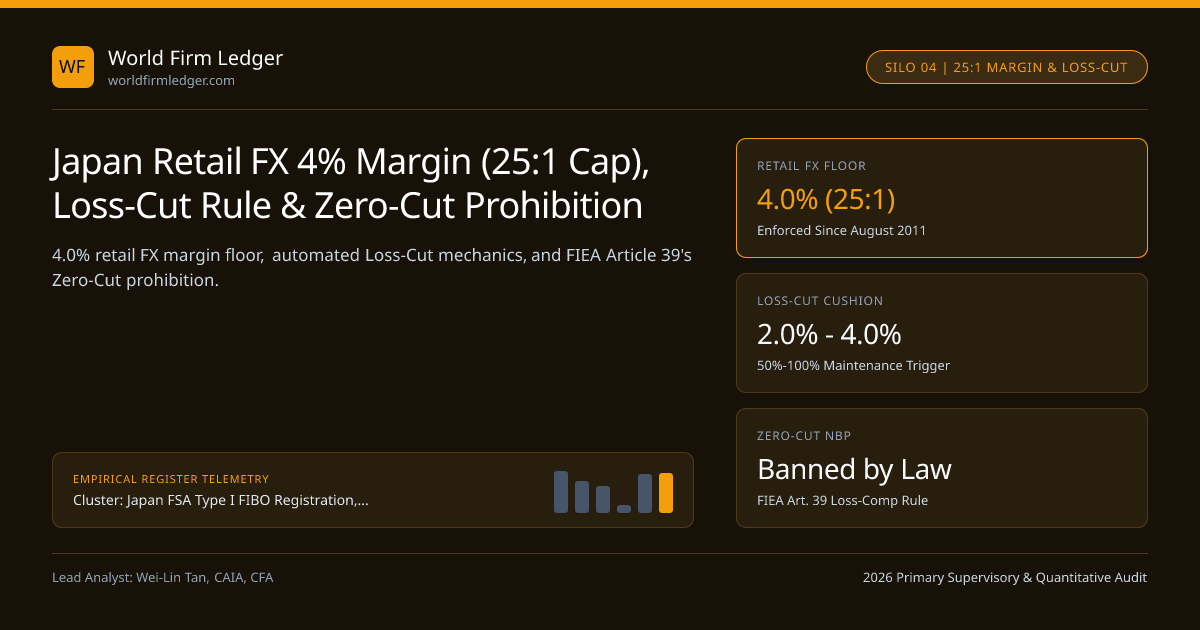
Global retail traders accustomed to European ESMA or Australian ASIC CFD accounts—where Negative Balance Protection ("Zero-Cut") is mandatory by law—encounter an astonishing legal inversion in Tokyo: inside Japan, offering "Zero-Cut" Negative Balance Protection is a criminal/administrative violation of FIEA Article 39(1)(ii)–(iii)! Why? Because reimbursing or forgiving a customer's negative debit balance (Oisho / Unpaid Deficiency) out of broker funds constitutes prohibited Compensation of Customer Investment Losses (Sonshitsu Hoten)! Within our Japan FSA Type I FIBO & trust segregation guide, understanding how the JFSA and FFAJ protect households without Zero-Cut reveals the twin engineering pillars of Japanese retail FX: the 4.0% Initial Margin Floor (25:1 Leverage Cap) and Mandatory Automated Loss-Cut (Rosukatto) Rules!
Two-Stage Leverage Compression (50:1 in 2010 -> 25:1 in 2011) & The Loss-Cut Mandate#
Prior to 2010, Tokyo FX brokers marketed 200:1 to 400:1 leverage on GBP/JPY and AUD/JPY carry trades—causing widespread household bankruptcies during the 2008 Lehman Yen surge. Japan intervened via Cabinet Office Ordinance on Financial Instruments Business Article 117(1)(xxvii) and FFAJ Self-Regulatory Rules:
- 4.0% Minimum Margin Across All Individual Retail FX Pairs (25:1 Maximum Leverage): Lowered to 2% (50:1) in August 2010 and locked permanently at 4.0% (25:1) in August 2011 across all currency pairs—whether USD/JPY, EUR/USD, TRY/JPY, or MXN/JPY! (Note: brokers voluntarily apply higher 8%–20% house margins on hyper-volatile emerging-market pairs during central bank elections!)
- Mandatory Automated Loss-Cut Rule (Rosukatto Rule no Seibi): Since August 2009, Cabinet Office Ordinance Article 123(1)(xxi-2) legally obligates every Type I FX FIBO to establish, disclose, and enforce an automated real-time Loss-Cut system that forcibly liquidates all open positions the instant a customer's Margin Maintenance Ratio (Shokokin Iji Ritsu) drops to a predetermined threshold (typically 50% to 100% of required 4% margin)—leaving a 2.0% to 4.0% spot-price cushion before account equity hits zero!
- Daily Margin Call (Oisho / Tsuika Shokokin) Check: Separate from real-time intraday Loss-Cut (e.g., at 50% maintenance), many Tokyo brokers run an NY-close (06:00/07:00 JST) maintenance check at 100% of 4% margin—requiring the client to either wire top-up cash or reduce positions by the next Tokyo deadline or face automatic liquidation!
Comparing Retail FX Protection Philosophies: Japan vs EU/UK/Australia vs Singapore#
Notice how three Tier-1 regulatory blocs solved the exact same Swiss-Franc / Flash-Crash retail wipeout problem using fundamentally different legal tools:
| Jurisdiction | Retail Major FX Leverage Cap | Retail Minor/EM FX Leverage Cap | Statutory Negative Balance Protection? | Mandatory Automated Margin Stop-Out? | Reference / Compendium |
|---|---|---|---|---|---|
| Japan — JFSA / FFAJ | 25:1 (4.0% Margin) | 25:1 (4.0% Floor) | ILLEGAL (Banned by FIEA Art. 39!) | Yes (Typically 50%–100% of 4% Margin) | JFSA Ministry |
| Australia — ASIC | 30:1 (3.33% Margin) | 20:1 (5.0% Margin) | Yes — Mandatory Statutory NBP | Yes (50% Account-Level Close-Out) | ASIC Compendium |
| Singapore — MAS | 20:1 (5.0% Margin) | 20:1 (5.0% Margin) | Not Mandated (Client Remains Liable) | Broker Risk Rules + 5% Cushion | MAS Compendium |
| South Korea — FSC/FSS | 10:1 (10.0% Margin) | 10:1 (10.0% Margin) | No (Client Remains Liable; High 10% Buffer) | Mandatory Maintenance Margin Liquidation | Korea 10x FX Rules |
Modeling Exact Yen Pip Distance to Loss-Cut & Flash-Crash Gap Risk on USD/JPY#
Let us calculate the exact pip buffer protecting a Japanese retail trader buying 100,000 USD/JPY at 150.00 (JPY 15,000,000 notional) with minimum 4.0% deposit (JPY 600,000) at a Tokyo broker running a 100% Loss-Cut versus a 50% Loss-Cut:
- LossCutTriggerEquityJPY = Required4PctMarginJPY * BrokerLossCutRatio (e.g., 1.00 or 0.50)
- SurvivableAdverseMovePct = (DepositedEquityJPY - LossCutTriggerEquityJPY) / PositionNotional_JPY
- Worked 100,000 USD/JPY Long Position at 150.000 (Notional = JPY 15,000,000; Deposited Equity = JPY 800,000):
- Required 4.0% Margin (Fixed at Entry 150.00) = JPY 600,000
- Case A (Conservative Tokyo Broker w/ 100% Loss-Cut = JPY 600,000):
- Loss-Cut Fires at -JPY 200,000 Unrealized Loss -> USD/JPY = 148.000 (-200 pips!). Remaining Cushion Against Gap = JPY 600,000 (4.00% / 600 pips before hitting JPY 0!)
- Case B (Active Tokyo Broker w/ 50% Loss-Cut = JPY 300,000):
- Loss-Cut Fires at -JPY 500,000 Unrealized Loss -> USD/JPY = 145.000 (-500 pips!). Remaining Cushion Against Gap = JPY 300,000 (2.00% / 300 pips before hitting JPY 0!)
- Flash-Crash Stress (e.g., Jan 3, 2019 Apple/Yen Flash Crash -420 pips in 3 minutes):
- Case A survives w/ +JPY 180k equity; Case B risks JPY 120,000 Unpaid Deficit (Oisho Debt Legally Collectable in Japanese Civil Court!)
Why Many Japanese Traders Choose 100% Loss-Cut Settings Over 50%#
Because an unpaid post-gap negative balance (Mishuukin) in Japan is a legally enforceable civil debt that the broker must bill to the customer (and report monthly in aggregate to FFAJ's public shortfall bulletin!), risk-conscious Japanese households intentionally select brokers enforcing 100% Loss-Cut (leaving a full 4.0% / ~600-pip cushion to absorb execution slippage during weekend openings or BoJ interventions) or keep effective account leverage at 3:1 to 8:1!
Why JFSA Considered—and Rejected—Cutting Retail Leverage From 25:1 to 10:1 in 2018#
In 2018, JFSA debated slashing individual FX leverage from 25:1 down to 10:1. Industry data presented by FFAJ proved that cutting onshore leverage to 10:1 would drive millions of Japanese retail traders into unregulated offshore 500:1 websites lacking domestic Trust Bank protection! Instead of cutting 25:1 for individuals, JFSA and FFAJ enacted dynamic historical-volatility corporate FX margin rules (examined in our Corporate FX margin guide) and enhanced broker Loss-Cut stress-testing—preserving market equilibrium across our Japan FSA FIBO and trust segregation topic hub.
Frequently asked questions
Can a Japanese trader legally be sued by a domestic FX broker if a flash crash creates a negative account balance?
Yes. Because FIEA Article 39 prohibits Japanese FIBOs from forgiving customer trading losses ("Zero-Cut"), any post-liquidation negative balance (Mishuukin) resulting from an extreme market gap remains a legally binding debt owed by the customer to the broker.
What is the difference between Oisho (Additional Margin Call) and Loss-Cut at a Japanese FX broker?
Oisho is typically evaluated once per day at New York close (if margin maintenance falls below 100%, giving you ~20 hours to deposit cash or close trades), whereas Loss-Cut monitors real-time tick-by-tick equity 24 hours a day and liquidates all positions immediately if equity breaches the 50%–100% trigger.
How is "Ryodate" (simultaneous long and short hedging on the same pair) margined in Japan?
Japanese Type I FIBOs must disclose Ryodate economic irrationality (paying double spread and net negative swap) under FFAJ rules, and most apply "MAX Method" margin (requiring 4% margin only on the larger of the long or short leg, though some charge both legs).
Do exotic emerging-market pairs like TRY/JPY or ZAR/JPY also get 25:1 leverage in Japan?
4.0% (25:1) is the statutory floor, meaning no broker can require less than 4% margin; however, Japanese brokers retain contractual authority to raise required margin to 8%, 10%, or 20% on Turkish Lira or South African Rand pairs ahead of elections or central bank meetings.
Publication record
- Published
- 14 November 2026
- Updated
- 15 November 2026
- Author
- Wei-Lin Tan, CAIA, CFA
- Review
- Review not recorded
- Automated fact check
- Passed in the stored pipeline record
- Source URLs
- 3 recorded
AI assistance recorded: anthropic/claude-opus-4.6. This field does not establish human review or source verification.
Academic & Institutional Attribution
Cite This Research & Embed Live Data Card
Standard academic & institutional research paper citation format.
Wei-Lin Tan, CAIA, CFA. (2026, November 14). Japan Retail FX 4% Margin (25:1 Cap), Loss-Cut Rule & Zero-Cut Prohibition. World Firm Ledger. https://worldfirmledger.com/almanac/japan-retail-fx-4-percent-margin-25x-leverage-loss-cutRegulatory Directory Cross-Reference
Referenced Institutions & Regulatory Registries
Top Regulated Institutions in This Coverage Slice
Related Japan Fsa Fibo Margin Segregation & Institutional Briefings
Explore Japan Fsa Fibo Margin Segregation Hub (20) →Japan Fsa Fibo Margin Segregation
Japan FSA Type I FIBO Guide: 25x FX Margin, 120% Capital & Trust SegregationJapan Fsa Fibo Margin Segregation
FFAJ Corporate FX Margin in Japan: Weekly Historical Volatility FormulaJapan Fsa Fibo Margin Segregation
Japan Non-FX CFD Leverage Caps: 5x Single Stocks, 10x Indices & 20x GoldJapan Fsa Fibo Margin Segregation
FFAJ Monthly OTC FX Statistical Bulletins: Auditing Unpaid Loss-Cut ShortfallsJapan Fsa Fibo Margin Segregation
JFSA Unregistered Foreign Broker Warnings (Mitoroku Gyosha) & Tax PenaltiesJapan Fsa Fibo Margin Segregation
Tokyo Financial Exchange (TFX) Click 365 vs OTC FIBO FX: Clearing & Tax ParityJapan Fsa Fibo Margin Segregation
Japan JVCEA & FIEA Crypto Rules: 2x Derivative Leverage Cap & 95% Cold CustodyJapan Fsa Fibo Margin Segregation
Decoding Kanto Local Finance Bureau (Kinsho) Numbers: JFSA Registry AuditBrazil Cvm Mexico Cnbv Emerging Hubs
Brazil Crypto Law 14.478: BCB PSAV Licensing, CVM Tokens & SegregationBrazil Cvm Mexico Cnbv Emerging Hubs
Mexico CNBV Casa de Bolsa Rules: LMV Capital & Foreign Broker SolicitationBrazil Cvm Mexico Cnbv Emerging Hubs
Mexico Ley Fintech (IFPE & IFC): Banxico Crypto & Foreign Broker FirewallsBrazil Cvm Mexico Cnbv Emerging Hubs
Mexico SIC Global Market: 10% Flat Capital Gains Tax on 3,500+ US/Global ETFs
World Firm Ledger Data, Benchmarks & Contributor Records
CC BY 4.0 Open Data
Open Institutional Datasets (CSV / JSON) →
Download desk-compiled quantitative series & schemas.
2026 Reference Matrix
2026 Institutional Benchmarks & Thresholds →
Statutory capital, clearing, margin & rate conventions.
Editorial Records
Authors & Review Records →
View named contributors where those records are available.
Complete Index
Master Research & Dossier Archive →
Browse all published briefings by topic pillar & date.