
Japan Fsa Fibo Margin Segregation
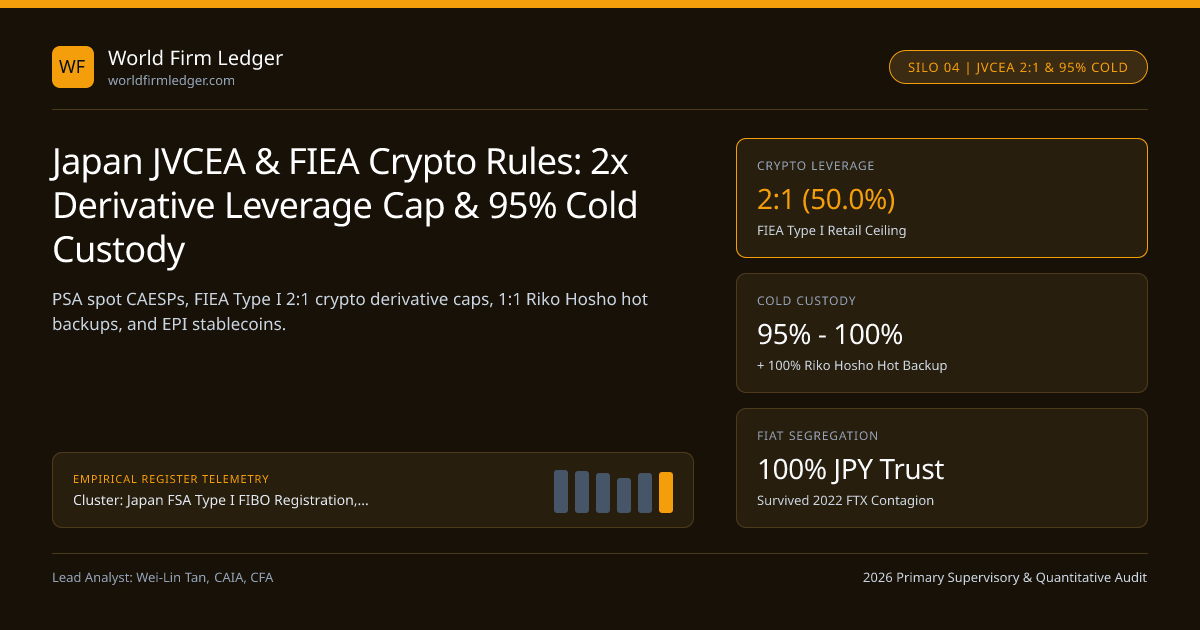
Japan JVCEA & FIEA Crypto Rules: 2x Derivative Leverage Cap & 95% Cold Custody
Scarred early by Mt. Gox and Coincheck, Japan enacted G7’s toughest crypto framework under JFSA and JVCEA—capping crypto derivatives at 2:1 leverage and locking 95%+ of tokens in offline cold wallets.
Because Tokyo experienced history's first two mega-exchange hacks—Mt. Gox (2014) and Coincheck's JPY 58 billion NEM hot-wallet theft (2018)—years before Western regulators wrote crypto statutes, the Japan FSA and the certified self-regulatory Japan Virtual and Crypto assets Exchange Association (JVCEA) forged the world's most battle-tested digital-asset custody and leverage architecture! Within our Japan FSA Type I FIBO & trust segregation guide—alongside Japanese blockchain pioneers like Soramitsu—operating a crypto platform in Japan splits across two distinct statutes: Spot Crypto under the Payment Services Act (PSA) and Crypto Derivatives / Margin under the Financial Instruments and Exchange Act (FIEA)!
Dual Statute Architecture: PSA Spot CAESPs vs FIEA Type I Crypto Derivatives#
Since the landmark 1 May 2020 enforcement of Japan's amended PSA and FIEA:
- Spot Crypto Trading & Custody (Crypto-Asset Exchange Service Provider / CAESP — Ango Shisan Kokan Gyosha): Regulated under the Payment Services Act, requiring at least JPY 10,000,000 minimum capital plus positive net assets, 100% domestic Japanese Trust Company/Trust Bank segregation of customer fiat Yen, and 95% to 100% offline Cold-Wallet storage of customer crypto assets!
- Hot-Wallet Liability Counter-Asset (Riko Hosho Ango Shisan): For the tiny <= 5% fraction of customer tokens kept in online hot wallets for instant withdrawal liquidity, PSA Article 63-11(2) forces the exchange to hold an equivalent 100% amount of the exact same crypto token in its own corporate cold reserve (e.g., if 100 client BTC sit in a hot wallet, 100 house-owned BTC must sit segregated in cold storage ready to make clients whole immediately after a hack!)!
- Crypto Margin, Perpetuals & CFDs (Ango Shisan Kanren Derivative Torihiki): Brought squarely inside FIEA Type I FIBO registration (JPY 50M+ capital and 120% Article 46-6 CAR)! And under Cabinet Office Ordinance Article 117(1)(li), retail crypto-asset margin and derivative leverage is capped strictly at 2:1 (50.0% minimum initial margin)—down from JVCEA's earlier 4:1 cap!
Japan's 2023 Electronic Payment Instruments (EPI) Stablecoin Law#
In June 2023, Japan became the first major economy to enact a dedicated fiat-backed Stablecoin statute inside the revised Payment Services Act—defining yen- and dollar-redeemable stablecoins as Electronic Payment Instruments (Denshi Kessai Shudan)! Issuance onshore is restricted strictly to licensed Japanese Banks, Trust Companies (Tokutei Shintaku — backed 100% by domestic bank demand deposits), and Fund Transfer Service Providers (such as initiatives pioneered with Japanese banks and Soramitsu), while intermediary distribution requires Electronic Payment Instruments Exchange Service Provider registration!
| Digital-Asset Regulatory Feature | Japan — JFSA / JVCEA | South Korea — FSC / VASP | Singapore — MAS DPT (PS Act) | Offshore Unregulated | Reference |
|---|---|---|---|---|---|
| Retail Crypto Futures / Margin Cap | 2:1 (50% Margin — Type I FIBO) | 0x (Crypto Derivatives Banned!) | Restricted / Institutional Focus | 100:1 – 125:1 | JFSA JVCEA |
| Offline Cold-Wallet Minimum | 95% – 100% Cold Storage | >= 80% Cold Storage (VAUPA 2024) | >= 90% Cold Storage | Opaque / Commingled | Korea FSS Peer |
| Mandatory 1:1 Hot-Wallet Own-Token Backup | Yes! (Riko Hosho Same-Token) | Insurance / Cold Reserve | Statutory Trust Segregation | Zero | JFSA Ministry |
| Customer Fiat Segregation | 100% Domestic Money Trust | Real-Name Korean Bank Custody | T+1 Statutory Bank Trust | Crypto / Tether Only | Korbit Peer |
Modeling the Capital Cost of a 5% Hot Wallet Under Japan's Riko Hosho Rule (And the DMM Bitcoin Test!)#
In May 2024, Japanese exchange DMM Bitcoin suffered a JPY 48.2 billion (4,502.9 BTC) private-key compromise. Did customers lose a single Satoshi? NO! Because Japanese PSA law legally obligated DMM Bitcoin (backed by group financing under JFSA supervision) to procure 4,502.9 replacement BTC and transfer 100% of customer accounts intact to SBI VC Trade! Here is how the statutory Riko Hosho balance-sheet lockup works daily:
- CorporateFXAndPriceHedgeCapitalJPY = RequiredCorporateGuaranteeCryptoUnits * SpotPriceJPY * (1 + Volatility_Buffer)
- Worked Tokyo CAESP Custody Balance-Sheet Audit (Customer Deposits = 20,000 BTC at JPY 14,000,000/BTC = JPY 280 Billion):
- Strategy A (96% Cold / 4% Hot Wallet = 800 Customer BTC in Hot Wallet):
- Exchange MUST purchase and hold 800 BTC (worth JPY 11,200,000,000 / ~$74.6M!) of its OWN corporate Bitcoin locked in cold reserve as Riko Hosho!
- Strategy B (100% Cold Wallet w/ Batched Manual/HSM Once-Daily Sweeps = 0 Customer BTC in Hot Wallet):
- Required Riko Hosho Corporate BTC Lockup = 0 BTC! (Explains why most Tokyo CAESPs run 100.0% cold customer wallets and fund instant withdrawals from a small corporate working float!)
Corporate Crypto Leverage (~2x to ~4x Volatility) & Ongoing Tax Reform Debate#
For Corporate Crypto Derivative Accounts in Japan, margin follows a JVCEA weekly historical-volatility ratio (similar to FFAJ corporate FX, though floored so corporate crypto leverage rarely exceeds 2:1 to 4:1). Meanwhile, industry bodies led by JVCEA and JBA continue advancing legislative proposals to shift individual Japanese crypto taxation from up to 55% Miscellaneous Income into 20.315% Separate Self-Assessment Tax alongside FIEA reclassification!
Elimination of Year-End Unrealized Corporate Tax on Startup/Long-Term Held Tokens#
For years, Web3 startups fled Tokyo because Japanese corporate tax taxed unrealized year-end paper gains on self-issued governance tokens at ~30%! Through FY2023 and FY2024 National Tax Reforms championed by JFSA and METI, Japan abolished unrealized year-end mark-to-market corporate taxation both on self-issued tokens and third-party tokens locked under transfer-restricted trust arrangements—reigniting institutional Web3 issuance across our Japan FSA FIBO and trust segregation topic hub.
Frequently asked questions
Can a Japanese crypto exchange offer 20x or 50x Bitcoin perpetual futures to retail traders?
No! Under FIEA Cabinet Office Ordinance Article 117(1)(li), offering crypto-asset derivatives in Japan requires Type I FIBO registration and enforces a strict 2:1 maximum leverage ceiling (50% initial margin) on retail accounts.
Why do most Japanese crypto exchanges keep 100% of customer tokens in cold wallets instead of 95%?
Because PSA Article 63-11 requires the exchange to hold an equal amount of its own corporate tokens (Riko Hosho) in cold storage to cover 100% of any customer tokens left in a hot wallet—keeping 100% of customer tokens in cold storage eliminates that massive corporate balance-sheet lockup!
Who is allowed to issue Yen-pegged or USD-pegged fiat stablecoins in Japan?
Under Japan’s June 2023 amended Payment Services Act, Electronic Payment Instruments (fiat-redeemable stablecoins) may be issued onshore exclusively by licensed Banks, Trust Companies, and Fund Transfer Service Providers.
Are privacy coins like Monero (XMR) or Zcash (ZEC) tradable on JVCEA-member exchanges in Japan?
No. Following AML/CFT guidance from the JFSA and JVCEA screening standards, anonymity-enhanced coins lacking transparent blockchain auditability are excluded from Japanese exchange whitelists.
Publication record
- Published
- 13 November 2026
- Updated
- 15 November 2026
- Author
- Wei-Lin Tan, CAIA, CFA
- Review
- Review not recorded
- Automated fact check
- Passed in the stored pipeline record
- Source URLs
- 3 recorded
AI assistance recorded: anthropic/claude-opus-4.6. This field does not establish human review or source verification.
Academic & Institutional Attribution
Cite This Research & Embed Live Data Card
Standard academic & institutional research paper citation format.
Wei-Lin Tan, CAIA, CFA. (2026, November 14). Japan JVCEA & FIEA Crypto Rules: 2x Derivative Leverage Cap & 95% Cold Custody. World Firm Ledger. https://worldfirmledger.com/almanac/japan-jvcea-fiea-crypto-derivative-2x-leverage-cold-trustRegulatory Directory Cross-Reference
Referenced Institutions & Regulatory Registries
Mentioned Regulated Institutions
Referenced Supervisory Authorities
Related Japan Fsa Fibo Margin Segregation & Institutional Briefings
Explore Japan Fsa Fibo Margin Segregation Hub (20) →Japan Fsa Fibo Margin Segregation
Japan FSA Type I FIBO Guide: 25x FX Margin, 120% Capital & Trust SegregationJapan Fsa Fibo Margin Segregation
Decoding Kanto Local Finance Bureau (Kinsho) Numbers: JFSA Registry AuditJapan Fsa Fibo Margin Segregation
Japan Investor Protection Fund (JIPF): JPY 10M Cap & Why OTC FX Is ExcludedJapan Fsa Fibo Margin Segregation
JFSA High-Speed Trading (HST) Registration: FIEA Article 66-50 Algo RulesJapan Fsa Fibo Margin Segregation
Japan FIEA Article 38(4): Unsolicited FX & CFD Cold-Calling ProhibitionJapan Fsa Fibo Margin Segregation
JFSA System Risk & FISC Guidelines: Tokyo Dual-Datacenter FIBO ResilienceJapan Fsa Fibo Margin Segregation
South Korea FSC & FSS Rules: 10:1 Retail FX Cap & KRW 10M Derivative GatesJapan Fsa Fibo Margin Segregation
Taiwan FSC & TPEx Leveraged Transaction Merchant (LTM) Retail FX/CFD RulesBrazil Cvm Mexico Cnbv Emerging Hubs
Colombia SFC Decree 2555 Part 4: Foreign Broker Promotion & Rep OfficesBrazil Cvm Mexico Cnbv Emerging Hubs
Colombia Banco de la Republica FX Rules: IMC Form 4 & Numeral 4585 TrapsBrazil Cvm Mexico Cnbv Emerging Hubs
Peru SMV & Argentina CNV: PSAV Crypto Registry & Dollar MEP/CCL MechanicsBrazil Cvm Mexico Cnbv Emerging Hubs
Israel ISA Trading Arena Law (Amendment 42): 20x–100x Tiers & Binary Ban
World Firm Ledger Data, Benchmarks & Contributor Records
CC BY 4.0 Open Data
Open Institutional Datasets (CSV / JSON) →
Download desk-compiled quantitative series & schemas.
2026 Reference Matrix
2026 Institutional Benchmarks & Thresholds →
Statutory capital, clearing, margin & rate conventions.
Editorial Records
Authors & Review Records →
View named contributors where those records are available.
Complete Index
Master Research & Dossier Archive →
Browse all published briefings by topic pillar & date.