
Japan Fsa Fibo Margin Segregation
Japan Kanzen Shintaku Hozen: Mandatory Domestic Trust-Bank Client Segregation
Enacted after early-2000s broker failures, Japan’s mandatory domestic Trust Bank money-trust segregation (Kanzen Shintaku Hozen) sets the G7 gold standard for bankruptcy-remote retail FX custody.
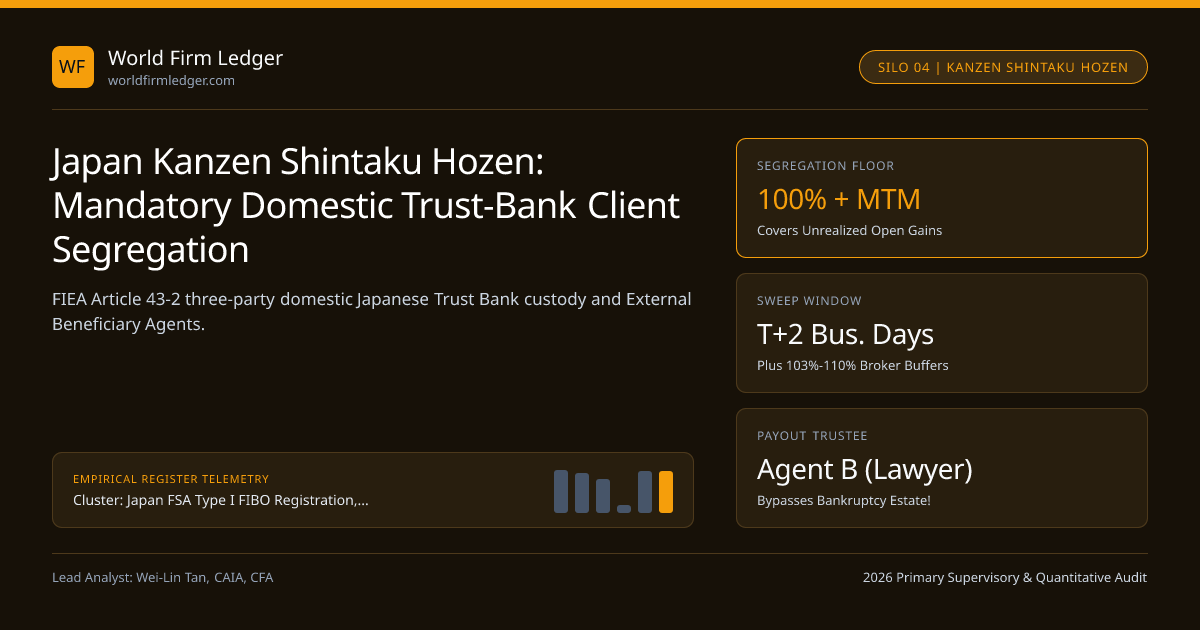
In London, Sydney, Dubai, or Johannesburg, "client money segregation" typically means the broker opens a "Client Designated Bank Account" at a commercial bank—where the broker's own CFO and treasury signatories still hold electronic wire credentials capable of misappropriating funds in a fraudulent crisis before external auditors notice months later! Japan eliminated that fraud and insolvency vector completely in February 2010: under FIEA Article 43-2 and Cabinet Office Ordinance on Financial Instruments Business Article 143, every Japan FSA Type I FIBO offering OTC FX or CFDs must segregate 100% of required customer equity inside a formal statutory Money Trust (Kokyaku Kubun Kanri Shintaku / Kanzen Shintaku Hozen) administered by a licensed domestic Japanese Trust Bank! Within our Japan FSA Type I FIBO & trust segregation guide, no other major retail FX jurisdiction on Earth enforces a stricter custody lock!
How Three-Party Japanese Trust-Bank Segregation (Settlor – Trustee – Beneficiary Agent) Works#
Under Japan's Trust Act (Shintaku Ho) and FIEA Article 43-2(2), a Japanese FX broker (Settlor / Itakusha) cannot simply wire money out of the trust bank (Trustee / Jutakusha—such as Mitsubishi UFJ Trust and Banking, Sumitomo Mitsui Trust Bank, Mizuho Trust & Banking, SBI Shinsei Bank, or Nomura Trust & Banking) at whim:
- 100% Daily Mark-to-Market Customer Requirement (Kubun Kanri Hitsuyogaku): Every single business day (T), the broker computes the exact sum across all clients of: (a) Deposited Cash Margin + (b) Settled Realized Gains/Losses + (c) Net Unrealized Mark-to-Market Open Position Profits/Losses + (d) Accrued Swap Points! Notice that even unrealized open floating profits must be backed 100% in the Trust Bank!
- Mandatory T+2 Deficiency Top-Up Rule: If Trust Property Value falls below the Daily Required Customer Amount on Day T, the broker must wire corporate cash into the Trust Bank within two business days (T+2)—and Trust Bank systems block the broker from withdrawing a single Yen from the trust unless verified excess surplus exists above the attested customer liability!
- Independent Beneficiary Agent (Juekisha Dairinin — External Attorney / CPA): Every broker must appoint an independent external Beneficiary Agent (typically an outside Japanese Bengoshi attorney or Konin Kaikeishi CPA—often splitting Internal Type A and External Type B Beneficiary Agents!). The instant a broker enters bankruptcy, fails, or loses its Type I registration, control flips automatically to External Beneficiary Agent B, who instructs the Trust Bank to distribute 100% of segregated Yen directly to each retail trader's personal bank account—completely bypassing bankruptcy court liquidators!
Real-World Proof: Why FTX Japan Customers Got 100% Back While Global FTX Froze#
History delivered the ultimate empirical stress test in November 2022: when global FTX collapsed in the Bahamas with an USD 8B+ commingled hole, FTX Japan K.K.—registered with the Kanto Local Finance Bureau as both a Type I FIBO and Crypto-Asset Exchange Service Provider under JFSA/JVCEA domestic trust and cold-wallet rules—held 100% of customer fiat Yen inside an onshore Japanese Trust Account and customer crypto inside segregated cold wallets! Result: JFSA issued an immediate domestic asset-retention order, insulated FTX Japan from US Chapter 11 clawbacks, and FTX Japan reopened full 100% fiat and crypto withdrawals in February 2023!
| Jurisdiction | Segregation Legal Vehicle | Covers Unrealized Floating Profit? | Can Broker CFO Wire Out Unchecked? | Insolvency Payout Cap | Reference / Peer |
|---|---|---|---|---|---|
| Japan — JFSA FIEA Art. 43-2 | Licensed Domestic Trust Bank (Shintaku) | Yes — 100% Daily MTM Included | NO — Beneficiary Agent + Trustee Gate! | Unlimited (100% of Trust Pool) | JFSA Ministry |
| Singapore — MAS SFA Reg 16 | Commercial Bank Statutory Trust Acct | Daily Segregated Balance Calc | Controlled by Broker Authorized Signers | Unlimited Pool (No State FX Bailout) | MAS Compendium |
| UK — FCA CASS 7 | Commercial Bank Client Money Trust | Daily Internal/External Reconcile | Broker CASS Signers (Audited Annually) | FSCS GBP 85,000 Backstop | FFAJ SRO |
| Indonesia — Bappebti / OJK | 70% Held at Central Clearinghouse (KBI/ICH) | Clearinghouse Margin Settled | No — 70% Locked at Clearinghouse! | Clearinghouse Reserve | Indonesia 70% Rule |
Modeling Working-Capital Drain: Segregating 100% of Client Unrealized Profits AND Posting LP Margin!#
Foreign CFOs entering Tokyo are often stunned by the dual cash lockup created by Kanzen Shintaku Hozen:
- Suppose your Japanese clients deposit JPY 10.0 billion, go long USD/JPY, and earn +JPY 1.8 billion in unrealized floating profit, while you hedged 100% of that trade on A-book at an interbank LP in London!
- Even though your London LP shows +JPY 1.8B unrealized hedge gain, you cannot use offshore London LP equity to satisfy your Japanese Trust Bank! You must wire JPY 11.8 billion of onshore Yen into Mitsubishi UFJ / Sumitomo Mitsui Trust Bank in Tokyo (100% of JPY 10B deposits + JPY 1.8B floating client profit) PLUS keep separate corporate margin posted in London!
- BrokerCorporateOverFundingBufferJPY = ActualTrustPropertyValueJPY - RequiredJapaneseTrustBankBalanceJPY
- Worked Tokyo Type I FX Broker Daily Trust Reconciliation (Day T -> Day T+2 Settlement):
- 42,000 Retail Accounts Total Deposited Cash + Settled Gains = JPY 18,400,000,000
- Net Aggregate Client Unrealized Floating MTM Gain (Note: Negative-Equity Accounts Floored at 0, Cannot Offset Winners!) = +JPY 2,150,000,000
- RequiredJapaneseTrustBankBalance_JPY (Day T Close) = 18,400,000,000 + 2,150,000,000 = JPY 20,550,000,000!
- Broker Policy Maintains 104% Precautionary Trust Buffer = JPY 21,372,000,000 Held in Mizuho Trust & Banking!
- Over-Collateralized Safety Cushion = +JPY 822,000,000 Corporate Yen Inside Trust (Zero T+2 Deficit Risk!)
Notice Why Deficit Accounts Are Floored at Zero in the Summation!#
Look closely at max(0, ...) in the formula above: if Client A has +JPY 1,000,000 equity and Client B suffered a flash-crash negative balance of -JPY 300,000 (unpaid shortfall after Loss-Cut), the broker cannot net Client B's -JPY 300k debt against Client A's +JPY 1M! Client B enters the sum at JPY 0, forcing the broker to fund 100% of JPY 1,000,000 in the Trust Bank from its own corporate pocket!
Verifying the Exact Named Trust Bank on Every Japanese Broker's Disclosure Page#
Every legitimate Tokyo FX/CFD broker names its exact Partner Trust Bank(s) and External Beneficiary Agent B (Law Firm / CPA Office) openly on its website—allowing investors to cross-check Kanzen Shintaku Hozen arrangements alongside JIPF securities boundaries across our Japan FSA FIBO and trust segregation topic hub.
Frequently asked questions
How is Japan’s Kanzen Shintaku Hozen different from standard UK or Australian segregated bank accounts?
In standard segregated bank accounts, the broker’s own treasury staff still hold wire-signing control over the bank account; in Japan’s Money Trust (Shintaku) model, legal title is held in trust by an independent Japanese Trust Bank overseen by an external attorney/CPA Beneficiary Agent, preventing internal misappropriation.
Why is there a two-business-day (T+2) timing window in Japanese Trust Bank segregation?
Cabinet Office Ordinance Article 143 calculates required customer equity at each business day’s close (T) and mandates settling any shortfall into the Trust Bank within two business days (T+2)—which is why top Japanese brokers maintain a permanent 103%–110% corporate over-funding buffer inside the trust.
Can a Japanese FX broker count cash sitting at its London liquidity provider toward its Japanese Trust Bank requirement?
No! Upstream hedge margin posted by the broker at domestic or foreign cover counterparties does NOT count toward customer segregation; the broker must hold 100% of customer equity inside the domestic Japanese Trust Bank separately from its own hedge capital.
What happens if my unrealized FX profit spikes by JPY 50 million the day before my Japanese broker goes bankrupt?
Assuming the T+2 settlement cycle or the broker’s precautionary over-funding buffer covers the daily calculation, both your deposited principal and calculated mark-to-market equity inside the Trust Bank are distributed pro-rata by External Beneficiary Agent B.
Publication record
- Published
- 14 November 2026
- Updated
- 15 November 2026
- Author
- Wei-Lin Tan, CAIA, CFA
- Review
- Review not recorded
- Automated fact check
- Passed in the stored pipeline record
- Source URLs
- 3 recorded
AI assistance recorded: anthropic/claude-opus-4.6. This field does not establish human review or source verification.
Academic & Institutional Attribution
Cite This Research & Embed Live Data Card
Standard academic & institutional research paper citation format.
Wei-Lin Tan, CAIA, CFA. (2026, November 14). Japan Kanzen Shintaku Hozen: Mandatory Domestic Trust-Bank Client Segregation. World Firm Ledger. https://worldfirmledger.com/almanac/japan-kanzen-shintaku-hozen-daily-trust-bank-segregationRegulatory Directory Cross-Reference
Referenced Institutions & Regulatory Registries
Mentioned Regulated Institutions
- Regulatory DossierView dossier →
Referenced Supervisory Authorities
Related Japan Fsa Fibo Margin Segregation & Institutional Briefings
Explore Japan Fsa Fibo Margin Segregation Hub (20) →Japan Fsa Fibo Margin Segregation
Japan FSA Type I FIBO Guide: 25x FX Margin, 120% Capital & Trust SegregationJapan Fsa Fibo Margin Segregation
Japan Retail FX 4% Margin (25:1 Cap), Loss-Cut Rule & Zero-Cut ProhibitionJapan Fsa Fibo Margin Segregation
FFAJ Corporate FX Margin in Japan: Weekly Historical Volatility FormulaJapan Fsa Fibo Margin Segregation
Japan Non-FX CFD Leverage Caps: 5x Single Stocks, 10x Indices & 20x GoldJapan Fsa Fibo Margin Segregation
FFAJ Monthly OTC FX Statistical Bulletins: Auditing Unpaid Loss-Cut ShortfallsJapan Fsa Fibo Margin Segregation
JFSA Unregistered Foreign Broker Warnings (Mitoroku Gyosha) & Tax PenaltiesJapan Fsa Fibo Margin Segregation
Tokyo Financial Exchange (TFX) Click 365 vs OTC FIBO FX: Clearing & Tax ParityJapan Fsa Fibo Margin Segregation
Japan JVCEA & FIEA Crypto Rules: 2x Derivative Leverage Cap & 95% Cold CustodyBrazil Cvm Mexico Cnbv Emerging Hubs
Banco Central do Brasil Resolution 277: eFX Cross-Border Pix & FX Law 14,286Brazil Cvm Mexico Cnbv Emerging Hubs
Brazil Crypto Law 14.478: BCB PSAV Licensing, CVM Tokens & SegregationBrazil Cvm Mexico Cnbv Emerging Hubs
Mexico CNBV Casa de Bolsa Rules: LMV Capital & Foreign Broker SolicitationBrazil Cvm Mexico Cnbv Emerging Hubs
Mexico Ley Fintech (IFPE & IFC): Banxico Crypto & Foreign Broker Firewalls
World Firm Ledger Data, Benchmarks & Contributor Records
CC BY 4.0 Open Data
Open Institutional Datasets (CSV / JSON) →
Download desk-compiled quantitative series & schemas.
2026 Reference Matrix
2026 Institutional Benchmarks & Thresholds →
Statutory capital, clearing, margin & rate conventions.
Editorial Records
Authors & Review Records →
View named contributors where those records are available.
Complete Index
Master Research & Dossier Archive →
Browse all published briefings by topic pillar & date.