
South Africa Fsca Fais Odp Licensing
South Africa FAIS Section 19(3) Client Trust Accounts & External Audit Rules
Under Section 19(3) of South Africa’s FAIS Act and Section 10 of the General Code of Conduct, FSPs receiving client money must maintain separate audited bank accounts insulated from general creditors.
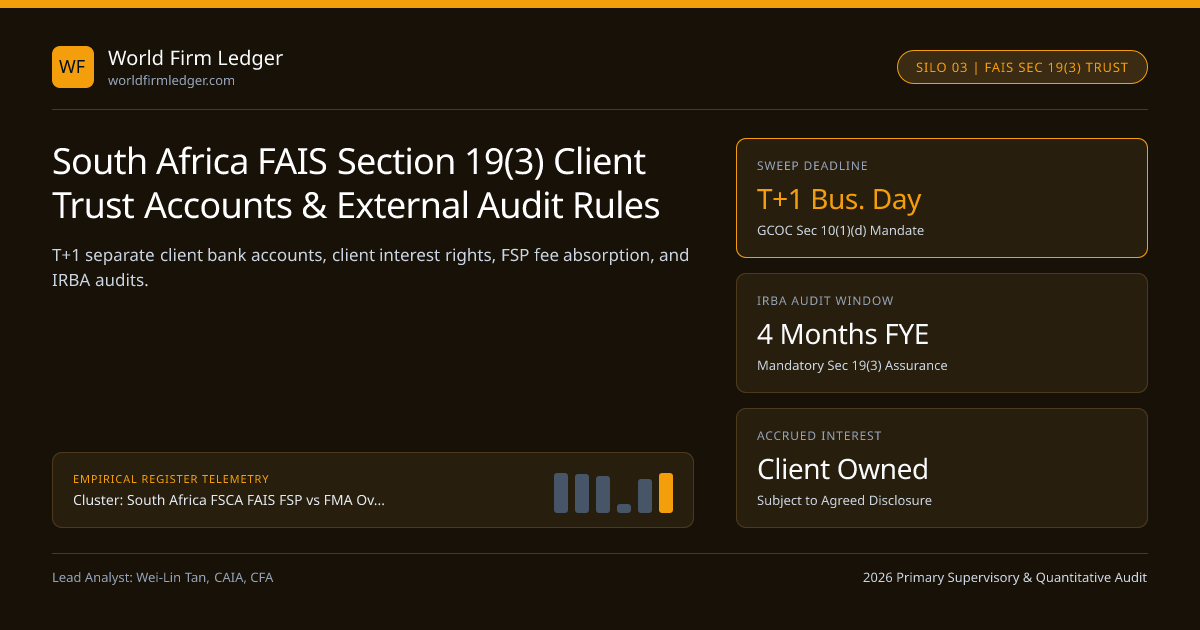
Whenever a South African Financial Services Provider receives client funds, margin cash, or investment premiums rather than instructing direct payment to the underlying product supplier, Section 19(3) of the FAIS Act 37 of 2002 and Section 10 of the FAIS General Code of Conduct activate strict statutory ring-fencing, T+1 deposit windows, and mandatory Independent Regulatory Board for Auditors (IRBA) Section 19(3) assurance reports! Within our South Africa FSCA FAIS vs FMA ODP licensing guide, understanding how client cash survives—or fails—during an FSP's insolvency separates institutional counterparties on the FSCA register from commingled retail shells.
Five Statutory Mandates of Section 10 (General Code) & Section 19(3) (FAIS Act)#
When an FSP holds client cash—whether an agency introducer like AccuMarkets, a Category II discretionary portfolio manager, or a dual-licensed FMA ODP—five statutory controls govern every Rand:
- Separate Designated Bank Account Within One Business Day: The FSP must open and maintain a separate account designated specifically for client funds at a registered South African bank under the Banks Act, depositing all received client funds within one business day (T+1) of receipt.
- Absolute Insolvency Exclusion from FSP Assets: Section 10(1)(d)(iv) stipulates that the separate client account is exclusively for client funds and does not form part of the general insolvency estate of the FSP in liquidation!
- Bank Charges Borne by the FSP, Interest Credited to the Client!: A uniquely pro-consumer South African rule in Section 10(1)(d)(ii)–(iii) dictates that all bank charges on the separate client account must be paid by the FSP out of its own corporate funds (except specific deposit/withdrawal fees explicitly agreed in writing), while any interest earned on the separate client bank account is payable to the client (net of disclosed admin costs)!
- External Auditor Section 19(3) Special Report: Even small FSPs otherwise granted partial financial-statement exemptions lose all audit exemptions the moment they receive client funds—requiring an IRBA-registered external auditor to submit a dedicated Section 19(3) Trust/Separate Account Assurance Report within four months of financial year-end!
- Higher Liquid Capital Floor: Receiving client money immediately triggers the 4/52 annual fixed-expenditure liquid asset requirement for Category I FSPs (or 8/52 for Category II).
Why "Client Nominee Companies" Add Extra Bankruptcy Protection in Category II & III#
For discretionary managers and investment platforms holding dematerialized JSE equities, RSA Treasury bonds, or money-market units, South African market practice goes a step beyond a simple Section 10 bank account: assets are registered inside an FSCA-approved Independent Nominee Company (RF (Pty) Ltd—Ring-Fenced Non-Operating Nominee) whose Memorandum of Incorporation bars it from incurring any corporate debt, taking principal trading risk, or employing staff!
| Safeguarding Mechanism in South Africa | Governing Statute / Rule | Asset Types Covered | Bankruptcy Remoteness Level | External Audit Requirement | Reference / Peer |
|---|---|---|---|---|---|
| FAIS Section 10 / 19(3) Separate Bank Acct | FAIS Act s.19(3) & GCOC s.10 | Client ZAR / FX Cash Pending Allocation | High (Statutory Exclusion) | Annual IRBA Sec 19(3) Report | FSCA Ministry |
| Ring-Fenced Independent Nominee (RF Pty) | Cat II / III Nominee Regs & Companies Act | Shares, Bonds, CIS Units, Cash Call | Maximum (Debt-Free Legal Vehicle) | Dual FSP + Nominee Audit | FSCA Compendium |
| FMA ODP Segregated Margin Account | FMA CS 2/2018 & Joint Standard 2 | Retail/Institutional Derivative Margin | High (Segregated from House Cash) | Annual ODP + PA Solvency Audit | SARB Prudential |
| Corporate Operating Cheque Account | Unlawful Commingling Breach! | Commingled Broker Rent/Payroll & Client Cash | 0% (Frozen by Liquidators!) | Triggers Summary FSP Suspension | FAIS Ombud |
Modeling Client Interest Attribution & Bank-Fee Top-Up Compliance#
Because South Africa's repo and call-deposit rates regularly sit between 7.25% and 8.25% per annum on ZAR balances, an FSP holding ZAR 120,000,000 in idle client margin cash generates nearly ZAR 9,300,000 per year in bank call interest—requiring careful compliance with Section 10(1)(d)(iii):
- FSPOwnAccountBankFeeTopUpZAR = UnagreedMonthlyBankMaintenanceFeesDeductedbyBankZAR
- Worked Johannesburg FSP Separate Client Call Account Annual IRBA Audit:
- Average Segregated Client ZAR Balance = ZAR 120,000,000 at 7.75% JIBAR-linked Bank Call Rate -> Gross Interest = ZAR 9,300,000
- Written Client Agreement Discloses 1.25% Treasury Administration Fee (ZAR 1,500,000) -> Net Interest Credited Pro-Rata to Clients = ZAR 7,800,000!
- Bank Deducted ZAR 42,000 in Monthly Account Service Fees Directly From Client Account:
- Auditor Flags Section 10(1)(d)(ii) Deficit -> FSP Must Reimburse ZAR 42,000 From House Corporate Account Prior to Sec 19(3) Sign-Off!
Comparing Global Client-Money Audit Windows: South Africa, Singapore, and Dubai#
Benchmarking South Africa's 4-month post-year-end IRBA Section 19(3) filing window against DIFC and Singapore underscores consistent Commonwealth trust-accounting discipline.
Summary License Suspension for Late Section 19 Financials#
Every year, over 60% of all summary FSP license suspensions published by the FSCA stem from failing to submit audited Section 19(1)/(2) annual financial statements and Section 19(3) client-account reports within four months of financial year-end! Institutional treasuries verifying local entities like Access Direct or ASPRO FX always demand the latest signed Section 19(3) auditor letter alongside active status on our South Africa FSCA and ODP licensing topic hub.
Frequently asked questions
Who is entitled to the 7.5%+ ZAR interest earned on segregated client cash at a South African FSP?
Under Section 10(1)(d)(iii) of the FAIS General Code of Conduct, any interest earned on the separate client bank account is legally payable to the client—an FSP may only retain an administration margin or treasury spread if explicitly disclosed and consented to in the written client agreement.
Can a small South African Category I FSP claim an accounting-officer exemption instead of an IRBA audit if it holds client money?
No! Any FAIS audit exemption evaporates immediately if the FSP receives or holds client funds or assets; full IRBA-registered external financial audits plus a separate Section 19(3) assurance report become mandatory.
What happens if a South African FSP deposits client margin EFTs into its own corporate operating account first?
Commingling client deposits with corporate operating funds breaches Section 10 of the General Code of Conduct, destroys insolvency ring-fencing during transit, triggers qualified Section 19(3) audit reports, and leads to FSCA suspension.
What is the administrative penalty for submitting Section 19 audited financials late to the FSCA?
Late submission incurs escalating daily administrative penalties (up to ZAR 1,000 per day) followed rapidly by provisional suspension and permanent withdrawal of the FSP license.
Publication record
- Published
- 14 November 2026
- Updated
- 16 November 2026
- Author
- Wei-Lin Tan, CAIA, CFA
- Review
- Review not recorded
- Automated fact check
- Passed in the stored pipeline record
- Source URLs
- 3 recorded
AI assistance recorded: anthropic/claude-opus-4.6. This field does not establish human review or source verification.
Academic & Institutional Attribution
Cite This Research & Embed Live Data Card
Standard academic & institutional research paper citation format.
Wei-Lin Tan, CAIA, CFA. (2026, November 16). South Africa FAIS Section 19(3) Client Trust Accounts & External Audit Rules. World Firm Ledger. https://worldfirmledger.com/almanac/south-africa-fais-section-19-trust-account-audit-rulesRegulatory Directory Cross-Reference
Referenced Institutions & Regulatory Registries
Top Regulated Institutions in This Coverage Slice
Referenced Supervisory Authorities
Related South Africa Fsca Fais Odp Licensing & Institutional Briefings
Explore South Africa Fsca Fais Odp Licensing Hub (20) →South Africa Fsca Fais Odp Licensing
South Africa FSCA FAIS FSP vs FMA Over-the-Counter Derivative Provider (ODP) GuideSouth Africa Fsca Fais Odp Licensing
South Africa FAIS Ombud Redress: Increased ZAR 3.5M Jurisdictional Limit GuideSouth Africa Fsca Fais Odp Licensing
JSE Clear Currency Futures vs OTC ODP CFDs: Rand Hedging & Margin RulesSouth Africa Fsca Fais Odp Licensing
South Africa FIC Act Compliance: RMCP, DPIP/FPPO & Beneficial Ownership RulesSouth Africa Fsca Fais Odp Licensing
Kenya CMA Online Foreign Exchange Licensing: Dealing vs Non-Dealing CapitalSouth Africa Fsca Fais Odp Licensing
Kenya CMA 20:1 Retail Leverage Cap & 80% Onshore Bank Client Trust RulesSouth Africa Fsca Fais Odp Licensing
Nigeria SEC & Central Bank (CBN): Digital Asset & FX Intermediation RulesSouth Africa Fsca Fais Odp Licensing
Mauritius FSC Investment Dealer + South Africa FSCA Dual-Hub ArchitectureJapan Fsa Fibo Margin Segregation
Japan JVCEA & FIEA Crypto Rules: 2x Derivative Leverage Cap & 95% Cold CustodyJapan Fsa Fibo Margin Segregation
Decoding Kanto Local Finance Bureau (Kinsho) Numbers: JFSA Registry AuditJapan Fsa Fibo Margin Segregation
Japan Investor Protection Fund (JIPF): JPY 10M Cap & Why OTC FX Is ExcludedJapan Fsa Fibo Margin Segregation
JFSA High-Speed Trading (HST) Registration: FIEA Article 66-50 Algo Rules
World Firm Ledger Data, Benchmarks & Contributor Records
CC BY 4.0 Open Data
Open Institutional Datasets (CSV / JSON) →
Download desk-compiled quantitative series & schemas.
2026 Reference Matrix
2026 Institutional Benchmarks & Thresholds →
Statutory capital, clearing, margin & rate conventions.
Editorial Records
Authors & Review Records →
View named contributors where those records are available.
Complete Index
Master Research & Dossier Archive →
Browse all published briefings by topic pillar & date.