
South Africa Fsca Fais Odp Licensing
Kenya CMA 20:1 Retail Leverage Cap & 80% Onshore Bank Client Trust Rules
Among African emerging markets, Kenya’s Capital Markets Authority enforces the continent’s strictest retail leverage cap at 20:1 alongside an 80% domestic Kenyan bank segregation rule.
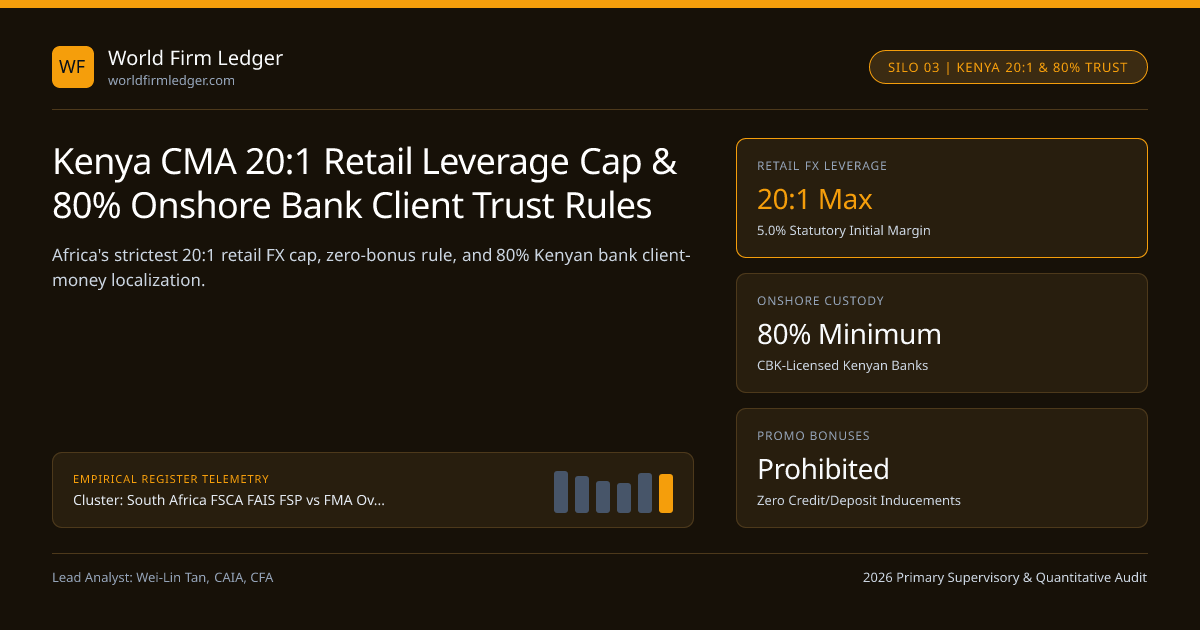
While Kenya CMA's KES 30M and KES 50M capital tiers mirror global STP/Market-Maker norms, Nairobi surprised international CFD executives in 2017 by enacting two prudential safeguards tougher than London, Sydney, or Johannesburg: a hard 20:1 maximum retail leverage cap (5% initial margin)—identical to Singapore MAS Notice SFA 04-N12—and a mandatory 80% onshore Kenyan bank localization rule preventing client deposits from being swept 100% offshore to foreign liquidity providers! Within our South Africa FSCA FAIS vs FMA ODP licensing guide, understanding how Nairobi STP brokers finance offshore liquidity-provider margin while keeping 80% of client funds inside Kenya is essential treasury engineering.
Inside Kenya's 20:1 Leverage Ceiling, Bonus Ban, and Credit-Trading Prohibition#
Under Part IV and the Schedules of Kenya's Online Foreign Exchange Trading Regulations (CMA portal reference):
- Strict 20:1 Maximum Leverage Across Retail Accounts (5.0% Initial Margin): Whereas offshore Seychelles/Mauritius websites aggressively market 500:1 to 2,000:1 leverage to Nairobi university students, CMA caps retail leverage at 20:1—cutting wipeout velocity during US CPI or Bank of Japan spikes by 96%!
- Complete Prohibition on Credit-Extended Margin Loans & Deposit Bonuses: An online FX broker in Kenya shall not extend credit or margin loans to retail clients to fund initial margin, and shall not offer cash bonuses, credit trading bonuses, or volume-linked promotional giveaways designed to induce over-trading!
- Mandatory Risk Warnings, Demo Onboarding & Automated Stop-Out: Platforms must provide realistic demo environments, prominent loss-rate disclosures, and automated margin-call (e.g., 100%/70%) and stop-out liquidation (e.g., 50%) protections preventing runaway debit balances.
The Working-Capital Conundrum of the 80% Onshore Client-Money Rule#
Look closely at what happens operationally when a Nairobi Non-Dealing STP Broker keeps 80% to 100% of Kenyan client cash segregated inside a Nairobi commercial bank (such as KCB, Equity Bank, Stanbic Kenya, or Standard Chartered Kenya, alongside regional institutions like Bank of Baroda or Bank of India), while simultaneously hedging 100% of client trades on an A-book basis at a London FCA Prime-of-Prime liquidity provider!
- Suppose Kenyan clients deposit USD 5,000,000 in Nairobi and take net long Gold (XAU/USD) positions of USD 40,000,000 notional (8:1 utilized leverage within the 20:1 cap).
- Even if the London institutional Prime-of-Prime grants the broker 50:1 institutional margin (2% = USD 800,000 initial margin) PLUS clients experience a temporary -3% unrealized drawdown (-USD 1,200,000 Variation Margin call in London = USD 2,000,000 total cash needed in London!), the broker cannot sweep USD 2,000,000 (40%) out of the Nairobi client trust account without breaching the 80% onshore rule! Instead, the broker must fund London LP Variation Margin out of its own corporate treasury credit lines!
| Jurisdiction | Retail Major FX Leverage Cap | Deposit Bonus Permitted? | Domestic Bank Client-Money Localization | Negative Balance Protection | Reference / Profile |
|---|---|---|---|---|---|
| Kenya CMA | 20:1 (5.0% Margin) | No (Banned) | >= 80% in CBK-Licensed Kenyan Banks | Platform Stop-Out / NBP Standard | CMA Portal |
| Singapore MAS | 20:1 (5.0% Margin) | Restricted | 100% Singapore Bank Statutory Trust (Retail) | Not Statutorily Mandated (5% Cushion) | MAS Compendium |
| Australia ASIC | 30:1 (3.33% Margin) | No (Banned) | Australian ADI Client Money Trust Account | Mandatory Statutory Retail NBP | ASIC Compendium |
| South Africa FSCA | Appropriateness / ODP Policy | Restricted Under GCOC s.3A | SA Registered Bank (FAIS Sec 19(3)) | Contractual / ODP Risk Policy | FSCA Ministry |
Modeling Corporate Treasury Liquidity Needed for Nairobi A-Book Hedging#
Let us quantify the corporate working-capital line a Nairobi Non-Dealing STP broker must budget in London to support Kenyan directional trading without violating Kenya CMA's 80% onshore trust localization floor:
- TotalGroupWorkingCapitalUSD = KenyaCMALiquidCapitalUSD + RequiredCorporateLPBridgeUSD
- Worked Nairobi STP Broker Liquidity Sizing (USD 5M Client Deposits; USD 35M Net Directional Gold/FX Exposure):
- Kenya CMA Liquid Capital Held Onshore (KES 30M + 5% Excess = ~USD 470,000; >=80% in Kenya Bank)
- Client Trust Cash Locked Onshore in Stanbic/SCB Kenya (>= 80% of $5M = USD 4,000,000+ untouchable for London margin!)
- London Prime-of-Prime Margin Demand:
- Institutional Initial Margin (2.0% on $35M) = USD 700,000
- 3-Sigma Intraday Adverse Move Buffer (3.5% on $35M before retail stop-outs settle) = USD 1,225,000
- RequiredCorporateLPBridgeUSD = USD 1,925,000 in Group Treasury Cash Posted at London LP!
Why the 80% Onshore Rule Saved Kenyan Traders During Foreign Broker Insolvencies#
When overseas parent entities face sanctions freezes or sudden European/offshore insolvency proceedings, regulators in emerging markets without localization rules often discover that 98% of local citizens' money was wired out months ago to Cyprus or Belize. Because Kenya CMA locks at least 80% of client funds and statutory capital inside CBK-regulated Nairobi banks, Kenyan liquidators and CMA trustees retain immediate sovereign court jurisdiction over the cash!
Investor Education Levies & Marketing Pre-Scrutiny in Nairobi#
Kenya CMA also actively polices billboard, radio, and influencer campaigns in Nairobi and Mombasa—prohibiting luxury-lifestyle "get-rich-quick" imagery, requiring clear risk disclaimers, and mandating active broker participation in Kenyan financial-literacy initiatives—setting an East African conduct benchmark across our South Africa FSCA and ODP licensing topic hub.
Frequently asked questions
Can a Kenya CMA-licensed forex broker offer me 500:1 leverage if I ask for a high-risk account?
No. Under Kenya’s Capital Markets (Online Foreign Exchange Trading) Regulations, retail online FX accounts under the Kenyan entity are bound by the statutory 20:1 leverage ceiling (5% initial margin).
Why are "100% Deposit Bonus" promotions illegal on CMA-licensed Kenyan trading apps?
Kenya CMA bans cash and credit trading bonuses because volume-locked bonus terms historically trapped retail traders from withdrawing their own principal and incentivized reckless over-leveraging.
Where is my money actually kept when I deposit via M-Pesa into a CMA-licensed broker?
Funds are swept into a segregated Client Trust Account at a commercial bank licensed by the Central Bank of Kenya, subject to daily internal reconciliation and CMA’s rule keeping at least 80% localized onshore.
How does Kenya’s 20:1 leverage rule compare with South Africa’s FSCA framework?
Kenya enforces a hard statutory 20:1 product-intervention ceiling across all retail accounts, whereas South Africa relies on FMA ODP solvency reserves (ZAR 50M+), Conduct Standard 2 appropriateness tests, and strict agency-vs-principal disclosure.
Publication record
- Published
- 14 November 2026
- Updated
- 15 November 2026
- Author
- Wei-Lin Tan, CAIA, CFA
- Review
- Review not recorded
- Automated fact check
- Passed in the stored pipeline record
- Source URLs
- 3 recorded
AI assistance recorded: anthropic/claude-opus-4.6. This field does not establish human review or source verification.
Academic & Institutional Attribution
Cite This Research & Embed Live Data Card
Standard academic & institutional research paper citation format.
Wei-Lin Tan, CAIA, CFA. (2026, November 14). Kenya CMA 20:1 Retail Leverage Cap & 80% Onshore Bank Client Trust Rules. World Firm Ledger. https://worldfirmledger.com/almanac/kenya-cma-20x-retail-leverage-cap-80-client-trust-bankRegulatory Directory Cross-Reference
Referenced Institutions & Regulatory Registries
Mentioned Regulated Institutions
Related South Africa Fsca Fais Odp Licensing & Institutional Briefings
Explore South Africa Fsca Fais Odp Licensing Hub (20) →South Africa Fsca Fais Odp Licensing
South Africa FSCA FAIS FSP vs FMA Over-the-Counter Derivative Provider (ODP) GuideSouth Africa Fsca Fais Odp Licensing
Nigeria SEC & Central Bank (CBN): Digital Asset & FX Intermediation RulesSouth Africa Fsca Fais Odp Licensing
Mauritius FSC Investment Dealer + South Africa FSCA Dual-Hub ArchitectureSouth Africa Fsca Fais Odp Licensing
Southern Africa CMA Peg & Cross-Border Rules: Namibia NAMFISA & Botswana NBFIRASouth Africa Fsca Fais Odp Licensing
South Africa COFI Bill: Activity-Based FSCA Licensing & Twin Peaks Phase 2South Africa Fsca Fais Odp Licensing
FSCA FSP Search Portal Forensic Audit: Verifying Product Codes & ODP StatusSouth Africa Fsca Fais Odp Licensing
FSCA FAIS Category I FSP Trap: Why Agency Intermediaries Cannot Act as PrincipalSouth Africa Fsca Fais Odp Licensing
South Africa FMA ODP License: Conduct Standard 1 & ZAR 50M+ Liquid Capital RulesJapan Fsa Fibo Margin Segregation
JFSA System Risk & FISC Guidelines: Tokyo Dual-Datacenter FIBO ResilienceJapan Fsa Fibo Margin Segregation
South Korea FSC & FSS Rules: 10:1 Retail FX Cap & KRW 10M Derivative GatesJapan Fsa Fibo Margin Segregation
Taiwan FSC & TPEx Leveraged Transaction Merchant (LTM) Retail FX/CFD RulesJapan Fsa Fibo Margin Segregation
Hong Kong SFC Type 3 Leveraged FX License: HKD 30M Capital & 20:1 Margin
World Firm Ledger Data, Benchmarks & Contributor Records
CC BY 4.0 Open Data
Open Institutional Datasets (CSV / JSON) →
Download desk-compiled quantitative series & schemas.
2026 Reference Matrix
2026 Institutional Benchmarks & Thresholds →
Statutory capital, clearing, margin & rate conventions.
Editorial Records
Authors & Review Records →
View named contributors where those records are available.
Complete Index
Master Research & Dossier Archive →
Browse all published briefings by topic pillar & date.