
Japan Fsa Fibo Margin Segregation
FFAJ Corporate FX Margin in Japan: Weekly Historical Volatility Formula
Implemented in February 2017 after Swiss Franc shock reviews, Japan’s corporate OTC FX margin regime replaces fixed caps with weekly historical-volatility ratios computed by the FFAJ.
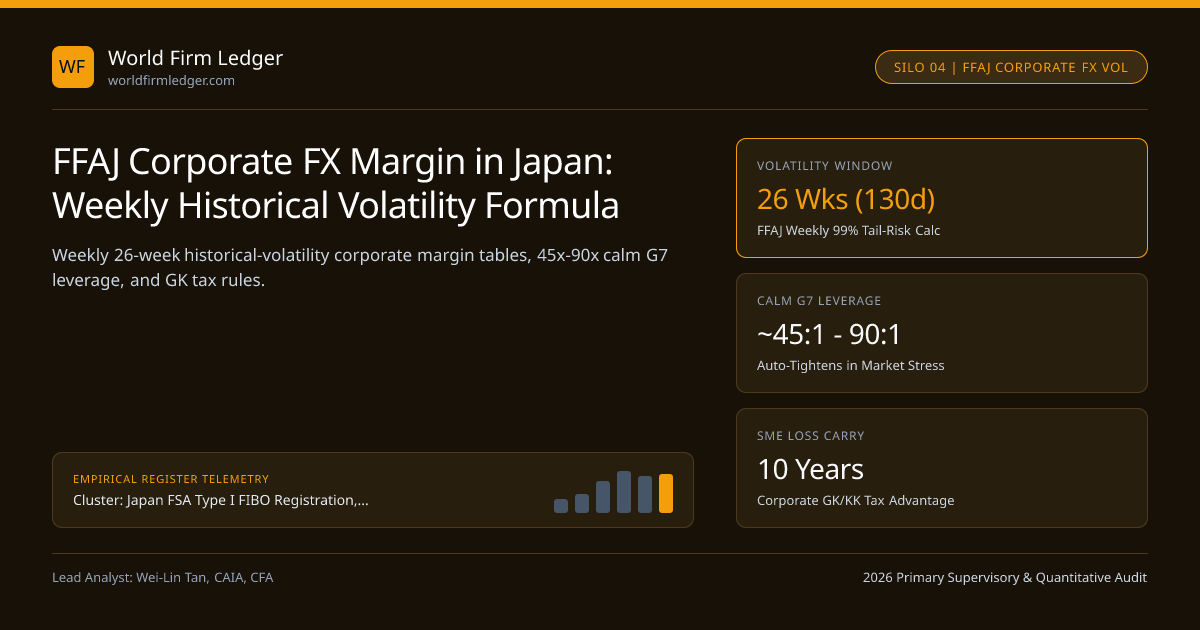
Between 2011 and early 2017, after Japan capped individual retail FX accounts at 25:1 (4% margin), thousands of active Japanese day-traders incorporated one-person micro-companies (Godo Kaisha / GK or Kabushiki Kaisha / KK) solely to open Corporate FX Accounts (Hojin Koza) offering 100:1 to 400:1 unregulated corporate leverage! Following the January 2015 Swiss National Bank EUR/CHF shock—which inflicted severe unpaid corporate shortfalls reported to the Japan FSA—Tokyo enacted Cabinet Office Ordinance Article 117(1)(xxviii-2) effective 27 February 2017: introducing the world's only dynamic weekly historical-volatility statutory margin engine administered centrally by the Financial Futures Association of Japan (FFAJ)!
How FFAJ Computes Pair-by-Pair Corporate FX Margin Every Single Week#
Within our Japan FSA Type I FIBO & trust segregation guide, corporate FX accounts in Japan are neither fixed at 25:1 nor uncapped! Instead, every single week (applying to the following week's trading), FFAJ ingests the trailing 26 weeks (130 business days) of spot exchange-rate moves for every currency pair (USD/JPY, EUR/JPY, EUR/USD, GBP/JPY, TRY/JPY, etc.) and publishes the statutory minimum Assumed Foreign Exchange Fluctuation Risk Ratio (Kawase Hendou Risk Soutou Ritsu):
- Calm Low-Volatility Weeks: When 26-week realized volatility on EUR/USD or USD/JPY compresses to ultra-calm levels, the FFAJ 99% one-day VaR-based risk ratio can drop to 1.0% to 1.6% margin—permitting legal corporate leverage of 60:1 up to ~100:1!
- High-Volatility Central Bank Shock Weeks: The instant Bank of Japan interventions, US Tariff shocks, or Turkish Lira devaluations inflate the 26-week volatility distribution, FFAJ's weekly table automatically hikes corporate margin to 3.5%, 6.0%, or 12.0%+ (slashing corporate leverage to 28:1, 16:1, or 8:1) across every Type I FIBO in Japan simultaneously!
- 1.0% Absolute Floor Boundary in Practice: Even during ultra-dormant currency pegs, brokers and FFAJ reference tables enforce sensible risk floors (~1.0% minimum on major pairs, never 0.1% / 1,000:1!).
Structural Advantages (and Risks!) of a Japanese Corporate (GK / KK) FX Account#
Why do high-volume Japanese algorithmic traders still incorporate a Godo Kaisha (GK) (~JPY 60,000 registration tax) to trade corporate accounts at Tokyo Type I FIBOs even when volatility occasionally pushes GBP/JPY margin near 3%–4%? Taxation & Loss Carry-Forward!
| Account Attribute | Japanese Individual Retail FX Account | Japanese Corporate (GK / KK) FX Account | Offshore Unregistered Corporate Acct | Reference / Portal |
|---|---|---|---|---|
| Statutory Margin Rule | Fixed 4.0% Floor (Max 25:1) | Dynamic Weekly FFAJ 26-Wk Volatility % | Unregulated (JFSA Warning Target) | FFAJ Portal |
| Typical EUR/USD / USD/JPY Leverage | 25:1 Cap | ~40:1 to 90:1 (Calm) / 20:1–35:1 (Volatile) | 500:1 (High Counterparty Risk) | JFSA Ministry |
| Mandatory Loss-Cut Required? | Yes (Cabinet Ordinance Art. 123) | Yes! Extended to Corporates in Feb 2017! | Contractual Only | 25:1 Loss-Cut Rules |
| Domestic Trust Bank (Shintaku)? | Yes — 100% Segregated | Yes — 100% Segregated Alongside Retail! | No — Zero Japanese Trust Bank! | Trust Segregation |
| Tax Rate & Loss Carry-Forward | 20.315% Flat; 3-Year Carry-Forward | ~23%–34% Effective Corp Tax; 10-Year Carry-Forward + Expense Offset! | Individual = Up to 55% Misc Tax | JFSA Compendium |
Quantitative Formula: FFAJ Historical Volatility Margin & Monday Rollover Shock#
Under the quantitative specification adopted by JFSA and FFAJ, a broker either adopts FFAJ's centrally calculated pair table (used by ~95% of Tokyo brokers!) or computes its own verified historical-volatility model over the 26-week window. Watch what happens on a Friday/Monday weekly reset when a central bank surprise spikes the 26-week standard deviation:
- CorporateEffectiveMaxLeverage(Pair) = 100% / FFAJWeeklyCorporateMargin_Pct(Pair)
- Worked Tokyo GK Corporate Account Weekly Reset Stress Audit (Long 1,000,000 USD/JPY at 152.00 = JPY 152,000,000 Notional):
- Week 1 (Calm 130-Day Daily Vol = 0.58% -> FFAJ 99% Ratio = 1.35% Margin = 74.0x Max Leverage):
- Required Corporate Margin = 152,000,000 * 0.0135 = JPY 2,052,000 (Account Equity Held = JPY 2,600,000 -> 126.7% Safe!)
- Week 2 (BoJ Surprise Rate Hike Pushes 130-Day Daily Vol to 0.96% -> New FFAJ Ratio = 2.24% Margin = 44.6x Leverage!):
- New Required Corporate Margin = 152,000,000 * 0.0224 = JPY 3,404,800!
- Account Equity (JPY 2,600,000) Suddenly Drops to 76.4% Maintenance Ratio -> Immediate Oisho / Loss-Cut Risk Without Even 1 Pip Price Move!
Mandatory Corporate Loss-Cut Rules & LEI Reporting Requirements#
Alongside the weekly volatility formula, Japan's February 2017 reform closed a second loophole: extending mandatory automated Loss-Cut rules to Corporate FX accounts (previously mandatory only for individuals!), while requiring corporate OTC derivative counterparties above reporting thresholds to maintain an active 20-character Legal Entity Identifier (LEI) via Japan Exchange Group (JPX-LEI)!
Fiscal-Year-End Unrealized Mark-to-Market Corporate Tax Nuance#
Corporate treasurers opening a Japanese GK / KK FX account must also account for one critical corporate tax rule: whereas Japanese individuals pay the 20.315% flat tax strictly on closed realized FX profits as of 31 December, Japanese corporations must generally mark open OTC FX positions to market at their corporate fiscal year-end (Kessanbi)—connecting tax, treasury, and volatility margin planning across our Japan FSA FIBO and trust segregation topic hub.
Frequently asked questions
Is there a fixed 10:1 or 25:1 leverage cap on Corporate FX accounts in Japan?
No! Neither 10:1 nor 25:1 is fixed for corporations: Japan uses a quantitative 26-week historical-volatility model updated weekly by the Financial Futures Association of Japan (FFAJ), allowing ~50:1–90:1 on calm G7 pairs while tightening automatically below 20:1 when volatility spikes.
Can a weekly FFAJ margin increase trigger liquidation on an already-open corporate FX position?
Yes! Because updated weekly corporate margin percentages apply across all open positions (not just newly opened trades), a jump in the FFAJ ratio from 1.5% to 2.5% raises required margin by 67% overnight and can trigger an Oisho margin call or Loss-Cut if excess equity is thin.
Can a foreign offshore BVI or Seychelles company open a Corporate FX account at a Tokyo Type I FIBO?
Virtually all Japanese Type I retail/corporate FX FIBOs accept only domestically registered Japanese legal entities (Kabushiki Kaisha or Godo Kaisha) holding a Japanese corporate number (Hojin Bango), Japanese corporate bank account, and Japan-resident representative director.
Why do Japanese traders with both FX and crypto gains incorporate a Godo Kaisha (GK)?
For Japanese individuals, 20.315% separate FX income CANNOT be netted against progressive Miscellaneous crypto gains/losses; inside a Japanese GK/KK corporation, all FX, CFD, crypto, and operating software expenses pool into unified corporate taxable income with 10-year SME loss carry-forwards!
Publication record
- Published
- 13 November 2026
- Updated
- 16 November 2026
- Author
- Wei-Lin Tan, CAIA, CFA
- Review
- Review not recorded
- Automated fact check
- Passed in the stored pipeline record
- Source URLs
- 3 recorded
AI assistance recorded: anthropic/claude-opus-4.6. This field does not establish human review or source verification.
Academic & Institutional Attribution
Cite This Research & Embed Live Data Card
Standard academic & institutional research paper citation format.
Wei-Lin Tan, CAIA, CFA. (2026, November 16). FFAJ Corporate FX Margin in Japan: Weekly Historical Volatility Formula. World Firm Ledger. https://worldfirmledger.com/almanac/ffaj-corporate-fx-weekly-historical-volatility-marginRegulatory Directory Cross-Reference
Referenced Institutions & Regulatory Registries
Top Regulated Institutions in This Coverage Slice
Related Japan Fsa Fibo Margin Segregation & Institutional Briefings
Explore Japan Fsa Fibo Margin Segregation Hub (20) →Japan Fsa Fibo Margin Segregation
Japan FSA Type I FIBO Guide: 25x FX Margin, 120% Capital & Trust SegregationJapan Fsa Fibo Margin Segregation
Japan Non-FX CFD Leverage Caps: 5x Single Stocks, 10x Indices & 20x GoldJapan Fsa Fibo Margin Segregation
FFAJ Monthly OTC FX Statistical Bulletins: Auditing Unpaid Loss-Cut ShortfallsJapan Fsa Fibo Margin Segregation
JFSA Unregistered Foreign Broker Warnings (Mitoroku Gyosha) & Tax PenaltiesJapan Fsa Fibo Margin Segregation
Tokyo Financial Exchange (TFX) Click 365 vs OTC FIBO FX: Clearing & Tax ParityJapan Fsa Fibo Margin Segregation
Japan JVCEA & FIEA Crypto Rules: 2x Derivative Leverage Cap & 95% Cold CustodyJapan Fsa Fibo Margin Segregation
Decoding Kanto Local Finance Bureau (Kinsho) Numbers: JFSA Registry AuditJapan Fsa Fibo Margin Segregation
Japan Investor Protection Fund (JIPF): JPY 10M Cap & Why OTC FX Is ExcludedBrazil Cvm Mexico Cnbv Emerging Hubs
Mexico CNBV Casa de Bolsa Rules: LMV Capital & Foreign Broker SolicitationBrazil Cvm Mexico Cnbv Emerging Hubs
Mexico Ley Fintech (IFPE & IFC): Banxico Crypto & Foreign Broker FirewallsBrazil Cvm Mexico Cnbv Emerging Hubs
Mexico SIC Global Market: 10% Flat Capital Gains Tax on 3,500+ US/Global ETFsBrazil Cvm Mexico Cnbv Emerging Hubs
Chile CMF Fintech Law (Ley 21.521) & NCG 502: CFD, Crypto & Trading Rules
World Firm Ledger Data, Benchmarks & Contributor Records
CC BY 4.0 Open Data
Open Institutional Datasets (CSV / JSON) →
Download desk-compiled quantitative series & schemas.
2026 Reference Matrix
2026 Institutional Benchmarks & Thresholds →
Statutory capital, clearing, margin & rate conventions.
Editorial Records
Authors & Review Records →
View named contributors where those records are available.
Complete Index
Master Research & Dossier Archive →
Browse all published briefings by topic pillar & date.