
Japan Fsa Fibo Margin Segregation
Japan FIBO Article 46-6 Capital Adequacy Ratio: 140%, 120% & 100% Triggers
Under Article 46-6 of Japan’s Financial Instruments and Exchange Act, every Type I FIBO publishes its Capital Adequacy Ratio publicly each quarter while guarding against the 120% statutory floor.
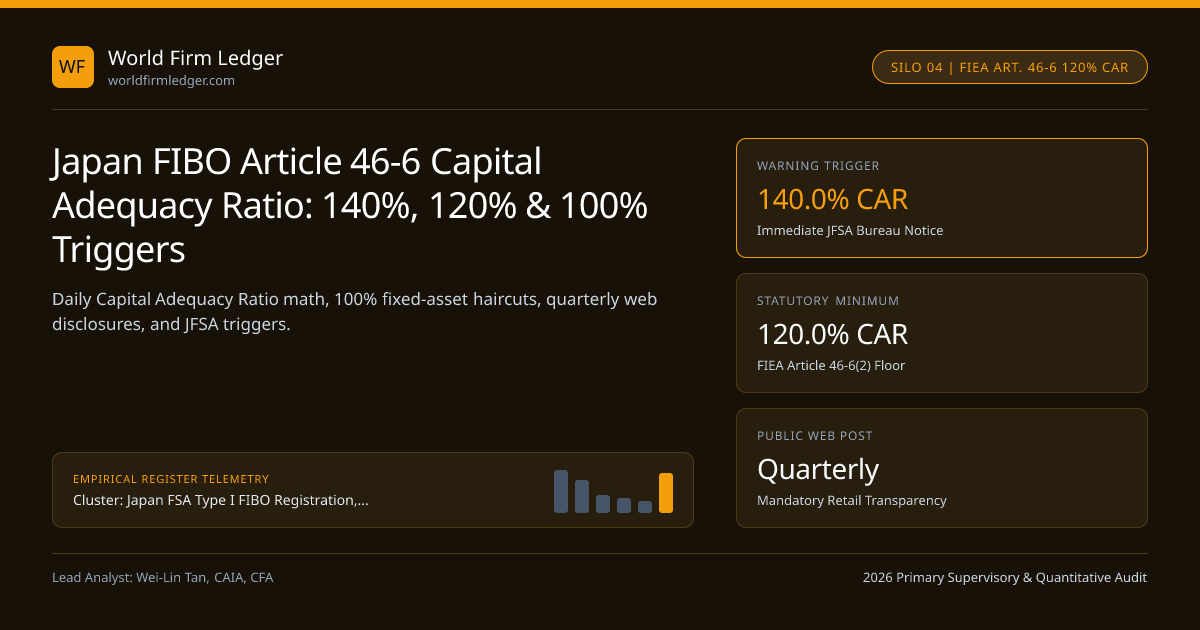
Article 46-6 of Japan's Financial Instruments and Exchange Act establishes one of the most transparent public solvency scorecards in global finance: every single Type I Financial Instruments Business Operator must calculate its Capital Adequacy Ratio (Jiko Shihon Kisei Hiritsu) daily, report it monthly to the Japan FSA, and publish the exact percentage for public retail inspection at every branch and on its website four times a year (March, June, September, and December)! Within our Japan FSA Type I FIBO & trust segregation guide, Japanese retail FX traders routinely compare brokers' published CAR scores (typically ranging from 250% to over 1,200% at major Tokyo houses!) alongside FFAJ monthly statistical disclosures before depositing a single Yen.
Anatomy of the Numerator (Koteikaka Sarenai Jiko Shihon) & Denominator (Risk Soto Gaku)#
Unlike accounting net worth, FIEA Article 46-6 measures strictly liquid, immediately loss-absorbing equity (Non-Fixed Own Capital) divided by three risk equivalents prescribed in Financial Services Agency Public Notice No. 59 of 2007:
- Numerator — Basic Equity + Supplementary Tier 2 LESS Fixed Illiquid Assets: Starts with Tier 1 Shareholder Equity plus qualifying subordinated loans/valuation reserves, minus 100% of Fixed Assets (Kotei Shisan)! Every Yen spent capitalizing in-house trading software, Tokyo office lease security deposits (Shikikin), server hardware, deferred tax assets, and illiquid affiliate investments is deducted 100% from the numerator!
- Denominator Component A — Market Risk Equivalent (Shijo Risk Soto Gaku): Standardized haircuts (or approved VaR) on net unhedged proprietary B-book currency, equity, commodity, and interest-rate exposures! An OTC FX broker warehousing unhedged retail USD/JPY, TRY/JPY, or ZAR/JPY positions takes an immediate 8% standardized FX market-risk charge on net open foreign currency positions (plus nonlinear option gamma/vega charges)!
- Denominator Component B — Counterparty Risk Equivalent (Torihikisaki Risk Soto Gaku): Credit-risk weights (0% to 100% depending on rating/collateral) on upstream Prime-of-Prime hedge margin deposits, OTC derivative replacement costs, and accrued receivables.
- Denominator Component C — Basic Operational Risk Equivalent (Kisoteki Risk Soto Gaku): Exactly 25% (3 months) of the total operating expenses incurred over the preceding 12 rolling months!
Comparing the Four CAR Thresholds & Supervisory Powers Under FIEA Articles 52–53#
Notice how closely Japan's 120% statutory floor / 140% early-warning trigger parallels Singapore MAS's 100% floor / 120% warning ratio, yet adds mandatory quarterly website publication so retail traders act as real-time market disciplinarians:
| Capital Adequacy Ratio Band | Legal Status Under FIEA | Mandatory Broker Action | JFSA / Local Finance Bureau Action | Public Retail Visibility | Reference |
|---|---|---|---|---|---|
| >= 250% – 1,000%+ | Institutional Best Practice | Routine monthly filing & quarterly web post | Standard periodic inspection | Marketed proudly on broker homepage | FFAJ SRO |
| 140.0% – 249.9% | Fully Compliant | Monitor intraday B-book FX spikes | Heightened desk monitoring near 150% | Published in quarterly statutory PDF | JFSA Ministry |
| 120.0% – 139.9% | Early-Warning Zone | Immediate written notice + remediation plan | Daily liquidity reporting ordered | Triggers analyst & media scrutiny | JFSA Compendium |
| 100.0% – 119.9% | Statutory Breach (Art. 46-6(2)) | Halt risky proprietary warehousing; raise cash | Art. 51/53 Capital Restoration Order | Public administrative action notice! | HK SFC FRR Peer |
| Below 100.0% | Critical Deficiency | Cease new order intake; transfer/unwind | Art. 52 Suspension (<=3m) or Revocation | Emergency customer withdrawal via Trust! | Trust Segregation |
Modeling How Capitalizing a JPY 600M Trading Platform Upgrades IT Yet Crashes CAR!#
One of the classic CFO traps in Tokyo occurs when a profitable mid-tier FX broker spends JPY 600,000,000 building a custom smartphone trading app and capitalizes it as an intangible software asset on its balance sheet. Under Japanese GAAP, total shareholder equity looks completely unchanged—yet under FIEA Article 46-6, cash (0% haircut) turned into Fixed Intangible Software (100% deducted!), instantly slashing CAR by over 80 percentage points!
- PostSoftwareCapExCAR = (UnfixedNetCapitalInitial - CapitalizedSoftwareIntangibleJPY + QualifyingSubLoanJPY) / TotalRiskEquivalent
- Worked CFO Balance-Sheet Simulation (Tokyo Mid-Tier FX FIBO):
- Initial Unfixed Net Capital = JPY 1,540,000,000; Total Risk Equivalent (Market + Cpty + 25% OpEx) = JPY 700,000,000
- Pre-CapEx CAR = 1,540,000,000 / 700,000,000 = 220.0% (Healthy)
- Broker Spends JPY 600,000,000 Cash on New Proprietary Mobile Trading Core (Capitalized as 5-Yr Software Asset):
- GAAP Net Worth = Unchanged!
- FIEA Unfixed Net Capital = 1,540,000,000 - 600,000,000 = JPY 940,000,000!
- Post-CapEx CAR Without Financing = 940,000,000 / 700,000,000 = 134.3% -> BREACHES 140% JFSA EARLY WARNING TRIGGER!
- Compliant Remedy: Parent injects JPY 500,000,000 Eligible Subordinated Loan (>= 2-Yr Lock-In Clause) -> Restores CAR to 205.7%!
How Automated Cover-Dealing Protects Intraday CAR During Bank of Japan Interventions#
Whenever the Ministry of Finance and Bank of Japan intervene abruptly by 400–500 pips in USD/JPY, Japanese retail traders ("Mrs. Watanabe") routinely buy tens of billions of Dollars against the spike. If a Type I FIBO fails to auto-hedge net directional exposure at Tier-1 interbank cover counterparties, its 8% Market Risk Equivalent explodes intraday—which is why Tokyo risk engines link automated A-book cover thresholds directly to live Article 46-6 CAR headroom!
Auditing a Broker's Statutory Explanatory Document (Gyomu Oyobi Zaisan no Jokyo ni Kansuru Setsumeisho)#
Under FIEA Article 46-4, in addition to quarterly CAR tables, every Type I FIBO must publish an annual Public Explanatory Document on Business and Property Status within four months of fiscal year-end—disclosing audited income statements, segregated trust-bank names, system outage counts, and administrative history—giving global counterparties unmatched transparency across our Japan FSA FIBO and trust segregation topic hub.
Frequently asked questions
Where can I check a Japanese forex broker’s current Capital Adequacy Ratio?
Under FIEA Article 46-6(3), every registered Japanese Type I FIBO is legally required to post its quarterly Capital Adequacy Ratio (Jiko Shihon Kisei Hiritsu) PDF openly in the "Company / Financial Disclosure" footer of its Japanese website.
What happens to my money if a Japanese broker’s Capital Adequacy Ratio drops below 100% and JFSA suspends it?
Even if JFSA suspends or revokes a broker’s registration under Article 52, 100% of customer deposits and unrealized FX profits sit inside an independent domestic Japanese Trust Bank (Kanzen Shintaku Hozen) and are returned directly to customers by the designated trustee/beneficiary agent.
Why did my Tokyo subsidiary’s Capital Adequacy Ratio fall right after we paid cash to build a new trading app?
Because spending corporate cash (an allowable liquid asset) to create capitalized software or leasehold improvements (classified as Fixed Assets) causes a 100% deduction from Unfixed Own Capital under FIEA Article 46-6 even though GAAP net equity did not change.
Can a foreign parent company rescue a Japanese Type I FIBO’s CAR quickly during market turmoil?
Yes—either via an immediate ordinary share capital injection or a pre-approved Qualifying Subordinated Loan Agreement containing mandatory FIEA lock-in clauses that prohibit repayment whenever doing so would push CAR below 140%/120%.
Publication record
- Published
- 14 November 2026
- Updated
- 16 November 2026
- Author
- Wei-Lin Tan, CAIA, CFA
- Review
- Review not recorded
- Automated fact check
- Passed in the stored pipeline record
- Source URLs
- 3 recorded
AI assistance recorded: anthropic/claude-opus-4.6. This field does not establish human review or source verification.
Academic & Institutional Attribution
Cite This Research & Embed Live Data Card
Standard academic & institutional research paper citation format.
Wei-Lin Tan, CAIA, CFA. (2026, November 16). Japan FIBO Article 46-6 Capital Adequacy Ratio: 140%, 120% & 100% Triggers. World Firm Ledger. https://worldfirmledger.com/almanac/japan-fibo-article-46-6-capital-adequacy-120-140-ratioRegulatory Directory Cross-Reference
Referenced Institutions & Regulatory Registries
Top Regulated Institutions in This Coverage Slice
Related Japan Fsa Fibo Margin Segregation & Institutional Briefings
Explore Japan Fsa Fibo Margin Segregation Hub (20) →Japan Fsa Fibo Margin Segregation
Japan FSA Type I FIBO Guide: 25x FX Margin, 120% Capital & Trust SegregationJapan Fsa Fibo Margin Segregation
Japan Kanzen Shintaku Hozen: Mandatory Domestic Trust-Bank Client SegregationJapan Fsa Fibo Margin Segregation
Japan Retail FX 4% Margin (25:1 Cap), Loss-Cut Rule & Zero-Cut ProhibitionJapan Fsa Fibo Margin Segregation
FFAJ Corporate FX Margin in Japan: Weekly Historical Volatility FormulaJapan Fsa Fibo Margin Segregation
Japan Non-FX CFD Leverage Caps: 5x Single Stocks, 10x Indices & 20x GoldJapan Fsa Fibo Margin Segregation
FFAJ Monthly OTC FX Statistical Bulletins: Auditing Unpaid Loss-Cut ShortfallsJapan Fsa Fibo Margin Segregation
JFSA Unregistered Foreign Broker Warnings (Mitoroku Gyosha) & Tax PenaltiesJapan Fsa Fibo Margin Segregation
Tokyo Financial Exchange (TFX) Click 365 vs OTC FIBO FX: Clearing & Tax ParityBrazil Cvm Mexico Cnbv Emerging Hubs
Brazil CVM BDR Rules: Retail Access to Global Stocks & ETFs on B3 in ReaisBrazil Cvm Mexico Cnbv Emerging Hubs
Banco Central do Brasil Resolution 277: eFX Cross-Border Pix & FX Law 14,286Brazil Cvm Mexico Cnbv Emerging Hubs
Brazil Crypto Law 14.478: BCB PSAV Licensing, CVM Tokens & SegregationBrazil Cvm Mexico Cnbv Emerging Hubs
Mexico CNBV Casa de Bolsa Rules: LMV Capital & Foreign Broker Solicitation
World Firm Ledger Data, Benchmarks & Contributor Records
CC BY 4.0 Open Data
Open Institutional Datasets (CSV / JSON) →
Download desk-compiled quantitative series & schemas.
2026 Reference Matrix
2026 Institutional Benchmarks & Thresholds →
Statutory capital, clearing, margin & rate conventions.
Editorial Records
Authors & Review Records →
View named contributors where those records are available.
Complete Index
Master Research & Dossier Archive →
Browse all published briefings by topic pillar & date.