Japan Fsa Fibo Margin Segregation
JFSA System Risk & FISC Guidelines: Tokyo Dual-Datacenter FIBO Resilience
Operating a Type I online brokerage in earthquake-prone Japan requires strict adherence to FISC Security Guidelines and JFSA System Risk rules—mandating active-standby datacenters and immediate outage reporting.
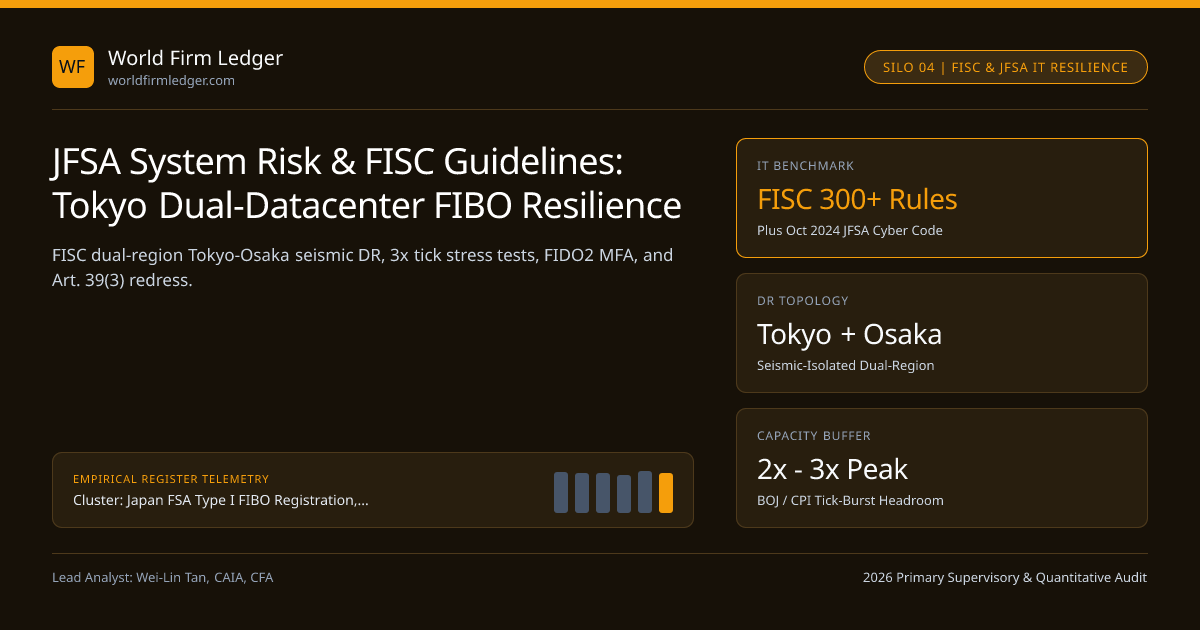
When retail OTC FX turnover regularly hits JPY 1,000+ trillion per month across millions of leveraged accounts subject to automated real-time Loss-Cut liquidation, a 20-minute matching-engine freeze during a US Non-Farm Payrolls spike is treated by the Japan FSA not as a minor IT hiccup—but as a *reportable statutory System Incident (System Shogai) under FIEA Article 40(2) and Comprehensive Supervisory Guidelines Section III-2-8! Within our Japan FSA Type I FIBO & trust segregation guide, passing Kanto Local Finance Bureau licensing requires architecting infrastructure to the gold-standard Center for Financial Industry Information Systems (FISC — Kinyu Joho System Center) Security Guidelines*!
What Are the FISC Security Guidelines (And Why Foreign SaaS Vendors Fail Them)?#
Originally developed with Bank of Japan and Ministry of Finance participation, the FISC Security Guidelines on Computer Systems for Financial Institutions comprise 300+ granular physical, seismic, network, cryptographic, and cloud-governance controls treated by JFSA examiners as the de facto benchmark for every Type I FIBO, bank, and JVCEA crypto exchange:
- Geographically Separated Dual-Region Disaster Recovery (Tokyo <-> Kansai/Osaka): Because a major Nankai Trough or Tokyo Inland Earthquake could sever power/fiber in Greater Kanto, Tier-1 FIBOs deploy Primary Production in Tokyo/Chiba seismic-isolated (Menshin) facilities paired with Synchronous/Near-Zero-RPO Disaster Recovery in Osaka/Kansai (or multi-AZ Japanese AWS Tokyo
ap-northeast-1+ Osakaap-northeast-3cloud regions under FISC Cloud Addendum rules!). - Capacity Headroom Stress-Testing (>= 2x to 3x Peak BOJ/FOMC Load): Matching engines, LP price aggregators, and Loss-Cut margin engines must pass documented load tests simulating 200% to 300% of historical peak tick/order bursts without price-feed staleness!
- Mandatory Multi-Factor Authentication (MFA) After 2025 Phishing Clampdowns: Following coordinated 2025 credential-stuffing attacks on Japanese online stock accounts, JFSA and JSDA/FFAJ mandated enforced device-bound Passkeys / FIDO2 / TOTP MFA on login, withdrawal-bank edits, and order execution!
The FIEA Article 39(3) Carve-Out: How Brokers Compensate Verified System-Outage Losses!#
Wait—didn't FIEA Article 38/39 make compensating customer losses a criminal offense? Yes, EXCEPT for verified System Incidents (Jiko Kakunin — Accident Confirmation / Exemption under FIEA Article 39[3])!
- If a broker's server crashes for 45 minutes while USD/JPY plunges 200 pips—preventing a client's resting Stop-Loss or documented close attempt from executing—the broker CAN and MUST compensate the exact price-difference damage, provided it files a formal Accident Confirmation Application (or qualifies under pre-exempted minor settlement categories) proving the payout stems 100% from an objective IT malfunction rather than disguised VIP favoritism!
| Operational Resilience Requirement | Japan — JFSA & FISC | Singapore — MAS TRM Notice PSN05/FSM-N14 | Offshore White-Label MT4/MT5 | Reference |
|---|---|---|---|---|
| Maximum Unplanned Downtime Tolerance | Immediate Flash Report Upon Any Client Impact | Max 4 Hours / 12 Months (Critical Systems) | Frequent "Server Maintenance" Freezes | JFSA Ministry |
| Geographic Disaster Recovery Standard | Tokyo + Kansai (Osaka) Dual-Region Seismic DR | Multi-AZ Active-Active Resilience | Single Contabo/VPS Instance | MAS TRM Peer |
| Third-Party Cloud / SaaS Audit Rights | Contractual Right for Broker & JFSA Inspection | Mandatory MAS Outsourcing Audit Clause | Opaque Sub-Licensing | FFAJ SRO |
| Verified Server-Freeze Loss Redress | Statutory Accident-Confirmed Price Make-Whole! | FIDReC Adjudication up to SGD 150k | "Read Clause 14: No Liability For IT" | JFSA Compendium |
Modeling Tick-Burst Capacity & Outage Price-Difference Compensation#
Let us examine both the 3x tick-throughput engineering sizing expected under FISC capacity planning and the objective timestamp reconstruction formula used when settling verified system-outage claims:
- VerifiedOutageCompensationJPY = max(0, (IntendedStopOrClosePriceDuringOutage - ActualDelayedRecoveryClosePrice) * LotUnits)
- Worked System-Outage Redress Audit ( Broker Server Freezes 22:30–22:52 JST During US CPI Spike):
- Client Held Long 200,000 USD/JPY w/ Server-Side Stop-Loss at 151.500 (or Logged Rejected Close Attempt at 22:32 JST when Interbank Mid = 151.480)
- Broker Server Recovers at 22:52 JST & Fills Delayed Liquidation at 150.680
- Verified System-Fault Slippage = 151.480 - 150.680 = 0.800 JPY/USD * 200,000 = JPY 160,000
- Broker Files FIEA Art. 39(3) Accident Record & Credits JPY 160,000 Make-Whole Legally!
JFSA's 2024–2025 Cybersecurity Self-Assessment & Threat-Led Penetration Testing (TLPT)#
Recognizing escalating ransomware and state-sponsored supply-chain risks across G7 capital markets, the JFSA Cybersecurity Management Guidelines (published October 2024) elevated board-level CISO accountability, third-party vendor SOC2/ISMAP verification, and Threat-Led Penetration Testing (TLPT) across systemically significant Japanese FIBOs and registered High-Speed Trading gateways.
Consequence of Chronic IT Neglect: FIEA Article 51 Business Improvement Orders#
If a Japanese online broker suffers recurring unpatched outages or delays customer withdrawals, JFSA swiftly issues a public *Business Improvement Order (Gyomu Kaizen Meirei) under FIEA Article 51*, forcing external Big-Four IT audits and freezing new product launches until full FISC remediation is verified across our Japan FSA FIBO and trust segregation topic hub.
Frequently asked questions
Can a foreign fintech startup host a Japanese Type I FIBO matching engine solely on US or European AWS servers?
While FISC and JFSA do not impose an absolute blanket ban on overseas cloud regions, latency for real-time Loss-Cut, data-sovereignty inspection rights, and FISC seismic resilience standards overwhelmingly lead registrants to deploy primary Tokyo (ap-northeast-1) and DR Osaka (ap-northeast-3) infrastructure.
What happens when a Japanese FX broker experiences a 30-minute login freeze during US Non-Farm Payrolls?
The broker must immediately post a timestamped System Incident alert on its public homepage, activate emergency telephone/fallback close procedures, notify its Local Finance Bureau, and compensate verified blocked-order losses under FIEA Article 39(3) procedures.
Why did Japanese online brokers roll out mandatory Passkey / FIDO2 authentication in 2025?
Following sophisticated real-time phishing attacks targeting retail securities accounts in early 2025, JFSA, JSDA, and FFAJ coordinated industry-wide enforcement of phishing-resistant MFA across logins, withdrawals, and order routing.
What is a "Gyomu Kaizen Meirei" from the Japan FSA?
A Business Improvement Order under FIEA Article 51 is a formal public enforcement order compelling a regulated firm’s board to remediate systemic IT, AML, or governance failures under monthly supervisory reporting.
Publication record
- Published
- 13 November 2026
- Updated
- 16 November 2026
- Author
- Wei-Lin Tan, CAIA, CFA
- Review
- Review not recorded
- Automated fact check
- Passed in the stored pipeline record
- Source URLs
- 3 recorded
AI assistance recorded: anthropic/claude-opus-4.6. This field does not establish human review or source verification.
Academic & Institutional Attribution
Cite This Research & Embed Live Data Card
Standard academic & institutional research paper citation format.
Wei-Lin Tan, CAIA, CFA. (2026, November 16). JFSA System Risk & FISC Guidelines: Tokyo Dual-Datacenter FIBO Resilience. World Firm Ledger. https://worldfirmledger.com/almanac/jfsa-system-risk-contingency-fisc-datacenter-resilienceRegulatory Directory Cross-Reference
Referenced Institutions & Regulatory Registries
Top Regulated Institutions in This Coverage Slice
Referenced Supervisory Authorities
Related Japan Fsa Fibo Margin Segregation & Institutional Briefings
Explore Japan Fsa Fibo Margin Segregation Hub (20) →Japan Fsa Fibo Margin Segregation
Japan FSA Type I FIBO Guide: 25x FX Margin, 120% Capital & Trust SegregationJapan Fsa Fibo Margin Segregation
South Korea FSC & FSS Rules: 10:1 Retail FX Cap & KRW 10M Derivative GatesJapan Fsa Fibo Margin Segregation
Taiwan FSC & TPEx Leveraged Transaction Merchant (LTM) Retail FX/CFD RulesJapan Fsa Fibo Margin Segregation
Hong Kong SFC Type 3 Leveraged FX License: HKD 30M Capital & 20:1 MarginJapan Fsa Fibo Margin Segregation
Indonesia Bappebti-to-OJK Transition: JFX/ICDX & 70% Clearinghouse SegregationJapan Fsa Fibo Margin Segregation
Japan FIEA Article 28: Type I vs Type II FIBO Registration & JPY 50M CapitalJapan Fsa Fibo Margin Segregation
Japan FIBO Article 46-6 Capital Adequacy Ratio: 140%, 120% & 100% TriggersJapan Fsa Fibo Margin Segregation
Japan Kanzen Shintaku Hozen: Mandatory Domestic Trust-Bank Client SegregationBrazil Cvm Mexico Cnbv Emerging Hubs
Turkey SPK / CMB Forex & Crypto Rules: 10:1 Leverage, TRY 50k & TakasbankBrazil Cvm Mexico Cnbv Emerging Hubs
India GIFT City IFSCA vs RBI LRS Forex Ban: FEMA Alert List & NSE RulesBrazil Cvm Mexico Cnbv Emerging Hubs
Kazakhstan AFSA (AIFC) vs Onshore ARDFM: English Common-Law Broker RulesBrazil Cvm Mexico Cnbv Emerging Hubs
2026 Multi-Jurisdictional Broker Almanac: MAS, DFSA, FSCA, JFSA & LatAm
World Firm Ledger Data, Benchmarks & Contributor Records
CC BY 4.0 Open Data
Open Institutional Datasets (CSV / JSON) →
Download desk-compiled quantitative series & schemas.
2026 Reference Matrix
2026 Institutional Benchmarks & Thresholds →
Statutory capital, clearing, margin & rate conventions.
Editorial Records
Authors & Review Records →
View named contributors where those records are available.
Complete Index
Master Research & Dossier Archive →
Browse all published briefings by topic pillar & date.