Japan Fsa Fibo Margin Segregation
South Korea FSC & FSS Rules: 10:1 Retail FX Cap & KRW 10M Derivative Gates
Neighboring Japan’s 25:1 FX cap, South Korea’s FSC and FSS enforce Asia’s strictest 10:1 retail forex leverage limit, mandatory KOFIA derivative training hours, and the 2024 VAUPA crypto custody law.
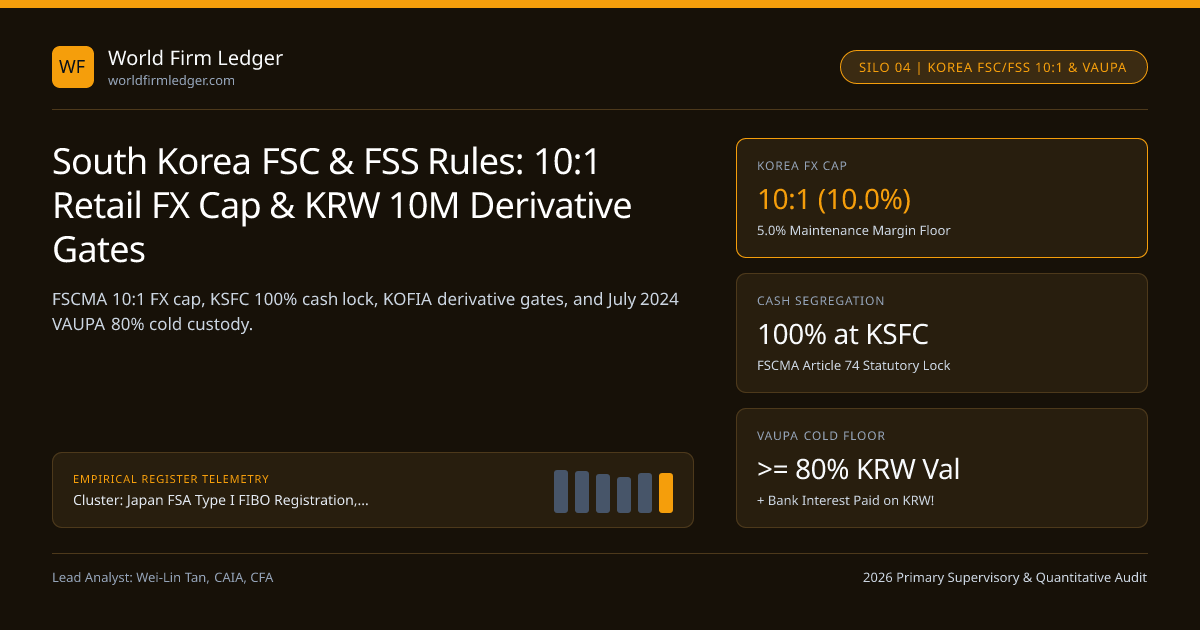
If you think Japan's 25:1 (4% margin) retail FX ceiling is conservative, look straight across the Korea Strait to Seoul! After Korean retail traders accounted for over 35% of global equity-index option volume in the late 2000s and suffered steep retail FX losses, South Korea's Financial Services Commission (FSC) and Financial Supervisory Service (FSS) enacted the tightest retail OTC FX leverage ceiling in the G20: 10:1 maximum leverage (10.0% minimum initial margin) under the Financial Investment Services and Capital Markets Act (FSCMA — Jabon Sijang-beop)! Within our Japan FSA Type I FIBO & trust segregation guide and South Korea FSC/FSS regulatory compendium, understanding Seoul's 10% FX margin, mandatory KOFIA pre-trade derivative education/mock-trading gates, and July 2024 Virtual Asset User Protection Act (VAUPA) explains Korea's extraordinary capital-market structure!
Why Retail FX Margin in South Korea Requires 10% Initial Margin (10:1 Cap)#
Under the FSCMA and FSS Regulations on Financial Investment Business:
- *Only Licensed Korean Securities / Futures Companies (Jeungkwon-sa / Seonmul-sa) May Offer FX Margin: Foreign MetaTrader brokers without an onshore FSC Financial Investment Business license are strictly prohibited* from soliciting South Korean residents (with Korean credit-card MCC blocks and Korea Communications Standards Commission KCSC DNS blocks enforced against illegal offshore FX/gambling domains!).
- 10.0% Initial Margin (10:1 Max Leverage) + 5.0% Maintenance Margin: Since March 2012 (tightened from 2% -> 5% -> 10%!), every retail FX Margin contract executed through a licensed Korean securities or futures firm requires at least USD 10,000 (10%) initial margin per standard USD 100,000 lot and triggers mandatory margin-call/liquidation protection at 5.0% maintenance margin!
- *Korea Securities Finance Corporation (KSFC — Hanguk Jeungkwon Geumyung) Statutory Custody: Just as Japan relies on domestic Trust Banks, FSCMA Article 74 forces Korean securities firms to deposit 100% of customer cash investor deposits (Yetak-geum) with the quasi-sovereign Korea Securities Finance Corporation (KSFC)* or segregated trust accounts—making investor cash completely immune to brokerage bankruptcy!
Kospi 200 Futures/Options Entry Walls & Why Koreans Flocked to Overseas US Futures & Spot Crypto!#
When FSC imposed 10:1 FX leverage alongside *KRW 10,000,000 to KRW 20,000,000 basic deposits (Gibon Yetak-geum) + KOFIA training + KRX simulation hours* on domestic Kospi 200 derivatives (relaxed slightly from the earlier KRW 30M–50M wall in 2019, while keeping higher walls for naked option writing!), Korean active traders pivoted legally into two huge regulated channels:
- CME Overseas Micro/Standard Futures via Domestic Korean Securities Brokers: Routing Nasdaq-100 (
MNQ/NQ) and Crude Oil futures on CME Clearing via Kiwoom, Mirae Asset, Samsung, or Korea Investment & Securities; and - Real-Name Spot Won (KRW) Crypto Exchanges: Led by Upbit, Bithumb, Coinone, and Korbit (alongside ecosystem wallets/platforms tracked in our directory such as Biport Wallet and historical venue Allbit)!
| Regulatory Metric | South Korea — FSC & FSS | Japan — JFSA & FFAJ | Taiwan — FSC & TPEx | Reference |
|---|---|---|---|---|
| Retail OTC FX Max Leverage | 10:1 (10.0% Initial Margin) | 25:1 (4.0% Initial Margin) | 20:1 – 30:1 (Major vs Minor Pairs) | Korea FSS |
| Customer Cash Segregation | 100% Deposited at KSFC (FSCMA Art. 74) | 100% Domestic Trust Bank (FIEA Art. 43-2-2) | Segregated Domestic Bank Margin Acct | Korea Framework |
| Retail Crypto Perpetuals / Margin | Strictly Prohibited Onshore (0x) | Permitted up to 2:1 (Type I FIBO) | Offshore / Restricted | Korbit Directory |
| Spot Crypto Cold-Wallet Floor | >= 80.0% Economic Value (VAUPA July 2024) | >= 95.0% Cold (+ 100% Hot Backup) | FSC VASP Custody Rules | JFSA Compendium |
Modeling South Korea's July 2024 VAUPA Crypto Reserve & Bank Yield Sharing Law#
Enacted after the Terra-LUNA collapse and enforced on 19 July 2024, South Korea's Virtual Asset User Protection Act (VAUPA — Gasang Jasan Iyongja Boho-beop) introduced three quantitative investor protections across FIU-registered Korean VASPs like Korbit:
- *Real-Name Commercial Bank KRW Deposits + Mandatory Interest Yield (Yetak-geum Iyongnyo) Paid to Users!*
- Minimum 80.0% Cold-Wallet Storage calculated daily by KRW economic market value across all customer tokens; and
- Mandatory Hack Insurance or Cold Reserve >= 5% of Hot-Wallet Exposure (Minimum KRW 3 Billion for KRW-Market Exchanges)!
- RequiredHackInsuranceOrReserveKRW = max(KRW3000000000, 0.05 * TotalHotWalletEconomicValueKRW)
- Worked Seoul KRW-Market Exchange Daily VAUPA Compliance Audit (Total Client Crypto = KRW 2,500,000,000,000 / ~$1.82B):
- Minimum 80% Cold-Wallet Economic Value Floor = 0.80 * 2.5T = KRW 2,000,000,000,000
- Remaining 20% Hot-Wallet Liquidity Pool = KRW 500,000,000,000
- Required Insurance Policy or Dedicated Cold Compensation Reserve = max(3.0B, 0.05 * 500B) = KRW 25,000,000,000 (~$18.2M Locked!)
- Plus: Partner Korean Bank Pays ~2.0%-2.2% Annual Deposit Fee Directly Into Customer KRW Balances!
Bank of Korea Foreign Exchange Transactions Act (Oeguk-hwan Georae-beop) Traps#
Just like South Africa's SARB exchange controls, South Korea enforces the Foreign Exchange Transactions Act (FETA): sending over USD 100,000 per year abroad without designated Foreign Exchange Bank documentation—or executing unauthorized "Kimchi Premium" stablecoin/wire round-tripping for unregistered FX/crypto arbitrage—triggers Korea Customs Service and FSS criminal prosecutions!
KDIC's Historic Upgrade to KRW 100,000,000 Deposit Protection#
Complementing KSFC investor-deposit segregation, South Korea legislated a landmark doubling of the Korea Deposit Insurance Corporation (KDIC — Yegeum Bohom Gongsa) protection ceiling from KRW 50,000,000 to KRW 100,000,000 (~USD 73,000)—strengthening household cash safety across banks and financial institutions tracked in our Japan FSA FIBO and Northeast Asia topic hub.
Frequently asked questions
Can an offshore MT4/MT5 broker legally accept South Korean retail clients with 500:1 leverage?
No! Under the Financial Investment Services and Capital Markets Act (FSCMA), offering FX margin or derivatives to South Korean residents without an FSC license is illegal; FSS and KCSC block unlicensed broker domains and Korean card processors block unauthorized FX merchant codes.
Why do Korean crypto exchanges like Korbit and Upbit require a Korean domestic real-name bank account?
Under Korea’s Act on Reporting and Using Specified Financial Transaction Information (FTRA), KRW-fiat crypto trading is permitted exclusively through Real-Name Verification Deposit/Withdrawal Accounts (Silmyeong Hwagin Ipchulgeum Gyejwa) linked 1-to-1 with a vetted domestic Korean bank.
Are Bitcoin perpetual futures legal on South Korean crypto exchanges?
No. Korean authorities do not currently classify virtual assets as eligible underlying assets for FSCMA retail derivatives, meaning all registered domestic Korean VASPs operate strictly 1:1 unleveraged spot markets.
How safe is uninvested KRW cash sitting in a licensed South Korean securities brokerage account?
Exceptionally safe: FSCMA Article 74 forces Korean securities companies to segregate and deposit 100% of customer brokerage cash daily with the Korea Securities Finance Corporation (KSFC), backed additionally by Korea’s upgraded KRW 100M KDIC framework.
Publication record
- Published
- 13 November 2026
- Updated
- 15 November 2026
- Author
- Wei-Lin Tan, CAIA, CFA
- Review
- Review not recorded
- Automated fact check
- Passed in the stored pipeline record
- Source URLs
- 3 recorded
AI assistance recorded: anthropic/claude-opus-4.6. This field does not establish human review or source verification.
Academic & Institutional Attribution
Cite This Research & Embed Live Data Card
Standard academic & institutional research paper citation format.
Wei-Lin Tan, CAIA, CFA. (2026, November 14). South Korea FSC & FSS Rules: 10:1 Retail FX Cap & KRW 10M Derivative Gates. World Firm Ledger. https://worldfirmledger.com/almanac/south-korea-fsc-fss-10x-fx-margin-kospi-derivative-wallsRegulatory Directory Cross-Reference
Referenced Institutions & Regulatory Registries
Top Regulated Institutions in This Coverage Slice
Referenced Supervisory Authorities
Related Japan Fsa Fibo Margin Segregation & Institutional Briefings
Explore Japan Fsa Fibo Margin Segregation Hub (20) →Japan Fsa Fibo Margin Segregation
Japan FSA Type I FIBO Guide: 25x FX Margin, 120% Capital & Trust SegregationJapan Fsa Fibo Margin Segregation
Taiwan FSC & TPEx Leveraged Transaction Merchant (LTM) Retail FX/CFD RulesJapan Fsa Fibo Margin Segregation
Hong Kong SFC Type 3 Leveraged FX License: HKD 30M Capital & 20:1 MarginJapan Fsa Fibo Margin Segregation
Indonesia Bappebti-to-OJK Transition: JFX/ICDX & 70% Clearinghouse SegregationJapan Fsa Fibo Margin Segregation
Japan FIEA Article 28: Type I vs Type II FIBO Registration & JPY 50M CapitalJapan Fsa Fibo Margin Segregation
Japan FIBO Article 46-6 Capital Adequacy Ratio: 140%, 120% & 100% TriggersJapan Fsa Fibo Margin Segregation
Japan Kanzen Shintaku Hozen: Mandatory Domestic Trust-Bank Client SegregationJapan Fsa Fibo Margin Segregation
Japan Retail FX 4% Margin (25:1 Cap), Loss-Cut Rule & Zero-Cut ProhibitionBrazil Cvm Mexico Cnbv Emerging Hubs
India GIFT City IFSCA vs RBI LRS Forex Ban: FEMA Alert List & NSE RulesBrazil Cvm Mexico Cnbv Emerging Hubs
Kazakhstan AFSA (AIFC) vs Onshore ARDFM: English Common-Law Broker RulesBrazil Cvm Mexico Cnbv Emerging Hubs
2026 Multi-Jurisdictional Broker Almanac: MAS, DFSA, FSCA, JFSA & LatAmMarket Insights
Cboe Global Markets Inc. stock rises Wednesday, still underperforms market - MarketWatch
World Firm Ledger Data, Benchmarks & Contributor Records
CC BY 4.0 Open Data
Open Institutional Datasets (CSV / JSON) →
Download desk-compiled quantitative series & schemas.
2026 Reference Matrix
2026 Institutional Benchmarks & Thresholds →
Statutory capital, clearing, margin & rate conventions.
Editorial Records
Authors & Review Records →
View named contributors where those records are available.
Complete Index
Master Research & Dossier Archive →
Browse all published briefings by topic pillar & date.