
Japan Fsa Fibo Margin Segregation
Japan FIEA Article 28: Type I vs Type II FIBO Registration & JPY 50M Capital
Article 28 of Japan’s Financial Instruments and Exchange Act divides market intermediaries into four license classes, locking liquid securities and OTC derivatives inside Type I FIBOs.
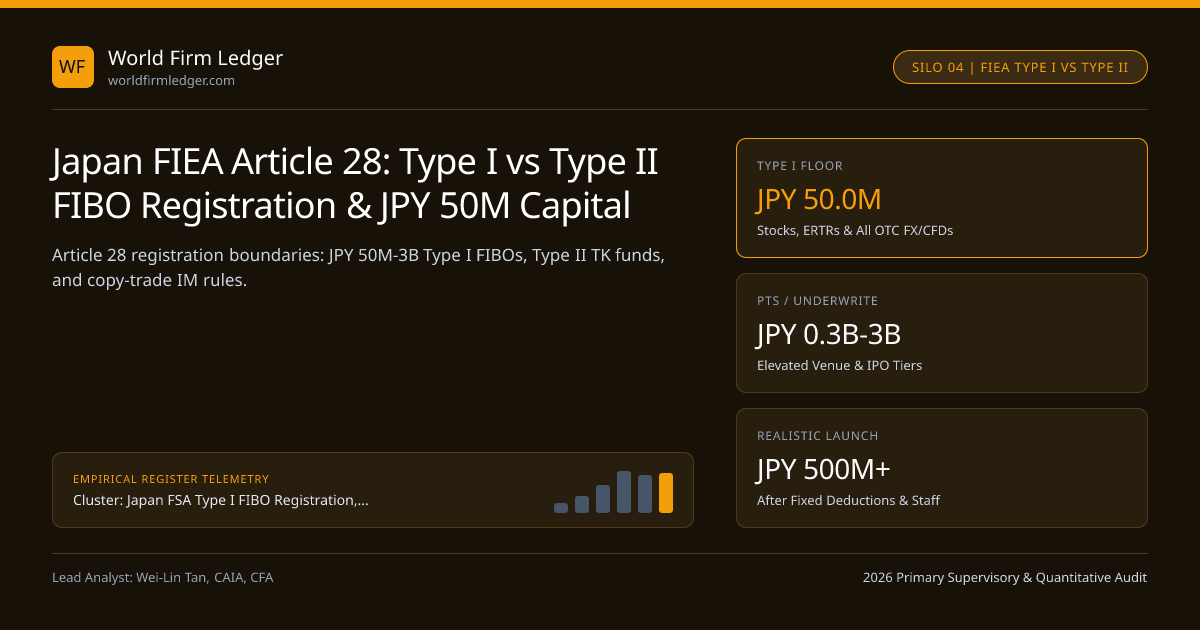
Article 28 of Japan's Financial Instruments and Exchange Act (FIEA) divides regulated capital-markets conduct into four primary registration pillars: Type I Financial Instruments Business, Type II Financial Instruments Business, Investment Management Business, and Investment Advisory and Agency Business. Within our Japan FSA Type I FIBO & trust segregation guide, understanding why Paragraph 1 securities and retail OTC derivatives trigger Type I FIBO registration (JPY 50,000,000 to JPY 3,000,000,000 stated capital) whereas illiquid real-estate trust beneficiary interests and private fund LP units fall under Type II FIBO (JPY 10,000,000 capital) is foundational to auditing entities on the Japan FSA public registry.
Paragraph 1 Liquid Securities & OTC Derivatives vs Paragraph 2 Illiquid Interests#
Japanese securities law draws a razor-sharp functional distinction in FIEA Article 2:
- Type I FIBO (Dai-Isshu — JPY 50,000,000 Minimum Capital & Net Assets): Covers highly liquid Paragraph 1 Securities (listed stocks, government bonds, corporate bonds, ETFs, REITs, security tokens / Electronically Recorded Transferable Rights [ERTRs]) PLUS all retail and institutional Over-the-Counter Derivatives (OTC FX margin trading, equity/index CFDs, interest-rate swaps, credit derivatives, and crypto-asset derivatives)! Note further that lead securities underwriting raises minimum capital to JPY 500,000,000 (or JPY 3,000,000,000 for wholesale lead underwriters of mega-offerings!), while operating a Proprietary Trading System (PTS) requires JPY 300,000,000!
- Type II FIBO (Dai-Nishu — JPY 10,000,000 Minimum Capital for Corporations): Covers Paragraph 2 Deemed Securities with low secondary liquidity—such as trust beneficiary interests (Shintaku Juekiken), silent partnership (Tokumei Kumiai / TK) solar/real-estate shares, limited partnership units, and self-offering of collective investment scheme units—as well as market commodity derivatives! Crucial Compliance Trap: Holding a Type II FIBO registration grants zero legal permission to offer retail FX, CFDs, or stock brokerage!
Mandatory Personnel Substance & Self-Regulatory Organization (SRO) Membership#
In practice, securing a Type I FIBO registration through a Local Finance Bureau (such as the Kanto Local Finance Bureau in Saitama/Tokyo, examined in Kinsho registration forensics) takes 12 to 24 months not because of the JPY 50M (~USD 330k) statutory capital, but because of FIEA Article 29-4(1)(e)(2) Human Resources Structure (Jinteki Kosei)!
- JFSA examiners demand an independent Compliance Department, an Internal Audit Office (Naibu Kansa) completely separate from Compliance and Sales, dedicated Risk Management, System IT Officers, and Japanese-speaking executive officers with multi-year domestic Type I FIBO track records!
- Furthermore, while SRO membership is technically encouraged by statute, any Type I FIBO without membership in the Japan Securities Dealers Association (JSDA), Financial Futures Association of Japan (FFAJ) (for OTC FX), or JVCEA (for crypto derivatives) is forced to adopt internal conduct rules identically matching SRO bylaws under strict JFSA inspection!
| FIEA Article 28 Registration Pillar | Statutory Capital / Deposit Floor | Ongoing Article 46-6 120% CAR? | Can Offer Retail FX or CFDs? | Primary Japanese SRO | Reference / Peer |
|---|---|---|---|---|---|
| Type I FIBO (Standard / OTC FX) | JPY 50,000,000 (Cap & Net Assets) | Yes — Strict Daily/Monthly CAR | Yes (Core FX/CFD License) | JSDA / FFAJ | JFSA Ministry |
| Type I Small-Amount Electronic (ECF) | JPY 10,000,000 | Exempt From Full CAR | No (Equity Crowdfunding < JPY 100M) | JSDA | 2ban JP |
| Type II FIBO | JPY 10,000,000 (or JPY 10M Dep.) | No (Net Worth Monitoring) | NO — Barred From OTC FX/Stocks! | Type II FIIA | JFSA Compendium |
| Investment Management Business | JPY 50,000,000 (Cap & Net Assets) | No (Net Assets >= JPY 50M) | Manages Discretionary Funds Only | JIAA / JITA | MAS CMS Peer |
| Investment Advisory & Agency | JPY 5,000,000 Security Deposit | No (Zero Capital Floor!) | NO — Non-Discretionary Advice Only | JIAA | Soramitsu |
Modeling Real-World Launch Capital vs the JPY 50,000,000 Statutory Minimum#
Why does every Tokyo securities law firm warn foreign broker-dealers that budgeting only JPY 50,000,000 guarantees immediate rejection? Because both Paid-Up Stated Capital AND Net Assets must stay >= JPY 50,000,000 at all times, AND Article 46-6 deducts all fixed/illiquid assets while charging 25% of annual operating expenses in the denominator!
- Worked Tokyo Type I Retail FX Subsidiary Capitalization Plan:
- Fixed Assets (Tokyo Marunouchi Lease Guarantee Deposit + Capitalized Matching/Trust Software) = JPY 85,000,000 (100% Deducted from Unfixed Equity!)
- Year-1 Mandatory Staffing (8 Full-Time Specialists: Rep Director, Compliance, Internal Audit, Risk, Dealing, IT) & OpEx = JPY 240,000,000
- Basic Operational Risk Equivalent = 0.25 * 240,000,000 = JPY 60,000,000 (Plus JPY 40M Market/Counterparty Risk = JPY 100M Total Risk)
- Target Safe 250% Capital Adequacy Cushion = 2.50 * 100,000,000 = JPY 250,000,000 Unfixed Equity
- Pre-Revenue 18-Month Launch Burn Allowance = JPY 165,000,000
- Realistic Day-1 Paid-Up Capital Injection = 85M + 250M + 165M = JPY 500,000,000 (~USD 3.33M — 10x the JPY 50M Headline Statute!)
Tokyo's Financial Market Entry Office: English-Language Path for Asset Managers#
Recognizing that traditional Japanese-only bureaucracy deterred global hedge funds, JFSA established the Financial Market Entry Office permitting all-English registration filings specifically for Investment Management, Investment Advisory, and Qualified Institutional Investor (QII / Tekikaku Kikan Toshika) managers—though retail-facing Type I OTC FX/CFD FIBOs still undergo exhaustive Japanese-language compliance vetting!
Why Social "Auto-Copy Trading" Triggers Dual Type I + Investment Management Licensing in Japan#
Just as in South Africa and Europe, offering automated trade-mirroring, EA signal auto-execution (Mirai Torihiki / System Trade), or MAM accounts in Japan crosses out of pure Type I execution into Discretionary Investment Management (Toshi Unyo Gyo)! That is why licensed Japanese brokers offering automated strategy-selection platforms hold dual registration as BOTH a Type I FIBO and an Investment Management Business Operator across our Japan FSA FIBO and trust segregation topic hub.
Frequently asked questions
Can a firm holding a Japanese Type II FIBO or Investment Advisory registration legally execute retail forex trades?
No! Retail OTC FX and CFD execution requires a full Type I Financial Instruments Business Operator registration plus FFAJ oversight; Investment Advisory (Toshi Jogen) permits non-discretionary advice only with zero custody or trade execution.
Why does acquiring an existing dormant Type I FIBO in Tokyo command a USD 3M to USD 8M M&A premium?
Because building a greenfield Type I FIBO from scratch requires 12 to 24 months of Local Finance Bureau document reviews, hiring scarce Japanese-certified Internal Audit and Compliance officers, and passing live IT/trust-bank readiness inspections.
Can foreign asset managers apply to the Japan FSA in English instead of Japanese?
Yes—for Investment Management, Investment Advisory, and certain wholesale fund businesses targeting Professional Investors, JFSA’s Financial Market Entry Office accepts complete registration and supervision filings in English.
How does Japan regulate tokenized real-estate or corporate bond "Security Tokens" on blockchains?
Under the 2020 FIEA amendments, tokenized securities are classified as Electronically Recorded Transferable Rights (ERTRs) treated as Paragraph 1 securities—requiring Type I FIBO registration rather than a Type II license.
Publication record
- Published
- 14 November 2026
- Updated
- 16 November 2026
- Author
- Wei-Lin Tan, CAIA, CFA
- Review
- Review not recorded
- Automated fact check
- Passed in the stored pipeline record
- Source URLs
- 3 recorded
AI assistance recorded: anthropic/claude-opus-4.6. This field does not establish human review or source verification.
Academic & Institutional Attribution
Cite This Research & Embed Live Data Card
Standard academic & institutional research paper citation format.
Wei-Lin Tan, CAIA, CFA. (2026, November 15). Japan FIEA Article 28: Type I vs Type II FIBO Registration & JPY 50M Capital. World Firm Ledger. https://worldfirmledger.com/almanac/japan-fiea-article-28-type-1-vs-type-2-fibo-capital-50mRegulatory Directory Cross-Reference
Referenced Institutions & Regulatory Registries
Mentioned Regulated Institutions
Referenced Supervisory Authorities
Related Japan Fsa Fibo Margin Segregation & Institutional Briefings
Explore Japan Fsa Fibo Margin Segregation Hub (20) →Japan Fsa Fibo Margin Segregation
Japan FSA Type I FIBO Guide: 25x FX Margin, 120% Capital & Trust SegregationJapan Fsa Fibo Margin Segregation
Japan FIBO Article 46-6 Capital Adequacy Ratio: 140%, 120% & 100% TriggersJapan Fsa Fibo Margin Segregation
Japan Kanzen Shintaku Hozen: Mandatory Domestic Trust-Bank Client SegregationJapan Fsa Fibo Margin Segregation
Japan Retail FX 4% Margin (25:1 Cap), Loss-Cut Rule & Zero-Cut ProhibitionJapan Fsa Fibo Margin Segregation
FFAJ Corporate FX Margin in Japan: Weekly Historical Volatility FormulaJapan Fsa Fibo Margin Segregation
Japan Non-FX CFD Leverage Caps: 5x Single Stocks, 10x Indices & 20x GoldJapan Fsa Fibo Margin Segregation
FFAJ Monthly OTC FX Statistical Bulletins: Auditing Unpaid Loss-Cut ShortfallsJapan Fsa Fibo Margin Segregation
JFSA Unregistered Foreign Broker Warnings (Mitoroku Gyosha) & Tax PenaltiesBrazil Cvm Mexico Cnbv Emerging Hubs
Brazil B3 Mini-Dolar (WDO) Futures: CORE Clearing Margin & RLP Retail RulesBrazil Cvm Mexico Cnbv Emerging Hubs
Brazil CVM BDR Rules: Retail Access to Global Stocks & ETFs on B3 in ReaisBrazil Cvm Mexico Cnbv Emerging Hubs
Banco Central do Brasil Resolution 277: eFX Cross-Border Pix & FX Law 14,286Brazil Cvm Mexico Cnbv Emerging Hubs
Brazil Crypto Law 14.478: BCB PSAV Licensing, CVM Tokens & Segregation
World Firm Ledger Data, Benchmarks & Contributor Records
CC BY 4.0 Open Data
Open Institutional Datasets (CSV / JSON) →
Download desk-compiled quantitative series & schemas.
2026 Reference Matrix
2026 Institutional Benchmarks & Thresholds →
Statutory capital, clearing, margin & rate conventions.
Editorial Records
Authors & Review Records →
View named contributors where those records are available.
Complete Index
Master Research & Dossier Archive →
Browse all published briefings by topic pillar & date.